For most conduit inspections, I’d start with the FOXWELL 2-Way 220° Articulating Borescope: its steerable probe and dual-lens view are better suited to checking bends and junctions than a fixed-view camera. The DEPSTECH 50FT Triple Lens is a standout when long runs matter, while the 3.9mm Endoscope Camera is the narrower-probe option for tight pathways. The main tradeoffs are reach versus maneuverability, and a slimmer camera versus easier viewing and control. Read on for how these ten options differ and which compromises make sense for your conduit work.

Get business pricing on networking and server gear
- Business-only prices and quantity discounts
- Tax-exempt purchasing
- Multiple users, one account, clear invoices
Key Takeaways
- Steering can matter more than headline resolution: the FOXWELL and other articulating picks are better positioned to inspect bends and branch points than fixed-view probes.
- Long conduit runs call for cable reach: the DEPSTECH’s 50-foot cable stands apart, but extra length can be harder to feed and control through bends.
- A narrow probe has a clear use case: the 3.9mm camera may fit tighter pathways than larger-headed models, though a small diameter does not by itself guarantee it can pass a bend.
- Dual- and triple-lens designs address blind spots: they can offer alternate viewing angles, but buyers should check how easily views can be switched and interpreted during an inspection.
- Standalone screens and phone-connected cameras suit different workflows: built-in displays avoid phone compatibility questions, while mobile models may appeal to buyers who prefer a device they already carry.






| boroscope cameras for conduit inspection | Display | Water resistance | Lighting | Resolution |
|---|---|---|---|---|
| Acoath Two-Way Articulating Bo | 4.3-inch IPS screen | IP67 | 8 LEDs with 4 adjustable levels | 1080p |
| DXZtoz Two-Way Articulating Bo | 4.3-inch HD IPS screen | IP67 | — | 1080p |
| 3.9mm Endoscope Camera with Li | 4.3 inches | IP67 | 6 adjustable LEDs | 1920P HD |
| FOXWELL 2-Way 220° Articulatin | IPS HD | IP67 | — | — |
| Teslong 5” Dual Lens Borescop | 5-inch IPS | IP67 | 7 LEDs with brightness control | — |
| DEPSTECH 50FT Endoscope Camera | 5-inch IPS | IP67 waterproof | — | — |
| Endoscope Camera with Light: 5 | 5-inch screen | IP67 | 8 adjustable LEDs | 1080P |
| Teslong Articulating Borescope | 4.5-inch IPS LCD | — | Built-in adjustable high-brightness LEDs | — |
| Daxiongmao Endoscope Camera wi | 4.3-inch LCD | IP67 | 8 adjustable LEDs | 1080P HD |
| Endoscope Camera with Light | — | — | 8 adjustable LEDs | 1920×1440 |
More Details on Our Top Picks
Acoath Two-Way Articulating Borescope with 1080P Camera and 4.3″ IPS Screen
For conduit work where seeing around an obstruction matters more than reaching far, the Acoath’s two-way articulation and dual lenses offer a useful combination. Its 70° main lens and 60° side lens give different viewing angles without relying on a removable mirror, while the 4.3-inch IPS screen keeps live inspection on the device. Compared with the DXZtoz Two-Way Articulating Borescope, Acoath has a slightly shorter cable and lists fewer steering details, but its stated 1080p resolution and adjustable lighting suit close visual checks. The five-foot semi-rigid cable is manageable in short conduit runs, though it may not reach distant bends. At 570 g, it is also less appealing for extended overhead work, and recording requires a separately supplied microSD card.
Pros:- Two-way articulation and separate main and side lenses help inspect around nearby bends.
- 1080p image output and four adjustable LED levels support checks in dim conduit.
- IP67 water resistance suits damp inspection areas.
- A 4.3-inch IPS screen provides on-device viewing.
Cons:- Five-foot cable limits reach on longer conduit runs.
- The 570 g body may be tiring during extended handheld or overhead work.
- MicroSD card is required for recording and is not included.
Best for: Electricians and maintenance technicians checking short conduit runs, nearby bends, and obstructions where two viewing directions matter.
Not ideal for: Buyers tracing long conduit routes or needing a lightweight camera for prolonged overhead inspections; its cable is five feet and the unit weighs 570 g.
- Resolution:1080p
- Display:4.3-inch IPS screen
- Cable length:5 ft
- Lens angles:70° main lens; 60° side lens
- Lighting:8 LEDs with 4 adjustable levels
- Water resistance:IP67
- Focus range:2–10 cm
- Weight:570 g
Our verdict“Choose the Acoath for short, complex conduit checks where dual-angle viewing matters more than cable reach or low weight.”
DXZtoz Two-Way Articulating Borescope with Light, 1080P Industrial Endoscope Inspection Camera, 5.5FT
The DXZtoz’s 220° two-way steering gives conduit inspectors more control when positioning the camera at a nearby bend or junction. Its 5.5-foot probe adds a little reach over the Acoath Two-Way Articulating Borescope, and the 8.5 mm diameter is specified clearly for buyers checking access through narrow openings. The 4.3-inch IPS monitor, autofocus, and eight adjustable LEDs make it a practical self-contained setup for viewing in dark spaces. Its IP67 probe rating also suits damp locations. This is still a short-reach tool rather than a route-tracing camera: the cable is far shorter than the Teslong 5” Dual Lens Borescope’s 16.5-foot cable. Recording needs a separate microSD card, and a stated battery life of up to five hours may mean recharging during longer workdays.
Pros:- 220° two-way articulation helps direct the camera around nearby bends.
- The 5.5-foot probe reaches slightly farther than the Acoath’s five-foot cable.
- Autofocus, 1080p resolution, and adjustable LEDs support clear close-range viewing.
- Includes hook, magnet, side mirror, and protective case.
Cons:- The 5.5-foot probe is too short for many extended conduit runs.
- An 8.5 mm diameter can exclude smaller openings.
- MicroSD storage is required for recording, and battery life is listed at up to five hours.
Best for: Technicians inspecting accessible conduit bends and junctions who want controlled probe steering and a standalone monitor.
Not ideal for: Users tracing long conduit routes or entering very narrow passages where an 8.5 mm probe may not fit.
- Resolution:1080p
- Display:4.3-inch HD IPS screen
- Probe length:5.5 ft
- Probe diameter:8.5 mm
- Articulation:Two-way, 220° steering
- Water resistance:IP67
- Focal range:1–15 cm
- Battery life:Up to 5 hours
Our verdict“Pick the DXZtoz when precise steering and a standalone screen matter more than slim access or long-distance reach.”
3.9mm Endoscope Camera with Light, 1920P HD Borescope Inspection Cam
When the opening is the limiting factor, the 3.9 mm probe is the clearest reason to choose this camera. It is substantially slimmer than the DXZtoz’s 8.5 mm probe, making it better suited to tight conduit access where a thicker head could stop at the entrance. The five-foot semi-rigid cable and IP67 rating suit short, damp inspections, while six adjustable LEDs help illuminate enclosed spaces. Its 1920P HD specification and 4.3-inch screen support direct viewing, but this is a basic inspection tool rather than a documentation system: it cannot capture photos or videos and has no image storage. The fixed 3–10 cm focus range may also limit sharpness when the lens is very close to a surface. Compared with the longer Teslong 5” Dual Lens Borescope, this pick trades reach and recording for a narrower probe.
Pros:- 3.9 mm probe fits tighter openings than the DXZtoz’s 8.5 mm probe.
- 1920P HD output and a 4.3-inch screen support on-device viewing.
- IP67 waterproofing and adjustable LEDs suit damp, dark inspection points.
Cons:- Cannot take photos or videos, so findings cannot be documented on the device.
- Five-foot cable limits reach compared with the Teslong’s 16.5-foot cable.
- Fixed 3–10 cm focus range can make very close surfaces harder to inspect clearly.
Best for: Electricians and DIY inspectors who need to pass a camera through especially narrow conduit openings and only need live viewing.
Not ideal for: Crews that need inspection records, longer reach, or close-up focus at very short distances; this model cannot capture media and has a fixed focus range.
- Probe diameter:3.9 mm
- Resolution:1920P HD
- Display:4.3 inches
- Cable length:5 ft
- Water resistance:IP67
- Lighting:6 adjustable LEDs
- Focus range:3–10 cm
- Battery life:4 hours
Our verdict“Choose this model for narrow access and live visual checks, but skip it if you need recorded evidence or a long probe.”
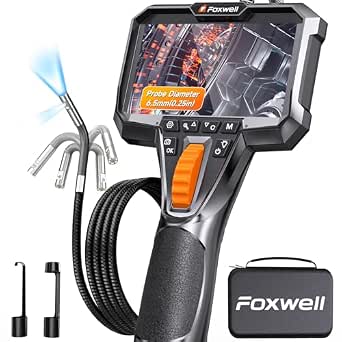
FOXWELL 2-Way 220° Articulating Borescope Camera with Light, Dual Lens
The FOXWELL’s built-in 32GB storage makes it the most straightforward choice here for saving inspection images and video without sourcing a memory card. That gives it a practical advantage over the Acoath Two-Way Articulating Borescope, which requires a separate microSD card for media storage. FOXWELL also pairs two-way 220° articulation with dual lenses, giving the operator ways to inspect a nearby conduit bend from different directions. Its 4.9-foot probe is close in reach to Acoath and shorter than the Teslong 5” Dual Lens Borescope, so it suits localized checks rather than long runs. The listed 0.25-inch diameter is relatively broad beside the 3.9 mm Endoscope Camera, which is a better fit for very narrow access. Power is another compromise: it requires one AAA battery, and battery life is not specified.
Pros:- Built-in 32GB storage supports image and video capture without a separate memory card.
- Two-way 220° articulation and dual lenses help examine nearby bends from multiple angles.
- IP67 rating and adjustable lighting suit wet or poorly lit inspection areas.
- 2X and 4X zoom options provide additional viewing flexibility.
Cons:- The 0.25-inch probe is much wider than the 3.9 mm Endoscope Camera’s probe.
- At 4.9 feet, the cable is intended for short checks rather than long conduit routes.
- Requires one AAA battery, and battery life is not specified.
Best for: Service technicians who need to save inspection evidence on the device and check short conduit sections with articulating, dual-lens viewing.
Not ideal for: Inspectors working through very small openings or on long conduit runs; the probe is 0.25 inches wide and 4.9 feet long.
- Probe diameter:0.25 inches
- Probe length:4.9 ft
- Articulation:Two-way, 220°
- Display:IPS HD
- Storage:32GB built-in
- Zoom:2X and 4X
- Water resistance:IP67
- Power:1 AAA battery
Our verdict“Choose FOXWELL when built-in recording and dual-angle steering outweigh the need for a slim probe or extended reach.”
Teslong 5” Dual Lens Borescope Camera for Wall & Engine Inspection
For conduit inspections where a five-foot probe will not reach the area of interest, the Teslong’s 16.5-foot semi-rigid cable is its defining advantage. It extends much farther than the Acoath and DXZtoz, making it better suited to following a longer section before repositioning the operator. A 5-inch IPS display gives the live image more viewing area than their 4.3-inch screens, and the dual-lens design offers alternate views inside the conduit. The tradeoff is 720p video, below the 1080p specifications of Acoath and DXZtoz, so buyers prioritizing image detail may prefer those shorter-reach tools. Its 8 mm cable also cannot match the 3.9 mm Endoscope Camera for narrow openings. Battery life is listed at up to 4.5 hours; the supplied data does not establish remote Wi-Fi viewing.
Pros:- 16.5-foot semi-rigid cable reaches farther than the other listed probes in this batch.
- 5-inch IPS display is larger than the 4.3-inch screens on the Acoath and DXZtoz.
- Dual lenses and adjustable lighting support alternate views in dark conduit.
- IP67 construction and rechargeable power suit field inspections.
Cons:- 720p video resolution is lower than the 1080p Acoath and DXZtoz.
- The 8 mm cable is too wide for some narrow access points.
- The listed data does not confirm remote Wi-Fi viewing, despite Wi-Fi being listed under connectivity.
Best for: Plumbers and maintenance crews checking longer, accessible conduit sections who value probe reach and a larger screen over the highest listed video resolution.
Not ideal for: Inspectors who need a very slim probe, 1080p video, or confirmed remote viewing; the cable is 8 mm wide and video is 720p.
- Display:5-inch IPS
- Cable length:16.5 ft
- Cable diameter:8 mm
- Video resolution:720p
- Photo resolution:2 MP
- Water resistance:IP67
- Battery life:Up to 4.5 hours
- Lighting:7 LEDs with brightness control
Our verdict“Pick the Teslong for longer conduit sections and a larger screen, but choose a slimmer or higher-resolution model when access or image detail takes priority.”
DEPSTECH 50FT Endoscope Camera with 5-Inch IPS Screen and Triple Lens System
For conduit inspections where the access point is far from the suspected blockage, the DEPSTECH’s 50-foot semi-rigid cable gives it a reach advantage over the 16.5-foot Daxiongmao and 16.4-foot Endoscope Camera with Light. Its 5-inch IPS screen and triple-lens setup provide a dedicated viewing system without relying on a phone, while onboard 1080p capture and a 32GB memory card support documenting findings. The waterproof build and adjustable LEDs suit damp runs, though cable length alone does not make the probe easy to steer through bends. Expect to guide it carefully, and plan around a battery runtime of about four hours. This is the strongest fit here for long, accessible conduit; buyers working mainly through tight elbows may prefer a shorter articulating probe.
Pros:- 50-foot semi-rigid cable reaches farther than the other long-probe options in this batch.
- Triple-lens system and adjustable LEDs help inspect a wider range of views and lighting conditions.
- Built-in 5-inch IPS screen avoids dependence on a phone or app.
- 1080p video capture, JPEG/AVI support, and included 32GB memory card allow inspection records.
Cons:- A 50-foot probe can be difficult to steer through tight conduit bends without a cable-pulling accessory.
- Battery runtime is approximately four hours, which can limit extended jobs.
- Getting the best results may require some familiarity with probe handling and camera controls.
Best for: Electricians and maintenance crews inspecting long, relatively straight conduit runs who need a built-in screen and saved footage.
Not ideal for: DIY users working through multiple tight bends or needing all-day inspection time; the long cable can be harder to guide, and runtime is about four hours.
- Probe length:50 ft
- Cable type:Semi-rigid
- Display:5-inch IPS
- Camera system:Triple lens
- Video resolution:1080p
- Water resistance:IP67 waterproof
- Storage:32GB memory card included
- Battery runtime:Approximately 4 hours
Our verdict“Choose the DEPSTECH when reach and saved inspection footage matter more than easy steering through tight bends.”
Endoscope Camera with Light: 5-inch 1080P HD Dual-Lens Inspection Borescope for Sewer, Plumbing, Automotive
This model suits conduit checks where the goal is to see what is inside, not create a record: its 5-inch screen works without an app or Wi-Fi, and the dual-lens view offers another angle for checking a passage. The 16.4-foot probe is much shorter than the DEPSTECH’s 50-foot cable, so it is easier to manage for nearby access points but cannot reach as far down a run. Its IP67 rating and adjustable LEDs make it plausible for damp inspection conditions. The key compromise is significant for contractors: it provides real-time viewing only, with no photo or video capture and no built-in storage. Compared with the Daxiongmao, it has a similar reach but also lacks recording; choose it for straightforward live viewing, not documentation.
Pros:- Dedicated 5-inch screen operates without a phone, app, or Wi-Fi connection.
- Dual-lens setup provides an additional viewing angle for checking conduit interiors.
- IP67-rated probe and adjustable LEDs suit damp, poorly lit inspection areas.
- 16.4-foot semi-rigid probe offers useful reach while remaining shorter than the DEPSTECH’s long cable.
Cons:- Cannot save photos or video, making it unsuitable for inspection reports or later review.
- Fixed-focus camera offers less flexibility when the viewing distance changes.
- 16.4-foot reach falls well short of the DEPSTECH for long conduit runs.
Best for: Homeowners and service technicians who need a plug-and-play live view of a short conduit section and do not need saved evidence.
Not ideal for: Inspectors who must share, archive, or compare images later, or crews tracing conduit beyond the probe’s 16.4-foot reach.
- Display:5-inch screen
- Resolution:1080P
- Lens configuration:Dual lens
- Probe length:16.4 ft
- Water resistance:IP67
- Lighting:8 adjustable LEDs
- Focus:Fixed focus
- Battery runtime:3–4 hours
Our verdict“Pick this camera for quick, app-free visual checks where live viewing matters and recording does not.”
Teslong Articulating Borescope for Automotive and Household Inspections
When conduit access involves a nearby opening and a difficult turn, the Teslong’s articulating joystick is more useful than simply adding cable length. Its 5-foot semi-rigid gooseneck is far shorter than the Daxiongmao’s 16.5-foot probe or the DEPSTECH’s 50-foot cable, but the controlled movement can help direct the camera around a local obstruction or toward a joint. The 4.5-inch IPS display and adjustable LEDs keep viewing self-contained in dark spaces. That short reach sharply limits its value for tracing long runs, and the product details do not specify battery runtime or image recording. I would treat it as a close-access steering tool, not a substitute for a long conduit camera.
Pros:- Articulating joystick helps aim the camera through nearby turns and confined access points.
- Semi-rigid gooseneck balances flexibility with enough body to guide the probe.
- 4.5-inch IPS display provides a dedicated screen for inspection work.
- Adjustable built-in LEDs help illuminate dark conduit interiors.
Cons:- Five-foot cable is much shorter than the Daxiongmao and DEPSTECH probes, limiting run length.
- Battery runtime is not specified, making it harder to plan longer jobs.
- No Wi-Fi or app connectivity is listed for transferring inspection images.
Best for: Electricians and repair technicians inspecting short conduit sections near an access opening where camera direction matters more than reach.
Not ideal for: Anyone tracing long conduit runs or needing recorded images; its cable is only five feet, and recording capability is not specified.
- Display:4.5-inch IPS LCD
- Cable length:5 ft
- Cable type:Semi-rigid gooseneck
- Camera control:Articulating joystick
- Lighting:Built-in adjustable high-brightness LEDs
- Power:Battery operated
Our verdict“Choose the Teslong for short, awkward access points where steering beats the long reach offered by the other cameras.”
Daxiongmao Endoscope Camera with Light, 1080P HD Borescope
The Daxiongmao makes a practical case for basic conduit checks with a 16.5-foot semi-rigid cable, a built-in screen, and no smartphone connection to set up. Its reach is close to the 16.4-foot Endoscope Camera with Light, but the supplied details list MP4 video and 2.07MP still resolution, giving it a documentation advantage over that live-view-only option. The 8mm camera and 120-degree viewing angle are useful for seeing the passage around the probe, while IP67 protection supports damp conditions. One specification mismatch deserves attention: the product data also says it cannot capture photos or videos, despite listing image and video formats. I would verify recording functions before buying if documentation is essential. For casual inspection, its screen-first simplicity is the draw.
Pros:- 16.5-foot semi-rigid cable provides practical reach for many accessible conduit sections.
- Built-in LCD screen works without a smartphone connection.
- IP67 rating and eight adjustable LEDs support damp, dark inspection conditions.
- Listed 120-degree view angle and 8mm camera diameter provide useful viewing coverage.
Cons:- Product details conflict on whether it can capture photos or video, so recording should be verified before purchase.
- Manual focus may require adjustment as the camera moves nearer to or farther from an obstruction.
- Approximately 3.5-hour battery life can be restrictive on longer inspection jobs.
Best for: DIY users and maintenance workers who want a self-contained screen and mid-length probe for checking accessible conduit.
Not ideal for: Buyers who need dependable saved inspection footage without confirming recording capability, or who must reach deep into long runs.
- Display:4.3-inch LCD
- Resolution:1080P HD
- Cable length:16.5 ft
- Cable type:Semi-rigid
- Camera diameter:8 mm
- Water resistance:IP67
- Lighting:8 adjustable LEDs
- Battery life:3.5 hours
Our verdict“Consider the Daxiongmao for uncomplicated mid-range conduit checks, but confirm recording functions if saved evidence is a requirement.”
Endoscope Camera with Light, 1920P HD Borescope, 16.4ft Semi-Rigid Snake, IP67 Waterproof for iOS & Android
This phone-connected camera is the pick for buyers who want to keep inspection images on a device they already use. Its 1920×1440 resolution is higher on paper than the 1080p Daxiongmao, and the 16.4-foot semi-rigid cable gives it similar reach for ordinary conduit checks. The 7.9mm camera and eight adjustable LEDs suit narrow, dim passages, while compatibility with iOS and Android broadens its appeal. The tradeoff is a less self-contained workflow: unlike the DEPSTECH or Daxiongmao, it depends on an app and a compatible phone, and some Android devices may show blur. Its specified waterproof depth is limited to 3.28 feet, so I would not choose it for deeper submerged inspections.
Pros:- 1920×1440 resolution offers more image detail on paper than the 1080p Daxiongmao.
- 16.4-foot semi-rigid cable covers many accessible conduit inspections.
- 7.9mm camera diameter and eight adjustable LEDs suit narrow, poorly lit spaces.
- iOS and Android compatibility supports phone-based viewing and image handling.
Cons:- Requires an app and phone setup rather than operating as a self-contained inspection unit.
- Some Android devices may produce slightly blurry images.
- Waterproof use is specified only up to 3.28 feet, and battery life is about 3.5 hours.
Best for: Technicians and DIY users who prefer recording and reviewing conduit images on a compatible iOS or Android phone.
Not ideal for: Buyers who need a built-in display, app-free operation, deeper underwater use, or predictable image quality across Android devices.
- Resolution:1920×1440
- Camera diameter:7.9 mm
- Cable length:16.4 ft
- Cable type:Semi-rigid
- Lighting:8 adjustable LEDs
- Compatibility:iOS 9.0+ and Android 7+
- Waterproof depth:Up to 3.28 ft
- Battery life:3.5 hours
Our verdict“Choose this model if phone-based image handling and higher stated resolution matter more than a built-in screen or app-free use.”

How We Picked
I ranked these cameras for conduit-specific usefulness, not for general automotive or household inspection. The main criteria were probe diameter and flexibility, cable reach, the ability to aim around bends, useful viewing angles, illumination, and whether the screen or phone connection suits repeated field work. I also weighed practical handling: a long cable can reach farther but may be cumbersome, while articulation adds control but can take more practice.
The FOXWELL leads because its stated 220-degree two-way articulation and dual lens speak directly to the challenge of seeing around conduit turns. I placed the DEPSTECH 50FT high for long runs, while the narrow 3.9mm model serves a different, tight-access need. Other options rank by how well their stated features fit conduit work; product names alone do not establish probe diameter, bend performance, or compatibility, so buyers should verify those details before choosing.
| boroscope cameras for conduit inspection | Water resistance |
|---|---|
| Acoath Two-Way Articulating Bo | IP67 |
| DXZtoz Two-Way Articulating Bo | IP67 |
| 3.9mm Endoscope Camera with Li | IP67 |
| FOXWELL 2-Way 220° Articulatin | IP67 |
| Teslong 5” Dual Lens Borescop | IP67 |
| DEPSTECH 50FT Endoscope Camera | IP67 waterproof |
| Endoscope Camera with Light: 5 | IP67 |
| Teslong Articulating Borescope | — |
| Daxiongmao Endoscope Camera wi | IP67 |
| Endoscope Camera with Light | — |
Factors to Consider When Choosing Boroscope Cameras For Conduit Inspections
For conduit, the right camera is the one that can reach the inspection point and give a useful view once it gets there. I’d match the tool to the conduit’s diameter, length, number of bends, and the kind of fault I need to locate, rather than choosing by image-resolution claims alone.
Match Probe Diameter to the Narrowest Passage
Start with the smallest opening the probe must pass, including couplings or crowded entries, not just the conduit’s nominal size. Allow room for the camera head and its protective housing; a probe that barely fits may snag or become difficult to retrieve. A slim model such as the listed 3.9mm camera is a candidate for restricted access, but check its full head diameter and cable stiffness. Smaller probes can be less forgiving to guide and may offer fewer viewing conveniences. If the path is roomy, a larger head with a side-view lens may be more useful than the thinnest available option.
Plan Reach Around the Whole Route
Measure from the access point to the target and include the slack needed to hold and steer the probe. A 50-foot cable, like the DEPSTECH’s, has an advantage on long routes, but cable length alone does not tell you how far it will travel through multiple bends. Long runs can add friction and make it harder to tell whether the camera is advancing or looping. For short checks near a box, extra cable can become a storage and handling burden. Choose enough reach for the job, then confirm the probe can be fed through the route’s bends.
Choose Steering for the Conduit Layout
A fixed camera can work for a fairly straight passage when the goal is to check for a blockage or confirm that a route is open. Curves, tees, and junctions make aiming more important: articulation or side-facing optics can help inspect surfaces that a forward-facing lens misses. Steering mechanisms add parts and require practice, so they are not automatically the best choice for every routine check. Before buying, confirm the stated articulation direction and range rather than assuming that “articulating” means the tip can turn in every direction. If the inspection requires seeing several walls, consider whether lens switching is practical while the probe is inside the conduit.
Treat Lighting and Water Resistance as Job-Specific
Built-in lights help reveal the conduit interior, but brightness controls and glare matter as much as the presence of LEDs. Reflective surfaces can wash out a close-up image, while a distant obstruction may need stronger illumination. Waterproof ratings also have limits: IP67, when specified, describes a defined level of protection and does not mean the entire display or cable connection is suitable for every wet environment. Check which parts carry the rating and follow the maker’s cleaning and immersion instructions. For ordinary dry conduit, a sealed probe may be less valuable than clear lighting and dependable cable handling.
Pick a Display and Recording Workflow You Can Use
A built-in screen keeps the inspection independent of phone ports, operating-system support, and battery sharing. A phone-connected camera can reduce the amount of dedicated equipment, but compatibility may depend on the exact connector, app, and device settings. If you need to document a hidden obstruction or share findings with another person, verify that still-image or video capture is supported and learn where files are saved. A larger display can make it easier to judge orientation, though it adds bulk to carry and hold. Do not assume a resolution label guarantees a sharper usable image in a dark, reflective conduit.
Check Cable Behavior Before Prioritizing Extra Features
Conduit inspection often depends on pushing a small camera through a route, so the cable must balance flexibility with enough stiffness to advance. A very soft cable may buckle near the entrance; a rigid one may resist tight bends or transmit too much force to the camera head. Product listings do not always describe this balance, so look for details on cable construction and the minimum bend radius when available. Avoid forcing a probe when it stops, since that can damage the cable or leave the camera trapped. For frequent work, storage, cleaning, replacement parts, and controls usable with gloves can matter more than extra lenses.
Frequently Asked Questions
Is an articulating borescope worth choosing for conduit with several bends?
It can be, especially when the inspection needs to look at a bend, junction, or the conduit wall rather than simply confirm that a route is open. The FOXWELL’s stated two-way articulation is the clearest fit among these picks for deliberate aiming, while a fixed camera may be simpler for straight runs. Articulation does not guarantee that the probe will pass a tight bend, and the stated range may not provide full directional control. Check the probe diameter and cable behavior alongside steering claims. For repeated inspections at known bends, the added control is more useful than it is for occasional straight-path checks.
Will a 50-foot borescope reach through 50 feet of conduit?
Not necessarily: cable length describes how much probe is available, not how easily it will travel through the route. Tight bends, joints, friction, and cable stiffness can limit practical reach well before the cable runs out. The DEPSTECH’s 50-foot cable suits buyers who need substantial reach, but it may be harder to feed and control than a shorter probe. Measure the route and account for turns, access position, and the length needed outside the conduit. If the path is complex, a shorter, more steerable camera may be more useful than extra cable.
Should I choose the 3.9mm camera or a dual-lens model?
Choose based on the tightest passage and the view needed, not lens count alone. The 3.9mm camera is the more relevant candidate when access diameter is the main obstacle, but verify the complete camera-head width before buying. A dual-lens model can offer another viewing direction, which may help inspect conduit walls without repeatedly repositioning the probe. That benefit matters only if the head fits and you can control the view while working. For a very narrow path, clearance usually comes first; for a roomier route with blind spots, alternate views may be more useful.
Can I use an IP67 borescope in a wet or flooded conduit?
Do not treat an IP67 label as permission to use the whole camera system underwater. The rating may apply only to the probe, and the display, connectors, or charging ports may have different limits. Confirm the manufacturer’s instructions for immersion, depth, duration, and cleaning before exposing any part to water. A flooded conduit also creates visibility and retrieval problems that waterproofing alone does not solve. If water is present, use equipment explicitly suited to that working condition and avoid relying on an unspecified rating.
What should I verify before buying a phone-connected borescope for field work?
Check that the exact connector and operating system work with your phone, and confirm whether the camera needs a particular app or permissions. A model described as compatible with iOS and Android still may not fit every device or connection type. Consider whether your phone will remain available for calls, documentation, or other work during the inspection. For repeated site use, a built-in display avoids some compatibility and battery-sharing concerns. Whichever setup you choose, confirm how images and videos are saved if you need records of the inspection.
Conclusion
For the best overall conduit fit, I’d choose the FOXWELL 2-Way 220° Articulating Borescope when bends and viewing around junctions are the priority. The best pick for long runs is the DEPSTECH 50FT Triple Lens, provided you can manage its longer cable; for tight access, the 3.9mm camera is the specialized option. Buyers who prefer a built-in screen can compare the Acoath, DXZtoz, and other screen-based models, while a phone-connected model may suit those who favor a compact setup and have confirmed compatibility. I can’t confidently name a best value or best premium from the supplied product details alone, so verify cable behavior, probe diameter, display workflow, and warranty before paying more. For beginners, I’d favor a straightforward screen-based camera with a probe that comfortably fits the conduit over an advanced feature set that will go unused.
Halloween Picks

27FT Giant Inflatable Pumpkin Lighted Outdoor Halloween Decor

ELAMAS 11ft Animatronic Flying Witch Halloween Decoration

9 ft Halloween Inflatable Haunted Castle with Dragon and Ghost
As an affiliate, we earn on qualifying purchases.