Many businesses overlook how seamlessly integrating Voice Over IP (VoIP) can transform their communication infrastructure, often assuming it’s just a cost-saving measure. In reality, VoIP offers more than just savings; it enhances flexibility, scalability, and call quality—if implemented correctly. But with so many options and technical considerations, understanding the full potential of VoIP might reveal opportunities you hadn’t considered before. Exploring these possibilities could change how you connect with clients and teams.
Key Takeaways
- Assess your existing network infrastructure to ensure sufficient bandwidth and stability for VoIP integration.
- Implement Quality of Service (QoS) settings to prioritize voice traffic and maintain call clarity.
- Secure the VoIP system with encryption, firewalls, and regular updates to protect against cyber threats.
- Choose compatible hardware and codecs to optimize call quality and system performance.
- Train staff on security best practices and system features to maximize VoIP benefits and safety.

Have you ever wondered how businesses and individuals are making calls more efficiently and cost-effectively? The answer lies in integrating Voice over IP (VoIP) systems into daily communication routines. VoIP technology transforms traditional phone calls into digital data that travels over the internet, offering significant advantages in cost savings and flexibility. But to truly harness its potential, you need to focus on two critical aspects: call quality and system security. These elements guarantee your communication remains clear, reliable, and protected from threats.
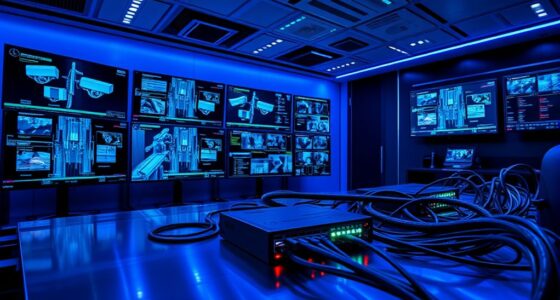
When you set up a VoIP system, call quality should be your top priority. Unlike traditional phone lines, VoIP relies on your internet connection, which means any instability or insufficient bandwidth can degrade call clarity. To keep your calls crisp and free of interruptions, you should invest in a robust internet connection with sufficient bandwidth. Quality of Service (QoS) settings on your network can prioritize voice traffic over other data, reducing latency and jitter that cause choppy audio or dropped calls. Additionally, choosing high-quality VoIP hardware and codecs can make a noticeable difference in how well your calls sound. Prioritizing call quality ensures that conversations remain seamless, fostering better communication and professionalism.
System security is another essential consideration when integrating VoIP. Since your calls are transmitted over the internet, they could potentially be vulnerable to eavesdropping, hacking, or other cyber threats. Protecting your VoIP system involves implementing strong encryption protocols to secure voice data during transmission. You should also set up firewalls and intrusion detection systems to monitor and block unauthorized access attempts. Regularly updating your VoIP software and firmware helps patch security vulnerabilities before hackers can exploit them. Additionally, training your team on security best practices minimizes the risk of accidental breaches, such as phishing attacks or weak passwords. Ensuring your VoIP system is secure not only protects sensitive information but also maintains your reputation and customer trust. Incorporating Glycolic Acid benefits into skincare routines can also enhance the overall health of your skin, leading to a more confident appearance.
Integrating VoIP systems isn’t just about switching from traditional phones; it’s about creating a reliable, secure, and high-quality communication platform. By paying close attention to call quality, you guarantee that your conversations are clear and professional. Simultaneously, focusing on system security safeguards your data and keeps your operations running smoothly without fear of cyber threats. When you combine these elements, you’ll unlock the full potential of VoIP technology—saving money, increasing flexibility, and enhancing communication. With the right setup and ongoing management, VoIP can become a powerful tool that transforms how you connect with clients, customers, and colleagues every day.

Yealink MP45 Microsoft Teams Certified USB Desk Phone,Cost-Effective Alternative to MP50,NOT SIP/VoIP Phone | Plug&Play via USB-A/C Cable | Powered by Computer | Dedicated for Teams & Skype
𝗡𝗼𝘁𝗶𝗰𝗲:𝗡𝗢𝗧 𝗦𝗨𝗣𝗣𝗢𝗥𝗧 𝗿𝗲𝗴𝗶𝘀𝘁𝗿𝗮𝘁𝗶𝗼𝗻 𝗼𝗳 𝗦𝗜𝗣 𝗮𝗰𝗰𝗼𝘂𝗻𝘁 𝘁𝗼 𝗩𝗼𝗜𝗣 𝘀𝘆𝘀𝘁𝗲𝗺. 𝗧𝗵𝗲 𝗠𝗣𝟰𝟱 𝗰𝗼𝗺𝗽𝗮𝘁𝗶𝗯𝗹𝗲 𝘄𝗶𝘁𝗵 𝗠𝗶𝗰𝗿𝗼𝘀𝗼𝗳𝘁 𝗧𝗲𝗮𝗺𝘀 𝗮𝗻𝗱 𝗦𝗸𝘆𝗽𝗲 𝗳𝗼𝗿…
As an affiliate, we earn on qualifying purchases.
As an affiliate, we earn on qualifying purchases.
Frequently Asked Questions
How Secure Are Voip Calls Against Eavesdropping?
VoIP calls can be quite secure if you use strong encryption protocols like SRTP and TLS. These help protect your conversations from eavesdropping by encrypting the data during transmission. However, privacy concerns still exist if your provider doesn’t implement robust security measures or if you don’t enable encryption. Always verify your provider’s security features and stay updated on best practices to guarantee your calls remain private and safe.
Can Voip Systems Integrate With Existing Traditional Phone Networks?
Did you know that over 80% of businesses successfully integrate VoIP with their traditional phone networks? You can definitely connect VoIP systems to legacy systems, but you might face compatibility challenges. These issues often stem from different protocols or hardware limitations, requiring careful planning and possibly additional adapters or gateways. With proper setup, seamless communication between modern VoIP and traditional phones becomes achievable, enhancing your overall communication infrastructure.
What Are the Bandwidth Requirements for High-Quality Voip Calls?
For high-quality VoIP calls, you typically need at least 85-100 kbps of bandwidth per call. You should focus on bandwidth optimization and choose the right codec, like G.711 for clear audio or G.729 for lower bandwidth usage. make sure your network has minimal latency and packet loss to maintain call quality. Regularly monitor your bandwidth to prevent congestion and guarantee smooth, high-quality voice communication.
How Does Emergency Calling Work With Voip Services?
When you dial emergency services with VoIP, it’s vital to understand that emergency protocols are designed to route calls quickly, but your location might not be precise without proper setup. VoIP systems use location tracking to identify where you are, but you need to make certain your address is correctly registered. Without this, responders could face delays. Always verify your emergency information to guarantee swift assistance when it matters most.
What Are the Long-Term Cost Savings of Switching to Voip?
Switching to VoIP offers significant long-term cost savings through cost reduction on call expenses and maintenance. You’ll also enjoy scalability benefits, allowing you to easily expand or reduce your system without hefty investments. This flexibility means you only pay for what you need, helping you optimize your communication costs over time. Plus, VoIP’s lower hardware and infrastructure costs contribute to even greater savings in the long run.

TP-Link ER707-M2 | Omada Multi-Gigabit VPN Router | Dual 2.5Gig WAN Ports | High Network Capacity | SPI Firewall | Omada SDN Integrated | Load Balance | Lightning Protection
【Flexible Port Configuration】1 2.5Gigabit WAN Port + 1 2.5Gigabit WAN/LAN Ports + 4 Gigabit WAN/LAN Port + 1…
As an affiliate, we earn on qualifying purchases.
As an affiliate, we earn on qualifying purchases.
Conclusion
Integrating VoIP systems is like planting a seed that grows into a robust communication tree, supporting your business with reliable, scalable connections. By embracing this digital evolution, you’ll enjoy clearer calls, enhanced efficiency, and secure conversations that nurture client trust. When you prioritize proper implementation, your communication network becomes a sturdy foundation—ready to weather any storm and flourish in today’s fast-paced digital landscape. Start nurturing your VoIP journey today for a future-proof business.

Securing VoIP: Keeping Your VoIP Network Safe
As an affiliate, we earn on qualifying purchases.
As an affiliate, we earn on qualifying purchases.

Wantek Yealink Phone Headset with Quick Disconnect Cord, RJ9 Office Telephone Headsets with Mic Noise Cancelling Compatible with Yealink VoIP Phone T21P T42S T46S T48S T27G T53W T54W Grandstream Snom
【Compatible List for Yealink IP Phones】RJ9 connectivity to Yealink IP phones, including T19(P)E2 /T20P/T21(P)E2/T22P/T23P/T23G/T26P/T27G/T28P/T29G/T30/T30P/T31/T31P/T31G/T33P/T33G/T38G/T40P/T40G/T41S/T42S/T46S/T48S/T42U/T43U/T46U/T48U/T53/T53W/T54W/T57W/T58A/VP59/T41S SFB/T42S SFB/T46S SFB/T48S SFB/T55A…
As an affiliate, we earn on qualifying purchases.
As an affiliate, we earn on qualifying purchases.