
Supporting VR and AR applications requires integrating advanced hardware and precise software systems that work seamlessly together. From motion controllers and sensors to haptic devices, each component plays a crucial role in creating immersive experiences. But how these systems communicate in real-time to deliver smooth, realistic interactions can be quite complex. Exploring these technologies reveals the critical factors that make virtual worlds feel truly responsive and engaging.
Key Takeaways
- Integration of motion controllers, sensors, and haptic devices enables immersive and tactile VR/AR experiences.
- Haptic feedback provides realistic sensations, enhancing interaction with virtual objects.
- Advanced spatial tracking ensures accurate movement reflection for seamless immersion.
- Optimized software processes real-time data, minimizing latency and ensuring smooth interactions.
- Hardware-software synergy supports applications like training, gaming, and virtual collaboration.
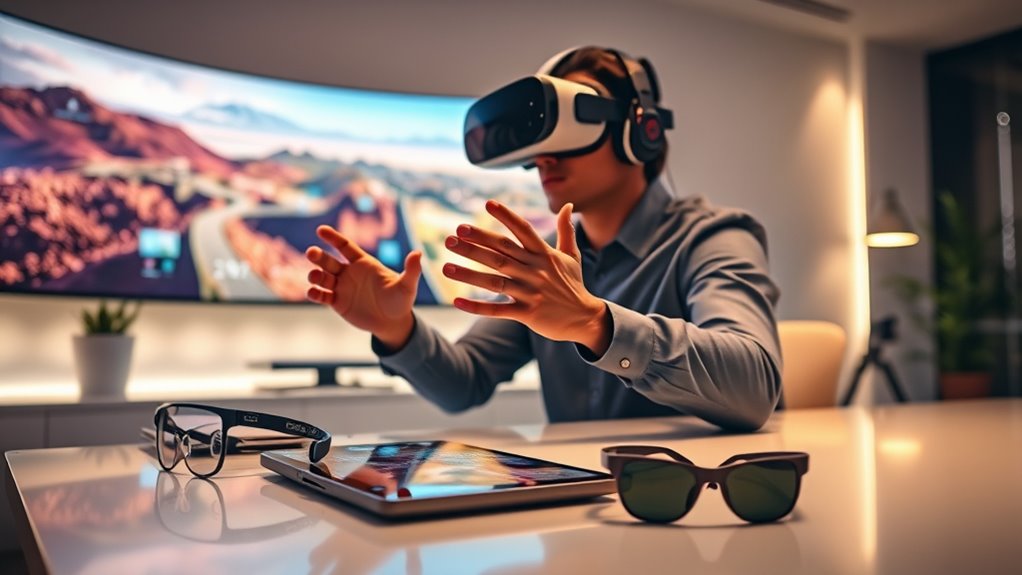
Virtual reality (VR) and augmented reality (AR) applications are transforming how we interact with digital content, but supporting these immersive experiences requires specialized hardware and software. To create realistic and engaging environments, developers rely heavily on features like haptic feedback and spatial tracking. Haptic feedback lets you feel virtual textures, vibrations, or impacts, making interactions more tangible. For example, when you pick up a virtual object, the device can simulate the sensation of weight or resistance, heightening immersion. Without this tactile component, experiences can feel disconnected or artificial, reducing user engagement and realism.
Spatial tracking, on the other hand, guarantees your movements are accurately reflected within the virtual environment. It tracks your head, hand, and body positions in real time, allowing the system to adjust visuals accordingly. This alignment is vital for maintaining immersion; if your movements aren’t tracked precisely, the virtual world feels off, and you risk motion sickness or disorientation. Advanced sensors, cameras, and algorithms work together to monitor your position and orientation with high precision, enabling seamless interaction with digital objects and environments. These tracking systems also support multi-user experiences, where multiple participants can interact naturally in the same virtual space.
Supporting VR and AR applications means integrating hardware like motion controllers, sensors, and haptic devices that provide both tactile feedback and spatial awareness. You might wear gloves embedded with sensors that detect finger movements and deliver haptic sensations, or use a headset equipped with cameras and accelerometers to track your head position. Software then processes this input, translating your physical actions into the virtual realm. Developers must optimize these systems to minimize latency—delays between your movement and the system response—to keep experiences smooth and believable.
Integrating motion controllers, sensors, and haptic devices creates immersive, responsive VR and AR experiences.
Furthermore, the combination of haptic feedback and spatial tracking enhances training simulations, gaming, and virtual collaboration by making interactions more natural and intuitive. For instance, in a virtual surgery simulation, feeling the resistance of tissues through haptic devices improves skill transfer. In AR applications, accurate spatial tracking allows digital content to linger precisely in the real world, whether you’re placing furniture virtually or navigating complex environments. To support these sophisticated features, hardware needs to be lightweight, comfortable, and precise, while software must be capable of processing massive amounts of data in real time.

PlayStation Move Motion Controllers – Two Pack
Advanced motion sensing and light tracking technology
As an affiliate, we earn on qualifying purchases.
As an affiliate, we earn on qualifying purchases.
Frequently Asked Questions
What ARe the Latest Hardware Requirements for VR and AR Applications?
You need a powerful PC with at least an Intel i5 or AMD Ryzen 5 processor, 8GB RAM, and a high-end GPU like an NVIDIA RTX 3060 or AMD Radeon RX 6700 XT. Guarantee your hardware specifications include USB 3.0 ports and HDMI or DisplayPort outputs. For ideal experience, prioritize advanced motion tracking sensors and precise controllers, which are essential for smooth, immersive VR and AR interactions.
How Do I Optimize Battery Life for Extended Vr/Ar Sessions?
To enhance battery life for extended VR and AR sessions, focus on power management and battery efficiency. Adjust settings like screen brightness, reduce unnecessary background processes, and enable power-saving modes. Use efficient hardware components and keep software updated for better energy management. Taking breaks and recharging periodically also helps maintain peak performance, ensuring your device lasts longer during immersive experiences.
What Safety Precautions Should Users Follow During Vr/Ar Use?
During VR and AR use, you should prioritize physical safety by clearing your space of obstacles and using wrist straps when necessary. To minimize motion sickness, take regular breaks, adjust the headset for comfort, and start with shorter sessions. Always stay aware of your surroundings, avoid sudden movements, and listen to your body. These precautions help guarantee a safe, enjoyable experience while reducing risks of discomfort or injury.
How Can Developers Ensure Accessibility for Diverse Users?
Did you know that 15% of the world’s population faces some form of disability? To guarantee accessibility, you should focus on inclusive design and user customization. You can incorporate adjustable controls, text-to-speech options, and customizable interfaces to accommodate diverse needs. By designing with flexibility and accessibility in mind, you make your VR and AR experiences welcoming and usable for everyone, regardless of their abilities.
What ARe Emerging Trends in VR and AR Technology Development?
You should focus on emerging trends like enhanced haptic feedback and spatial audio, which markedly improve immersion. Developers are integrating more realistic physical sensations and 3D soundscapes to create lifelike experiences. Expect advancements in lightweight hardware, improved AI for personalized content, and better cross-platform compatibility. These innovations will make VR and AR more accessible, engaging, and immersive for diverse users, pushing the boundaries of what these technologies can achieve.

AMVR Controller Straps VR Haptic Feedback Golf Club Attachment Compatible with Meta/Oculus Quest 3/Quest 3S
Extended and Weighted Design:Compatible with Meta/Oculus Quest 3/Quest 3S,the new VR golf club features a professional-grade lengthened and…
As an affiliate, we earn on qualifying purchases.
As an affiliate, we earn on qualifying purchases.
Conclusion
By integrating advanced hardware and software, you create an experience as seamless as a well-choreographed dance. Precise tracking, haptic feedback, and real-time data processing work together to make virtual worlds feel alive and responsive. As you immerse yourself in VR and AR, these technologies bridge the gap between the physical and digital, turning imagination into reality. Embrace these tools, and you’ll open a new level of interaction that’s both enthralling and limitless.

OBSBOT Tiny 3 AI-Powered Spatial Audio 4K Webcam, AI Tracking PTZ Camera with 1/1.28" Sensor, Tri-Mic, Voice & Gesture Control, 120FPS, HDR, Web Cam for PC, Laptop, Streaming, Meeting, Switch 2, etc.
【Tiny Titan】Compared to its predecessor, the Tiny 3 webcam is 48% smaller and 34% lighter, yet houses a…
As an affiliate, we earn on qualifying purchases.
As an affiliate, we earn on qualifying purchases.

DeadEyeVR Enforcer Haptic Pistol – Haptic Pistol Accessory with Force Feedback for Quest VR, Realistic Gaming VR Experience
Haptic Feedback: Feel every shot with adjustable force feedback, providing a realistic recoil experience for every pull of…
As an affiliate, we earn on qualifying purchases.
As an affiliate, we earn on qualifying purchases.