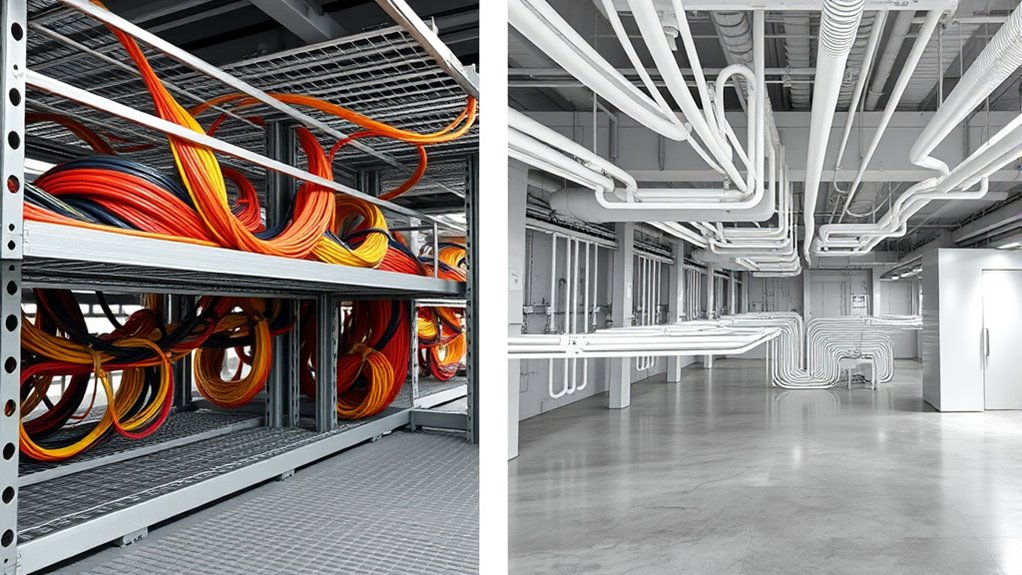

When choosing between cable trays and underfloor routing, you need to weigh their benefits and drawbacks carefully. Both options serve to organize and protect your electrical cables, but they differ markedly in installation, accessibility, and safety features. Your decision can impact not only your budget but also maintenance ease and future expansion. Understanding these differences is vital to making the best choice for your project’s needs, so it’s worth exploring what each system offers in detail.

Get networking and server gear delivered free — and shop member deals
- Fast, free delivery on millions of items
- Access to Prime Big Deal Days deals on October 6–7
- Prime Video, Amazon Music and more included
Key Takeaways
- Cable trays are open, accessible, and cost-effective for quick installation and maintenance, while underfloor routing offers hidden, protected pathways.
- Underfloor systems provide better containment and fire safety, reducing fire spread risk compared to open cable trays.
- Cable trays allow easier future cable addition and modification, whereas underfloor routing may require removing panels for access.
- Initial costs are lower for cable trays due to simpler installation; underfloor systems involve higher upfront investment.
- Both options impact safety, durability, and environmental factors, requiring careful evaluation based on project needs.

When choosing the best cable management system for your facility, understanding the differences between cable trays and underfloor routing is vital. Both options serve to organize and protect your cables but do so in distinct ways that impact safety, cost, and overall efficiency. Cable trays are open, horizontal pathways mounted above ceilings or along walls, providing quick access and easy maintenance. Underfloor routing, on the other hand, involves installing conduits or cable ducts beneath the floor, creating a hidden pathway that keeps cables out of sight.
Fire safety is a key factor in your decision. Cable trays, being open and accessible, can potentially allow the spread of fire if cables are not properly rated or if flammable materials are used. Properly selecting fire-retardant cables and ensuring trays are made from fire-resistant materials can mitigate these risks. Underfloor systems often provide better containment, reducing the risk of fire spreading through cables, especially when using fire-rated conduits and protective measures. This makes underfloor routing a safer choice in environments where fire safety is paramount, such as data centers or hospitals.
Underfloor systems offer superior fire containment for safer, more secure cable management.
Installation cost is another significant consideration. Cable trays tend to be more economical initially because they are easier to install and require less complex infrastructure. You simply mount the trays, run your cables, and secure them, which shortens setup time and labor expenses. Underfloor routing, however, generally involves higher upfront costs. You need to install a raised floor system, including flooring panels, cable conduits, and specialized supports. The installation process is more labor-intensive and requires precise planning to ensure proper airflow, accessibility, and safety. Although the initial investment is higher, underfloor systems can reduce ongoing maintenance costs and improve cable longevity by protecting cables from physical damage and environmental factors.
Furthermore, consider future expansion and maintenance. Cable trays offer straightforward access, making it easier to add or replace cables without disrupting the entire system. This flexibility can save you time and money down the line. Underfloor systems, while more secure and discreet, may require lifting floor panels or dismantling sections to access cables, which can be time-consuming and costly.
As an affiliate, we earn on qualifying purchases.
Frequently Asked Questions
How Do Installation Costs Compare Between Cable Trays and Underfloor Routing?
You’ll find that installation costs are generally lower with cable trays due to their simplicity and quicker setup, leading to better installation efficiency. Underfloor routing often involves more complex work, such as floor modifications and additional planning, which increases costs. For a clear cost comparison, consider the project’s scope and accessibility, but overall, cable trays tend to be more cost-effective and efficient to install.
Which System Offers Better Scalability for Future Electrical Needs?
You’ll find that cable trays offer better scalability for future electrical needs because they support modular expansion and enhance infrastructure flexibility. With cable trays, you can easily add or modify cables without major disruptions, making them ideal for evolving systems. Underfloor routing might require more extensive work for future upgrades, limiting flexibility. So, if growth and adaptability are priorities, cable trays give you a more scalable and flexible solution.
What Are the Maintenance Requirements for Each Routing Method?
Imagine your cables crying out for attention! Cable trays demand regular inspection protocols and occasional cleaning to prevent dust buildup and corrosion, keeping your system running smoothly. Underfloor routing requires meticulous inspection and maintenance of access points, ensuring no debris obstructs airflow or cables. Both systems need consistent upkeep, but cable trays are easier to access, making inspections faster, while underfloor systems demand more effort to maintain hidden components.
How Do Safety Standards Differ Between Cable Trays and Underfloor Systems?
You’ll find that safety standards differ between cable trays and underfloor systems mainly in fire safety and environmental impact. Cable trays often require fire-resistant materials and proper grounding to prevent fire spread, while underfloor systems must guarantee adequate ventilation and insulation to minimize fire hazards. Both systems should follow environmental guidelines, but cable trays may pose more challenges in fire safety due to exposed cables, impacting overall safety compliance and environmental considerations.
Can Both Systems Be Used Together in the Same Facility?
You can definitely use both systems together in the same facility. This integration allows you to optimize costs and improve system flexibility. Visualize it like combining different pathways to streamline cable management. By integrating cable trays and underfloor routing, you can target specific needs for safety, accessibility, and cost efficiency. This hybrid approach guarantees you maximize system advantages, ultimately leading to better system performance and cost savings.
As an affiliate, we earn on qualifying purchases.
Conclusion
Ultimately, choosing between cable trays and underfloor routing depends on your priorities for safety, budget, and maintenance. Cable trays offer quick access and flexibility, but require proper fire-rated cables. Underfloor systems provide better protection but come with higher costs. Remember, “A stitch in time saves nine”—investing wisely now guarantees a smoother, safer electrical setup later. Make your decision carefully, balancing immediate needs with long-term benefits.
metal cable tray for electrical wiring
As an affiliate, we earn on qualifying purchases.
As an affiliate, we earn on qualifying purchases.
raised floor cable management system
As an affiliate, we earn on qualifying purchases.
As an affiliate, we earn on qualifying purchases.
Halloween Picks
halloween
As an affiliate, we earn on qualifying purchases.