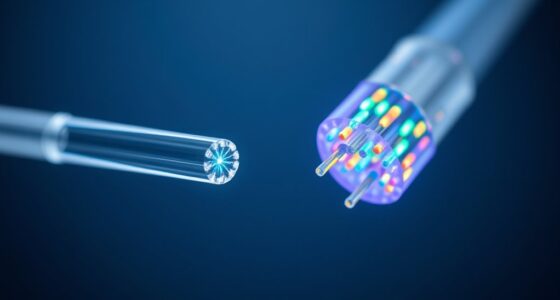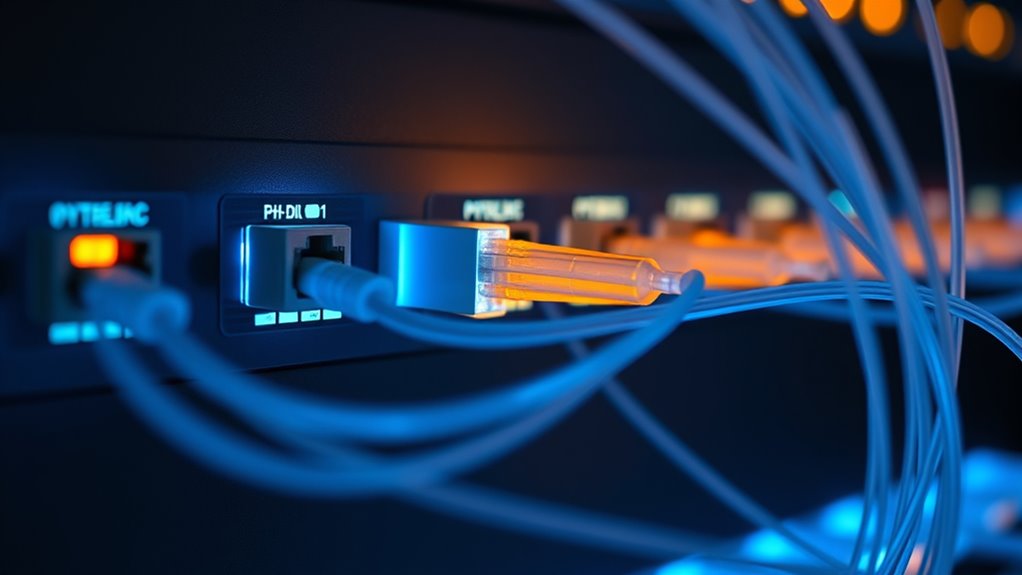

The rise of BiDi transceivers in fiber networks is transforming how you connect and expand your infrastructure. These devices allow you to send and receive data over a single fiber by using different wavelengths, boosting efficiency and cutting costs. They simplify network upgrades, reduce physical space, and improve reliability with less equipment. As demand for higher bandwidth grows, BiDi transceivers offer a scalable, future-proof solution—stay tuned to discover how they’re shaping modern networks.
Key Takeaways
- BiDi transceivers enable bidirectional data transmission over a single fiber, increasing network efficiency and reducing infrastructure costs.
- Wavelength division multiplexing allows simultaneous send/receive, maximizing fiber bandwidth and supporting scalable network architectures.
- Growing demand for high-capacity, cost-effective fiber solutions drives the adoption of BiDi transceivers in modern networks.
- BiDi technology simplifies network design, reduces physical components, and facilitates easier upgrades and future expansion.
- Enhanced reliability, lower latency, and compatibility with advanced filtering make BiDi transceivers essential for real-time, high-demand applications.

BiDi transceivers play an essential role in modern fiber optic networks by enabling bidirectional data transmission over a single fiber strand. This technology allows you to send and receive data simultaneously, which markedly enhances network efficiency and reduces infrastructure costs. At the core of this capability lies wavelength division, a technique that separates signals based on their wavelengths. By assigning different wavelengths to transmit and receive paths, BiDi transceivers use signal multiplexing to combine multiple data streams into a single fiber. This multiplexing process guarantees you can maximize the bandwidth of each fiber, making your network more scalable and capable of handling increasing data demands.
When you deploy BiDi transceivers, you leverage wavelength division multiplexing (WDM) — specifically, a form called bidirectional WDM. This approach allows you to use one wavelength for transmitting data in one direction and a different wavelength for the opposite direction. Thanks to this separation, both channels can operate simultaneously without interference, increasing overall throughput. You’ll find this especially advantageous in locations where fiber runs are limited or costly, as it minimizes the amount of fiber needed while maintaining high data capacity.
Signal multiplexing in BiDi transceivers isn’t just about combining signals; it’s about efficiently managing your network’s bandwidth. By multiplexing signals onto separate wavelengths, you can also reduce the need for multiple fibers and simplify the network architecture. This means fewer physical components, less space, and easier maintenance. As your network grows, this multiplexing approach makes it easier to upgrade or expand capacity without overhauling your entire infrastructure. You simply add more wavelengths or upgrade your transceivers to support higher data rates, guaranteeing your network remains future-proof.
Moreover, the technology behind wavelength division and signal multiplexing in BiDi transceivers results in lower latency, as data can travel in both directions simultaneously. This is essential for applications that require real-time data transfer, like video conferencing, financial transactions, or cloud services. You also benefit from improved network reliability because the use of a single fiber reduces potential points of failure, and advanced filtering within the transceivers ensures clean separation of wavelengths, preventing crosstalk. Natural elements such as connectors and protective enclosures also contribute to the durability and performance of fiber optic systems.
In essence, the integration of wavelength division and signal multiplexing in BiDi transceivers transforms your fiber optic network into a more efficient, cost-effective, and scalable system. It empowers you to make the most of your fiber infrastructure, supporting high-capacity data transmission while simplifying your network design. As demand for bandwidth continues to grow, adopting these technologies will keep your network ahead, delivering faster, more reliable connectivity with less complexity.

A Pair of 1.25G/s Bidi Gigabit Multi-Mode Fiber Ethernet Media Converter with 2PCS Bidi SFP LC Dual Transceiver Module Included, 10/100/1000Base-Tx to 1000Base-SX SMF RJ45 to SFP Slot up to 550M
What You Get: 2pcs Gigabit Multi-Mode Ethernet SFP Slot media converters; 2pcs SFP BiDi LC Dual Multi-Mode transceiver;…
As an affiliate, we earn on qualifying purchases.
As an affiliate, we earn on qualifying purchases.
Frequently Asked Questions
How Do Bidi Transceivers Compare to Traditional Transceivers’ Cost?
You’ll find that BiDi transceivers often have a higher initial investment compared to traditional transceivers, but they can offer better cost savings over time. The cost comparison shows that BiDi units reduce the need for additional fiber strands, which lowers infrastructure expenses. So, while upfront costs are higher, their efficiency and capacity to cut overall network costs make them a smart, cost-effective choice for expanding fiber networks.
What Are the Main Challenges in Deploying Bidi Transceivers?
Imagine deploying BiDi transceivers in a busy data center. Your main challenge is ensuring precise optical alignment during installation, which can be tricky due to tight fiber splicing tolerances. You must also manage increased complexity in testing and maintenance, as dual wavelengths require careful calibration. These issues demand skilled technicians and meticulous procedures, making deployment more demanding than traditional transceivers.
Are Bidi Transceivers Compatible With All Fiber Types?
Bidi transceivers aren’t compatible with all fiber types; their fiber compatibility depends on the fiber’s core type and quality. You need to check transceiver standards to guarantee proper compatibility, especially regarding single-mode or multi-mode fibers. For best performance, follow manufacturer specifications and confirm that your fiber infrastructure aligns with the transceiver’s standards. This way, you avoid issues like signal loss or connection failures.
How Does Bidi Technology Impact Network Scalability?
Bidi technology considerably boosts your network’s scalability by enabling fiber optic innovation through efficient bandwidth expansion. With bidirectional transceivers, you can transmit and receive data over a single fiber strand, reducing infrastructure costs and simplifying upgrades. This allows you to easily increase network capacity without laying new cables, making your fiber network more adaptable to growing data demands and future-proofing your infrastructure as your needs evolve.
What Maintenance Is Required for Bidi Transceiver-Equipped Networks?
Maintaining a BiDi transceiver network is like tending a garden—you need regular care. You should perform fiber cleaning to keep connections clear and efficient, preventing dirt from clogging signals. Connection testing ensures everything runs smoothly, catching issues early. Check transceivers periodically for proper operation and update firmware when needed. These simple steps keep your network healthy, reliable, and ready to grow without disruptions.
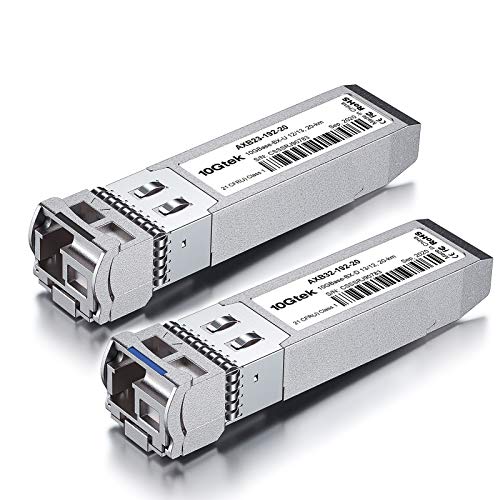
10Gtek a Pair of 10G SFP+ Bidi Transceiver, LC Single-Mode Single Fiber Module, 10GBASE-BIDI 1270nm/1330nm for Cisco SFP-10G-BX20D-I/SFP-10G-BX20U-I, Ubiquiti UniFi, Mikrotik, and More, DOM, 20km
10GBASE-BIDI Bidirectional SFP+ to single LC Optical transceiver module, Single Mode, Wave length: Up: TX1270nm/RX1330nm; Down: TX1330nm/RX1270nm, DDM,…
As an affiliate, we earn on qualifying purchases.
As an affiliate, we earn on qualifying purchases.
Conclusion
As you adopt BiDi transceivers, you’ll notice faster, more efficient fiber networks that keep your business competitive. Imagine a small ISP deploying these transceivers, transforming their outdated infrastructure into a reliable backbone for thousands of customers. You can experience similar success by embracing this innovative technology. Don’t let your network fall behind—step into the future with BiDi transceivers and open new levels of performance and connectivity.

One Pair of 1.25G SFP WDM SC Bidi Transceiver 1000Base-BIDI SingleMode Simplex Fiber Module SMF 1310nm/15500nm DDM up to 20 km for Cisco GLC-BX-D, Ubiquiti UniFi UF-SM-1G-S, Mikrotik and More
1000BASE-BIDI SC TRANSCEIVER: 1.25G SC WDM SFP optical transceiver module supports 1.25Gbps data transmission rate over single mode…
As an affiliate, we earn on qualifying purchases.
As an affiliate, we earn on qualifying purchases.

Fluke Networks NFC-KIT-BOX Fiber Optic Cleaning Kit
Kit includes cleaning cube with wipes, five cards with sealed cleaning zones, solvent pen and 2.5 mm port…
As an affiliate, we earn on qualifying purchases.
As an affiliate, we earn on qualifying purchases.