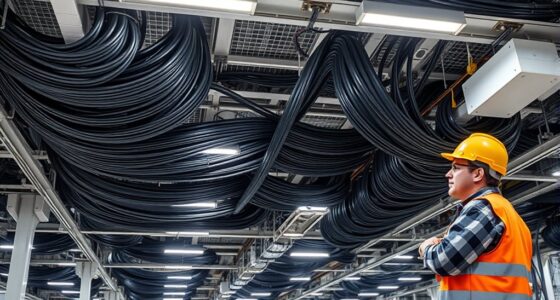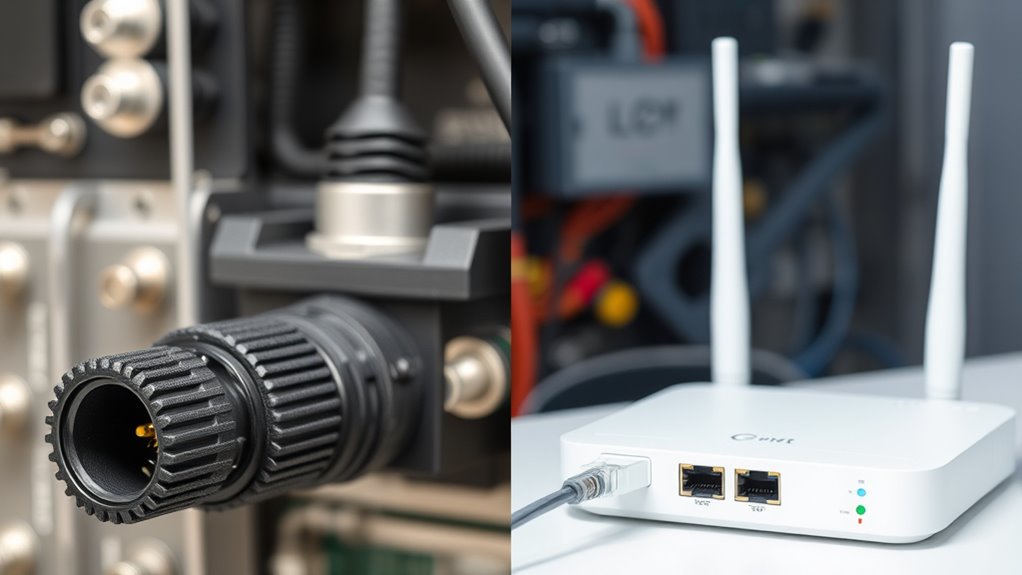

Imagine the difference between a sturdy bridge and a delicate footpath—your choice of Ethernet type can be just as critical. Industrial Ethernet and Standard Ethernet look similar on the surface, but their core strengths lie in how they handle the demands of their environments. Whether you need resilience against harsh conditions or high-speed performance in controlled spaces, understanding these differences can impact your network’s reliability and longevity. The key factors might surprise you.
Key Takeaways
- Industrial Ethernet is built for harsh environments, offering rugged hardware and environmental resistance, unlike standard Ethernet.
- Standard Ethernet is optimized for controlled settings, providing high-speed connectivity with less environmental protection.
- Installing Industrial Ethernet is more complex and requires specialized equipment, whereas standard Ethernet offers straightforward, plug-and-play setup.
- Industrial Ethernet ensures long-term reliability and reduces downtime in demanding conditions compared to standard Ethernet.
- The choice depends on environmental resilience needs: Industrial Ethernet for harsh conditions, standard Ethernet for controlled environments.
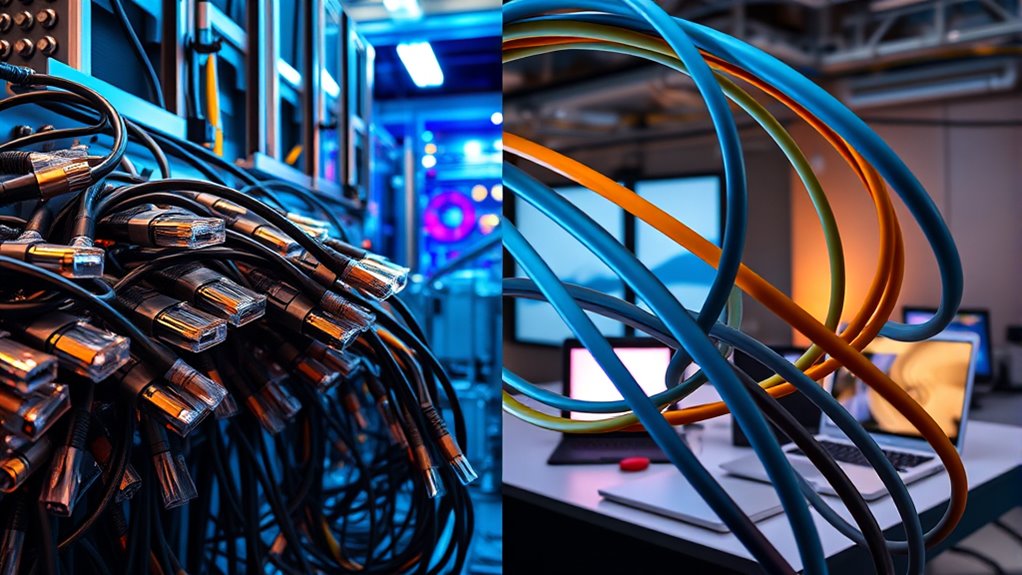
When choosing between Industrial Ethernet and Standard Ethernet, understanding their core differences is essential for optimizing network performance in various environments. Your decision impacts not only how reliable your network is but also how easily you can install and maintain it. Industrial Ethernet is designed specifically for harsh, demanding conditions often found in manufacturing plants, outdoor setups, and other industrial settings. It offers enhanced network reliability by using ruggedized hardware, connectors, and protocols that resist dust, moisture, extreme temperatures, and vibrations. This robustness minimizes downtime caused by environmental factors, ensuring your system remains operational even under adverse conditions. On the other hand, Standard Ethernet, commonly used in offices, homes, and data centers, is optimized for controlled environments where environmental stresses are minimal. While it provides high-speed connectivity and ease of use, it doesn’t typically accommodate the physical and electrical challenges encountered in industrial settings, which can compromise network reliability if used improperly.
Additionally, selecting the appropriate Ethernet type often involves considering environmental resilience, which is a key factor in determining long-term network stability. When it comes to installation complexity, these differences become even more apparent. Installing Industrial Ethernet often involves additional planning and specialized equipment. You need to think about ruggedized connectors, shielded cables, and sometimes even specialized enclosures to protect the hardware. The process may be more time-consuming and require skilled technicians familiar with industrial standards. This initial complexity can be a hurdle if you’re just setting up a network, but it pays off by delivering a resilient system that’s less prone to failure. Conversely, Standard Ethernet installation is generally straightforward. Its plug-and-play nature, standardized connectors, and widespread availability of compatible hardware make setup quick and accessible, especially for non-experts. However, this simplicity can be misleading in industrial environments, where standard equipment might not withstand harsh conditions, leading to potential network reliability issues down the line.
Your choice hinges on balancing these factors. If your environment presents challenging conditions, investing in Industrial Ethernet might seem more complex upfront but ensures long-term reliability and stability. For controlled environments with minimal environmental stress, Standard Ethernet offers an efficient, cost-effective solution with less installation complexity. Keep in mind that while Industrial Ethernet may require more initial effort, its tailored design provides peace of mind through consistent performance and durability. Conversely, opting for Standard Ethernet in unsuitable environments can result in frequent disruptions, costly repairs, and increased downtime. Ultimately, understanding the core differences in network reliability and installation complexity helps you make an informed decision that aligns with your operational needs and long-term goals.

Ethernet Server Room Temperature Monitor, PoE Server Rack Temperature Humidity Sensor with Web Interface, SNMP Modbus MQTT Support, Dual Power, IP55, Data Logging, Alarm & Relay Output
Precision Monitoring for Critical Environments: The server room temperature monitor is a professional temperature and humidity monitor built...
As an affiliate, we earn on qualifying purchases.
Frequently Asked Questions
How Does Latency Differ Between Industrial and Standard Ethernet?
You’ll notice that industrial Ethernet offers lower latency than standard Ethernet, enhancing real-time performance vital for automation. It achieves this with specialized hardware that prioritizes data flow, reducing delays. Standard Ethernet, designed for general use, might introduce higher latency due to less optimized hardware and protocols. For tasks requiring precise timing and quick responses, industrial Ethernet guarantees your system runs smoothly, meeting real-time demands effectively.
What Are the Cost Implications of Adopting Industrial Ethernet?
Imagine upgrading your network like planting a sturdy tree. Industrial Ethernet often costs more upfront due to specialized hardware, but it offers better durability and performance, reducing long-term maintenance costs. Your cost analysis should consider investment strategies that weigh initial expenses against ongoing savings. While the initial investment might seem steep, the resilience and efficiency gains can make it a smart choice, especially for critical industrial applications.
Can Industrial Ethernet Integrate With Existing Standard Ethernet Systems?
Yes, industrial Ethernet can integrate with existing standard Ethernet systems. You’ll find that its protocol compatibility allows seamless network integration, making it easier to upgrade without complete overhauls. By ensuring that industrial and standard Ethernet devices communicate effectively, you reduce costs and complexity. This compatibility enables you to leverage your current infrastructure while benefiting from industrial Ethernet’s robustness and real-time capabilities, simplifying your network management and expansion.
What Are the Security Considerations Unique to Industrial Ethernet?
You should prioritize security in industrial Ethernet by implementing network segmentation to isolate critical systems from less secure devices, reducing the risk of cyber attacks. Additionally, use data encryption to protect sensitive information during transmission. Regularly update firmware and enforce strong access controls. These measures help prevent unauthorized access and ensure operational integrity, safeguarding your industrial network from evolving cyber threats.
How Scalable Is Industrial Ethernet for Large Manufacturing Setups?
You’ll find industrial Ethernet highly scalable for large manufacturing setups thanks to its flexible network capacity and modular design. You can easily expand your network by adding switches or segments without disrupting existing systems. This adaptability allows your setup to grow with your needs, ensuring reliable performance across extensive factory floors. Its design supports high bandwidth demands and complex configurations, making it an ideal choice for large-scale industrial environments.

TP-Link Omada SG2005P-PD | 5 Port Outdoor PoE Passthrough Gigabit Ethernet Switch | 1 PoE++ in@90W, 4 PoE+ Out Up to 64W | IP55, Static Routing, Access Control List, QoS, VLAN | PoE Powered ONLY
【PoE Passthrough】 With 1 x Gigabit PoE++ input, 4 x Gigabit PoE+ output, this device supports up to...
As an affiliate, we earn on qualifying purchases.
Conclusion
You might think standard Ethernet is enough for all your needs, but the truth is, Industrial Ethernet’s rugged design can actually prevent costly downtime in harsh environments. If you believe your setup won’t face extreme conditions, consider this: even in controlled settings, long-term reliability matters. Investing in Industrial Ethernet could be the key to avoiding future issues and ensuring seamless operation. So, don’t just assume; evaluate your environment’s demands to make the smartest choice.

TP-Link Omada WiFi 7 Wireless Access Point | BE11000 Tri-Band | 10G Port | Business Standard | Seamless Roaming | Easy Setup | 5-Year Warranty | Omada Remote Managed(EAP773)
𝐅𝐑𝐄𝐄 𝐎𝐦𝐚𝐝𝐚 𝐄𝐬𝐬𝐞𝐧𝐭𝐢𝐚𝐥 𝐏𝐥𝐚𝐭𝐟𝐨𝐫𝐦 𝐂𝐞𝐧𝐭𝐫𝐚𝐥𝐢𝐳𝐞𝐝 𝐑𝐞𝐦𝐨𝐭𝐞 𝐌𝐚𝐧𝐚𝐠𝐞𝐦𝐞𝐧𝐭: Unlock numerous advanced features by integrating with Omada Cloud Management Platform,...
As an affiliate, we earn on qualifying purchases.

LINOVISION Industrial 8-Port Full Gigabit POE++ Switch with 4 BT 90W PoE Ports, 2 Gigabit SFP Uplinks, POE Budget 120W, POE Watchdog, DIN-Rail POE Switch for PTZ Camera/POE Lighting/ POE Monitor
8 PORT FULL GIGABIT POE SWITCH - Providing 8*10/100/1000Base-T Ethernet PoE ports and 2*1000Base-X SFP Ports. (Noted: Each...
As an affiliate, we earn on qualifying purchases.