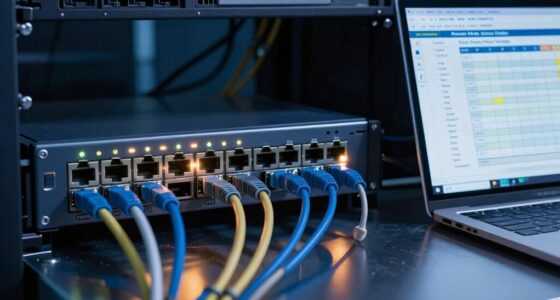

To make network expansion easier for the next team, focus on thorough planning, detailed documentation, and strategic phased growth. Conduct site surveys to identify existing strengths and gaps, then plan upgrades to support future scalability. Keep clear records of infrastructure changes, compliance efforts, and technical specs. Communicate with vendors and authorities early on, automating where possible to reduce manual errors. By following these steps, you’ll create a smooth, manageable expansion process—if you want to find out more, keep exploring effective strategies.
Key Takeaways
- Develop detailed documentation and training materials to ensure seamless knowledge transfer.
- Implement phased expansion to allow manageable, incremental growth and testing of new infrastructure.
- Conduct thorough site surveys and assessments to inform strategic upgrade planning.
- Maintain clear communication channels with vendors, regulatory bodies, and team members throughout the process.
- Use scalable, standards-compliant equipment supporting future upgrades to simplify future expansions.

Are you struggling to expand your network efficiently? Growing a network isn’t just about adding more hardware; it involves careful planning, especially when dealing with complex wireless infrastructure and ensuring regulatory compliance. If you overlook these elements, you risk delays, increased costs, and potential legal issues. To make your network expansion smoother, start by assessing your current infrastructure. Understand where your wireless infrastructure is strongest and identify gaps that need reinforcement. This allows you to plan upgrades strategically rather than rushing into unnecessary hardware purchases. When expanding, prioritize scalability—choose equipment and designs that can grow with your needs, reducing the need for frequent overhauls.
Assess your current infrastructure to identify strengths and gaps, enabling strategic, scalable network expansion and avoiding unnecessary costs.
Next, familiarize yourself with the regulatory landscape. Different regions have specific rules regarding spectrum use, licensing, and data security. Ignoring these regulations can lead to hefty fines and operational shutdowns. Make compliance a core part of your planning process. Engage with legal experts or regulatory bodies early to understand the requirements for new installations or frequency allocations. This proactive approach minimizes surprises and keeps your project on track. Incorporate compliance checks at every stage—from site surveys to equipment deployment—to ensure adherence.
Another key aspect is leveraging technology. Use network management tools that help monitor your infrastructure’s performance and security. These tools provide real-time insights, allowing you to detect issues before they escalate. When deploying new wireless infrastructure, select devices that support the latest standards for speed and security. This not only future-proofs your network but also helps maintain regulatory compliance related to security protocols. Automating parts of the deployment process can also cut down on manual errors, ensuring consistency across your network. Additionally, understanding bandwidth capacity and other technical specifications can help you select the right equipment that aligns with your performance goals. Being aware of spectrum management strategies can further optimize your wireless network’s efficiency and compliance. Furthermore, staying updated on emerging wireless standards will enable you to adapt your network seamlessly as technology advances.
Communication plays a vital role in simplifying expansion. Coordinate with vendors, technicians, and regulatory authorities to streamline installation and approval processes. Clear documentation of your plans, compliance measures, and hardware specifications will facilitate smoother inspections and approvals. Training your team on the importance of regulatory compliance and proper network management also helps prevent costly mistakes. Always keep detailed records of your infrastructure changes and compliance efforts to demonstrate adherence during audits.
Finally, adopt a phased approach to expansion. Tackle one segment at a time, testing and optimizing before moving forward. This reduces risks, allows you to troubleshoot effectively, and ensures that your wireless infrastructure remains robust throughout growth. Being aware of color accuracy and other technical specifications can help you select the right equipment that aligns with your performance goals. By combining strategic planning, compliance awareness, technological tools, and clear communication, you’ll make network expansion more manageable—setting your team up for success now and in the future.

Cambium Networks ePMP 2000 Sector Antenna 5GHz 90/120 Degree with Mounting Kit
- Global Deployment: Over five million radios deployed worldwide
- High-Density Coverage: Ideal for 90° and 120° high-density networks
- Spectrum Efficiency: Supports frequency re-use and wide-band coverage
As an affiliate, we earn on qualifying purchases.
As an affiliate, we earn on qualifying purchases.
Frequently Asked Questions
What Are Common Pitfalls During Network Expansion?
You might face scaling challenges that strain your existing infrastructure, leading to slower performance or outages. Security concerns often get overlooked during rapid expansion, leaving vulnerabilities open to threats. To avoid these pitfalls, plan your network growth carefully, prioritize security protocols, and guarantee your team stays updated on best practices. Regular monitoring and testing can help identify issues early, making expansion smoother and more secure.
How to Prioritize Network Expansion Projects?
Prioritize network expansion projects like a conductor directing an orchestra, ensuring harmony among tasks. Start with network planning to identify critical gaps and potential impacts, then allocate resources based on urgency and strategic value. Focus on projects that deliver the most value first, and reassess regularly. By aligning priorities with your business goals and resource capacity, you’ll make smarter decisions and streamline the expansion process for your next team.
What Tools Assist in Managing Large Network Growth?
You can manage large network growth effectively by leveraging tools that focus on network automation and capacity planning. These tools automate routine tasks, reduce manual errors, and streamline deployment processes. Capacity planning tools help you forecast future needs, ensuring your network scales smoothly without disruptions. Together, they simplify expansion, improve efficiency, and prepare your team to handle growth confidently. Embracing these tools makes managing large network growth much more manageable and less stressful.
How to Train Teams for Network Expansion Challenges?
Your team’s readiness can be overwhelmed like a tidal wave if you don’t employ effective training strategies. Focus on hands-on sessions, scenario-based exercises, and regular updates to strengthen team communication. Encourage open dialogue, foster collaboration, and simulate real-world challenges to build confidence. By emphasizing continuous learning and clear communication, you prepare your team to adapt swiftly, making network expansion smoother and more resilient for the next crew.
How to Measure Success in Network Expansion Efforts?
You measure success in network expansion by tracking scalability metrics like bandwidth growth, connection stability, and latency improvements. Set clear growth benchmarks—such as increasing coverage area or user capacity—and monitor progress regularly. By analyzing these metrics and benchmarks, you’ll see how well your expansion efforts are performing, identify areas needing improvement, and guarantee the network scales efficiently to meet future demands.

Building Network Management Tools with Tcl/Tk
As an affiliate, we earn on qualifying purchases.
As an affiliate, we earn on qualifying purchases.
Conclusion
By streamlining your network expansion process, you can save time and reduce headaches for your team. Embrace automation tools, clear documentation, and scalable strategies to make growth smoother. Did you know that companies that prioritize structured network planning see up to 30% faster expansion? Keep these tips in mind, and you’ll be well on your way to building a resilient, efficient network that supports your team’s future success with ease.

Ubiquiti UniFi AP AC PRO 802.11ac Scalable Enterprise Wi-Fi Access Point (UAP-AC-PRO-E-US) PoE Adapter Sold Separately
- PoE Adapter: Sold separately
- 2.4 GHz Speed: 450 Mbps
- 5 GHz Speed: 1300 Mbps
As an affiliate, we earn on qualifying purchases.
As an affiliate, we earn on qualifying purchases.

FortiGate-90G Network Security Appliance Plus 3 Year FortiGuard Unified Threat Protection (UTP) and FortiCare Premium (FG-90G-BDL-950-36)
- Hardware and Service Package: Includes FortiGate-90G with 3-year support
- Unified Threat Protection Bundle: Protects against web-borne and DNS threats
- Advanced Security Features: Includes ATP, DNS, URL, video filtering, and anti-botnet
As an affiliate, we earn on qualifying purchases.
As an affiliate, we earn on qualifying purchases.