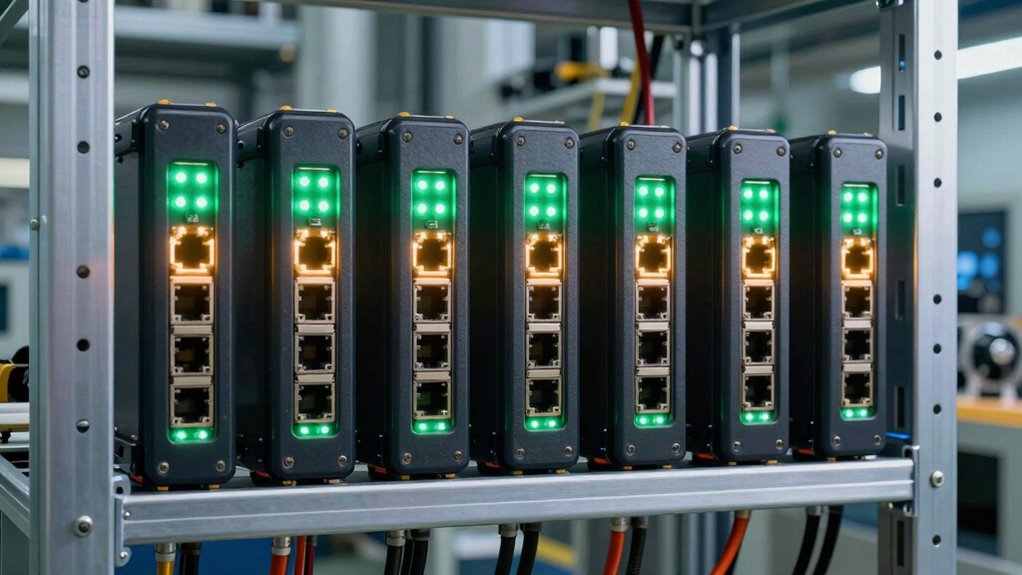

When selecting an industrial PoE switch for factory environments, durability, power capacity, and network management are key concerns. The LINOVISION 8-Port Gigabit PoE Switch stands out as the best overall choice, thanks to its robust build and high PoE wattage. For those needing a compact, cost-effective solution, the TRENDnet 8-Port Industrial Gigabit PoE+ DIN-Rail Mini Switch offers reliable performance with easy installation. Meanwhile, the Omada IES206GPP provides advanced management features for larger, complex networks. Keep reading for a detailed breakdown of these options and what tradeoffs each presents.

Get business pricing on networking and server gear
- Business-only prices and quantity discounts
- Tax-exempt purchasing
- Multiple users, one account, clear invoices
Key Takeaways
- High PoE wattage is critical for powering multiple high-demand devices simultaneously in factory setups.
- DIN-rail mounting remains the most popular and practical installation method for industrial environments.
- Managed switches like the Omada IES206GPP are better suited to complex factory networks, despite higher costs.
- Compact switches are ideal for space-constrained areas but may sacrifice some ports or features.
- Build quality and environmental ratings (IP ratings) are essential to ensure longevity in harsh factory conditions.
| LINOVISION 8-Port Gigabit PoE Switch with 4 BT 90W PoE++ Ports |  | Best Overall for High-Demand Devices | Number of Ports: 8 Gigabit Ethernet ports | PoE Ports: 4 PoE++ (up to 90W), 4 PoE+ (up to 30W) | SFP Ports: 2 | VIEW ON AMAZON | See Our Full Breakdown |
| TRENDnet 16-Port Industrial Gigabit PoE+ DIN-Rail Switch TI-PG160 |  | Best for Harsh Environments and Flexibility | Number of Ports: 16 Gigabit PoE+ ports | PoE Power per Port: 30W | Total PoE Power Budget: 240W | VIEW ON AMAZON | See Our Full Breakdown |
| LINOVISION Industrial 5 Ports Gigabit 12V PoE Switch, Solar Powered Switch |  | Best for Solar and Remote Installations | Ports: 4 PoE + 1 Gigabit uplink | PoE Standard: IEEE802.3af/at | PoE Power Budget: 120W (DC24V/DC48V input) or 60W (DC12V input) | VIEW ON AMAZON | See Our Full Breakdown |
| TRENDnet 8-Port Industrial Gigabit PoE+ DIN-Rail Mini Switch, TI-PGLC80 |  | Best Compact Rugged Design | Device Interface: 8 x Gigabit PoE+ Ports | Housing: Mini, IP30 metal enclosure | Dimensions: 3.93” x 3.16” x 1.53” | VIEW ON AMAZON | See Our Full Breakdown |
| Omada IES206GPP 5 Port Gigabit Managed Industrial PoE++ Switch |  | Best Managed for Professional Networks | Ports: 4× Gigabit RJ45 (1× PoE++, 3× PoE+), 1× Gigabit combo RJ45/SFP, 1× Gigabit SFP | Power Budget: 120W, up to 60W for PoE++ | Operating Temperature: -40~75°C | VIEW ON AMAZON | See Our Full Breakdown |
| Industrial 8-Port Full Gigabit PoE+ Switch with DIN-Rail Power Supply |  | Best for Rugged Industrial Environments | Number of Ports: 8 PoE ports, 2 uplink ports | Switch Capacity: 20Gbps | Power Supply: 52V industrial-grade | VIEW ON AMAZON | See Our Full Breakdown |
| industrial poe switches for factorie | Number of Ports |
|---|---|
| LINOVISION 8-Port Gigabit PoE | 8 Gigabit Ethernet ports |
| TRENDnet 16-Port Industrial Gi | 16 Gigabit PoE+ ports |
| LINOVISION Industrial 5 Ports | — |
| TRENDnet 8-Port Industrial Gig | — |
| Omada IES206GPP 5 Port Gigabit | — |
| Industrial 8-Port Full Gigabit | 8 PoE ports, 2 uplink ports |
More Details on Our Top Picks
LINOVISION 8-Port Gigabit PoE Switch with 4 BT 90W PoE++ Ports
This industrial-grade switch stands out for its powerful 4 PoE++ ports capable of delivering up to 90W each, making it ideal for high-demand devices like advanced cameras or lighting systems. Compared with the TRENDnet 16-Port Industrial Gigabit PoE+ switch, it offers higher power per port but fewer total ports, which suits environments prioritizing power over port count. Its redundant power inputs and real-time PoE load monitoring add reliability for mission-critical setups. However, the need for an optional, separate power supply to reach maximum PoE budget introduces extra complexity and cost. This makes it best suited for factories with demanding PoE applications that require high power and redundancy, rather than smaller, simpler networks.
Pros:- High-power PoE++ ports up to 90W for demanding devices
- Supports redundant power inputs for enhanced reliability
- Real-time PoE load monitoring and automatic reboot features
Cons:- Requires optional power supply for maximum PoE capacity
- Limited to 8 ports, less scalable for larger networks
Best for: Factories needing high-power PoE++ support for demanding devices with a focus on reliability
Not ideal for: Small-scale installations or budget-conscious setups where extra power supplies and complexity are unwarranted
- Number of Ports:8 Gigabit Ethernet ports
- PoE Ports:4 PoE++ (up to 90W), 4 PoE+ (up to 30W)
- SFP Ports:2
- PoE Budget:120W (expandable to 240W with optional power supply)
- Redundant Power:Yes, support for 2-channel DC48-56V input
- Power Adapter:UL-listed 120W, optional 240W Mean Well
Our verdict“This switch is perfect for factories with critical, high-power PoE needs and redundancy requirements.”
TRENDnet 16-Port Industrial Gigabit PoE+ DIN-Rail Switch TI-PG160
The TRENDnet TI-PG160 offers a solid industrial performance with 16 Gigabit PoE+ ports, making it a versatile choice for extensive factory networks. Its robust metal enclosure and wide temperature range (-40°C to 75°C) outperform many competitors like the LINOVISION 8-Port, especially in extreme conditions. While it lacks an included power supply, its support for DIN-rail and wall mounting provides flexible deployment options. The power supply is sold separately, which might be a drawback for those seeking an all-in-one solution. This switch is ideal for large-scale factory setups that demand high port density and rugged durability, but smaller or less demanding environments should consider simpler models to avoid unnecessary complexity and cost.
Pros:- High port density with 16 Gigabit PoE+ ports
- Durable metal enclosure suitable for harsh environments
- Wide operating temperature from -40°C to 75°C
Cons:- Power supply sold separately
- No included redundant power source, adding to setup cost
Best for: Large factories or facilities requiring extensive, durable network infrastructure with high environmental resilience
Not ideal for: Small factories or budget-sensitive setups where extra costs for power supplies or smaller port counts are a concern
- Number of Ports:16 Gigabit PoE+ ports
- PoE Power per Port:30W
- Total PoE Power Budget:240W
- Operating Temperature Range:-40°C to 75°C
- Enclosure:IP30 rated metal
- Mounting Options:DIN-rail and wall mount
Our verdict“This switch is well-suited for large, rugged factory environments demanding extensive PoE+ connectivity.”
LINOVISION Industrial 5 Ports Gigabit 12V PoE Switch, Solar Powered Switch
This compact industrial switch excels in solar-powered or remote environments, featuring 4 PoE ports supporting IEEE802.3af/at and a gigabit uplink. Its dual power redundancy with wide input voltage (DC9V-54V) makes it highly reliable in off-grid setups. Compared to larger switches like the TRENDnet 16-Port, this model offers fewer ports but compensates with its rugged design and solar compatibility. Its support for high power PoE output up to 120W makes it suitable for powering cameras or sensors in harsh outdoor conditions. The main tradeoff is its limited port count and specialized input voltage range, which may require technical expertise during setup. This pick makes the most sense for solar-powered factories or remote sites needing dependable PoE in tough environments.
Pros:- Supports high power PoE up to 120W
- Dual redundant power inputs for high reliability
- Rugged design suitable for extreme outdoor conditions
Cons:- Limited to 5 ports, restricting network expansion
- Supports only Mode B PoE output, limiting compatibility with some devices
Best for: Factories utilizing solar power or operating in remote, off-grid locations
Not ideal for: Large factories needing extensive port counts or plug-and-play solutions with standard power sources
- Ports:4 PoE + 1 Gigabit uplink
- PoE Standard:IEEE802.3af/at
- PoE Power Budget:120W (DC24V/DC48V input) or 60W (DC12V input)
- Input Voltage:DC9V-54V
- Enclosure:IP40 rugged metal
- Temperature Range:-40℉ to 176℉
Our verdict“Ideal for solar-powered or off-grid factories requiring reliable, rugged PoE connectivity in harsh conditions.”
TRENDnet 8-Port Industrial Gigabit PoE+ DIN-Rail Mini Switch, TI-PGLC80
This miniature industrial switch offers 8 Gigabit PoE+ ports in a compact, rugged enclosure, making it suitable for tight spaces within factory control panels. Its IP30-rated metal housing ensures durability in vibration-prone environments. While the power supply is sold separately, its high-power PoE+ support up to 30W per port and easy DIN-rail or wall mounting makes it accessible for small-scale industrial deployments. Compared with larger models like the TRENDnet 16-Port, it’s less scalable but excels where space is limited, and a rugged form factor is necessary. Its lack of an integrated power supply means additional setup steps, but this is offset by its portability and industrial-grade resilience.
Pros:- Compact, rugged industrial design
- Supports high-power PoE+ up to 30W per port
- Easy to mount with DIN-rail and wall options
Cons:- Power supply sold separately
- Limited to 8 ports, less suitable for large networks
Best for: Factories with limited space needing reliable PoE+ in a compact form factor
Not ideal for: Large networks or environments requiring high port density without space constraints
- Device Interface:8 x Gigabit PoE+ Ports
- Housing:Mini, IP30 metal enclosure
- Dimensions:3.93” x 3.16” x 1.53”
- Compliances:NDAA, TAA, IEC 61000-4-2/4/5
- Shock & Vibration Resistance:Yes
- Power Supply:Sold separately
Our verdict“Best suited for space-constrained factory environments requiring rugged, reliable PoE+ connectivity.”
Omada IES206GPP 5 Port Gigabit Managed Industrial PoE++ Switch
The Omada IES206GPP offers a compelling choice for factory networks requiring centralized management and high power PoE++. Its 5 ports include 1 PoE++ port supporting up to 60W, alongside 3 PoE+ ports, and a combo SFP for fiber integration. Its IP40 aluminum casing and lightning protection ensure dependable operation in demanding environments. Compared to unmanaged switches like LINOVISION, the Omada’s cloud management simplifies complex industrial network control, making it more suitable for professional setups. The limited port count, however, restricts scalability for larger networks, and setup can be complex for non-technical users. This switch appeals to factories needing advanced features and centralized control over their PoE deployments.
Pros:- Supports high power PoE++ up to 60W
- Cloud-based centralized management simplifies network control
- Robust industrial design with lightning protection
Cons:- Limited to 5 ports, less scalable
- Setup complexity may be a barrier for non-experts
Best for: Factories requiring managed network solutions with high power PoE++ and centralized control
Not ideal for: Small, simple factory setups where unmanaged switches suffice and management complexity is unnecessary
- Ports:4× Gigabit RJ45 (1× PoE++, 3× PoE+), 1× Gigabit combo RJ45/SFP, 1× Gigabit SFP
- Power Budget:120W, up to 60W for PoE++
- Operating Temperature:-40~75°C
- Protection:6kV Lightning Protection
- Input:Redundant Power
- Features:VLAN, QoS, STP/RSTP, Cloud Management
Our verdict“Ideal for professional factory environments needing managed, high-power PoE solutions with remote oversight.”
Industrial 8-Port Full Gigabit PoE+ Switch with DIN-Rail Power Supply
This 8-port Gigabit PoE+ switch stands out for its rugged build and reliable power delivery, making it ideal for outdoor or harsh factory settings. Unlike the LINOVISION 8-Port Gigabit PoE Switch, which offers a similar port count but lacks industrial-grade protection, this model provides a robust aluminum housing and IP40 rating that withstands physical and environmental stress. Its wide temperature operation (-40°C to 85°C) ensures consistent performance across extreme conditions, but the lack of advanced management features could be a limitation for those needing detailed network control. Compared to smaller switches like TRENDnet’s 8-port model, this one is better suited for environments demanding durability and comprehensive protection, though it may be overkill for simpler setups.
Pros:- Durable aluminum housing with IP40 rating for tough environments
- Supports a wide temperature range from -40°C to 85°C
- Easy DIN-rail mounting for quick installation
- Reliable power delivery with 120W budget and protection features
Cons:- Limited to industrial environments, not suitable for home or office use
- No advanced network management features for fine control
- Requires professional installation for optimal setup
Best for: Factory managers or engineers deploying outdoor security cameras and wireless access points requiring rugged, reliable switches.
Not ideal for: Small-scale workshops or indoor office environments where industrial-grade features are unnecessary and a simpler switch suffices.
- Number of Ports:8 PoE ports, 2 uplink ports
- Switch Capacity:20Gbps
- Power Supply:52V industrial-grade
- Protection Features:Short circuit, over-voltage, overload protection
- Housing Material:Aluminum alloy
- Protection Rating:IP40
- Operating Temperature:-40°C to 85°C
- Mounting:DIN-Rail
Our verdict“This switch is ideal for industrial settings where durability and environmental resilience outweigh the need for advanced management features.”

How We Picked
These products were selected based on their industrial build quality, power output capabilities, ease of installation, and management features. We prioritized switches that are specifically designed for factory environments, with robust casings and environmental ratings like IP67 or higher. Our ranking also considers value for money, ease of use, and scalability for different factory sizes. By comparing technical specs alongside real-world applicability, we aimed to highlight options suitable for a broad range of industrial applications.Factors to Consider When Choosing Industrial Poe Switches For Factories
Choosing the right industrial PoE switch involves balancing several factors beyond just port count. First, consider the power budget—high PoE wattage allows powering multiple devices like cameras, sensors, and access points without additional power sources. Next, evaluate the environmental ratings; switches with higher IP ratings withstand dust, moisture, and temperature variations common in factories. Management features can streamline network control, especially for larger setups, but add complexity and cost. Lastly, installation methods such as DIN-rail mounting are popular for their simplicity and security, especially in tight spaces. Being aware of these broader considerations helps avoid common pitfalls like underpowered switches or inadequate environmental protection.Power Capacity and PoE Standards
The core reason for choosing a PoE switch in factories is its ability to deliver power alongside data. Higher wattage ports enable powering multiple high-demand devices without extra power supplies. Not all PoE standards are equal—PoE+ (802.3at) and PoE++ (802.3bt) support different power levels, with PoE++ offering the highest capacity. Selecting a switch with a sufficient power budget prevents overloads and ensures reliable operation, particularly when deploying multiple cameras or sensors simultaneously.Environmental Durability and Ratings
Factory environments often involve dust, moisture, and temperature fluctuations. Switches with IP ratings—such as IP67—are designed to withstand these conditions. Investing in ruggedized switches reduces maintenance costs and downtime. However, these models tend to be more expensive and slightly larger, so weighing durability needs against space and budget constraints is essential. Skipping environmental ratings can lead to equipment failures and costly replacements.Management and Scalability
Managed switches, like the Omada IES206GPP, provide advanced features such as VLANs, QoS, and remote configuration, making them suitable for complex factory networks. Unmanaged switches are simpler and more affordable but lack these controls. When planning for growth or increased device density, prioritizing managed options can save time and reduce future upgrade costs. However, they demand more technical knowledge and can be overkill for smaller or straightforward setups.Installation and Form Factor
DIN-rail mounting remains the standard for industrial switches because it simplifies installation and ensures secure positioning. Compact switches can fit into tight spaces but may limit future expansion. Consider your factory layout—whether switches need to be mounted in enclosures, on walls, or inside equipment—before choosing the form factor. Proper installation not only ensures safety but also enhances the longevity and reliability of your network infrastructure.Cost vs. Features
Budget constraints are common, but under-investing can compromise network stability and device uptime. Higher-priced switches often offer better build quality, higher power budgets, and management features. For smaller operations or those just beginning digital upgrades, a cost-effective unmanaged switch might suffice. Conversely, larger factories with complex needs will benefit from investing in premium, managed solutions that provide flexibility and future-proofing.Frequently Asked Questions
Can I power all my factory devices with a single PoE switch?
While some high-capacity PoE switches can deliver enough wattage for multiple devices, it’s important to calculate the total power requirement of all connected equipment. Overloading a switch can lead to performance issues or shutdowns. Therefore, selecting a switch with a higher power budget than your current needs offers headroom for future expansion and ensures stable operation.Are managed switches worth the extra cost in a factory setting?
Managed switches provide vital features like VLAN segmentation, prioritized traffic, and remote troubleshooting, which are beneficial in large or complex factory networks. They help improve network reliability, security, and scalability. However, they come with a steeper learning curve and higher price. For small-scale setups, unmanaged switches may be sufficient, but for larger operations, managed options justify their cost through enhanced control and future growth potential.What environmental ratings should I look for in an industrial switch?
Factory switches should ideally have an IP rating of at least IP54, which protects against dust and splashing water. For harsher environments with dust, moisture, or temperature extremes, ratings like IP65 or IP67 are preferable. These ratings indicate robust sealing and durability, reducing maintenance and replacement costs over time. Ignoring environmental ratings can result in premature switch failures and network downtime.Is it better to choose a smaller switch with fewer ports or a larger one for future-proofing?
The decision depends on your current needs and growth plans. Smaller switches are more affordable and easier to fit into tight spaces but may limit expansion. Larger switches with more ports and higher capacity offer scalability but come at a higher cost and size. If you anticipate significant growth or increased device density, investing in a larger switch now can prevent costly upgrades later, but for small or temporary setups, a compact model may suffice.How important is power redundancy in a factory PoE switch?
Power redundancy can be critical in factory settings where downtime is costly. Switches with dual power supplies or backup power options can continue operation during power failures or fluctuations. This feature enhances overall network reliability and reduces maintenance interruptions. However, such models tend to be more expensive, so evaluating your factory’s risk tolerance and critical device dependencies will guide whether redundancy is a worthwhile investment.Conclusion
For those seeking the best overall balance of performance and durability, the LINOVISION 8-Port Gigabit PoE Switch makes a compelling choice. Budget-conscious buyers or smaller factories will find the TRENDnet 8-Port Industrial Gigabit PoE+ DIN-Rail Mini Switch offers reliable service at a lower cost. Larger operations or networks needing advanced management should consider the Omada IES206GPP for its scalability and control. Beginners or those with minimal requirements might opt for simpler, unmanaged models, while factories with harsh environments must prioritize ruggedized, high IP-rated options. These distinctions help tailor your choice to your specific needs and future growth plans.Fall Picks
fall essentials
As an affiliate, we earn on qualifying purchases.