For most low-voltage troubleshooting, I’d start with the FNIRSI DMT-99: its 9999-count True RMS design offers more measurement detail than the basic 2000-count meters here. The KAIWEETS KIT01 stands out for buyers who want a meter alongside outlet-testing tools, while the Klein Tools MM325 favors straightforward manual-ranging operation. The main tradeoffs are ease of use versus measurement flexibility, and whether you need a clamp meter or a conventional probe meter. Low-voltage work can include electronics, automotive circuits, batteries, and control wiring, so the right choice depends on the signals and tasks you handle. Read on for how all 15 options compare and which one fits your work.

Get business pricing on networking and server gear
- Business-only prices and quantity discounts
- Tax-exempt purchasing
- Multiple users, one account, clear invoices
Key Takeaways
- The FNIRSI DMT-99 separates itself on measurement detail: its 9999-count True RMS format gives it an edge over the lineup’s many basic 2000-count meters when readings are less straightforward.
- Auto-ranging is common, but not universal: the Klein MM325 is manual-ranging, which can suit deliberate measurement work but asks more of a beginner than the auto-ranging picks.
- Clamp meters solve a different problem: the AstroAI clamp models let buyers measure current without placing the meter in series, but their clamp functions do not replace probes for small-circuit voltage checks.
- The KAIWEETS KIT01 is the broadest bundled testing approach: its included non-contact voltage tester and GFCI outlet tester add practical checks beyond a meter alone.
- Count and feature lists are not the whole decision: the roundup spans simple meters, True RMS models, and bundled kits, so matching the tool to the signal, accessories, and task matters more than choosing the longest spec list.
| TM-510 Digital Multimeter, 4000 Counts, Auto-Ranging, Non-Contact Voltage Test, Green |  | Best Overall for Everyday Low-Voltage Checks | Measurement type: Multimeter, voltmeter | Minimum operating voltage: 0.8 volts | Maximum operating voltage: 600 volts | VIEW ON AMAZON | See Our Full Breakdown |
| KAIWEETS Electrical Test Kit KIT01 – Digital Multimeter, Non‑Contact Voltage Tester & GFCI Outlet Tester with LCD and Carrying Case |  | Best Complete Kit for Home Electrical Checks | Model: KIT01 | Minimum operating voltage: 12 volts | Current limit: 10 A | VIEW ON AMAZON | See Our Full Breakdown |
| Digital Multimeter Volt-Ohm-Amp Tester with Backlit LCD Display |  | Best for Basic Bench and Automotive Troubleshooting | Measurement functions: AC/DC voltage, current, resistance, continuity, diode test | Display count: 2000 counts | Display: Backlit LCD | VIEW ON AMAZON | See Our Full Breakdown |
| AstroAI Digital Multimeter Tester 2000 Counts with DC AC Voltmeter and Ohm Volt Amp Meter |  | Best for Simple Household Checks | Model: AM33B | Measurement functions: AC/DC voltage, current, resistance, diode test | Display: Backlit LCD | VIEW ON AMAZON | See Our Full Breakdown |
| AstroAI Digital Multimeter Tester 2000 Counts with DC AC Voltmeter and Ohm Volt Amp Meter, Blue |  | Best for Continuity and Basic Component Checks | Measurement type: Multimeter | Minimum operating voltage: 2 volts | Maximum operating voltage: 500 volts | VIEW ON AMAZON | See Our Full Breakdown |
| KAIWEETS Digital Multimeter with Case for Car Battery Testing and DIY Use |  | Best for Basic Automotive Checks | Measurement types: AC/DC voltage, resistance, continuity, and diode testing | Fuses: Double fuses | Display: Backlit LCD | VIEW ON AMAZON | See Our Full Breakdown |
| ANENG Digital Multimeter with Case, DC/AC Voltmeter, Ohm Volt Amp Meter |  | Best Value for Range of Measurements | DC voltage range: 200mV–600V | AC voltage range: 200mV–600V | Current range: 2mA–10A AC/DC | VIEW ON AMAZON | See Our Full Breakdown |
| FNIRSI DMT-99 Digital Multimeter 9999 Counts TRMS, Rechargeable Volt Meter |  | Best Feature-Rich Pick | Display count: 9999 counts | AC measurement: True RMS | Auto-ranging: Yes | VIEW ON AMAZON | See Our Full Breakdown |
| Klein Tools 69149P Electrical Test Kit, 3 Piece | 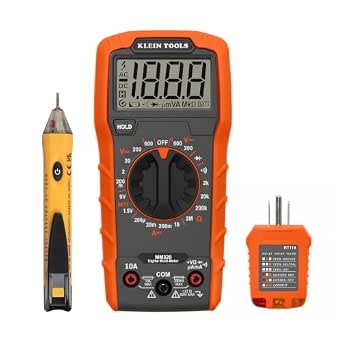 | Best for Outlet Troubleshooting | Kit contents: Digital multimeter, non-contact voltage tester, and receptacle tester | Multimeter functions: Voltage, current, and resistance | Power: Battery powered; batteries included | VIEW ON AMAZON | See Our Full Breakdown |
| Klein Tools MM325 Multimeter, Digital Manual-Ranging 600V AC/DC Voltage Tester |  | Best for Hands-On Manual Control | AC/DC voltage: Up to 600V | DC current: Up to 10A | Resistance: Up to 2MΩ | VIEW ON AMAZON | See Our Full Breakdown |
| AstroAI Digital Clamp Meter Multimeter 4000 Counts Auto-ranging Amp Tester |  | Best Entry Clamp Meter for Low-Voltage Troubleshooting | Measurement range: 4000 counts | Maximum operating voltage: 600 volts | Measurement functions: AC/DC current, voltage, resistance, capacitance, frequency, and more | VIEW ON AMAZON | See Our Full Breakdown |
| 2026 Upgraded FS899L Digital Multimeter, 6000 Counts True RMS Auto-Ranging AC/DC Voltage Tester, NCV Capacitance Meter, USB-C Rechargeable Color Screen with 2 Alligator Clips |  | Best Display and Hands-Free Setup | Measurement resolution: 6000 counts | Display: 4.8-inch high-definition color screen | Measurement types: AC/DC voltage, current, resistance, capacitance, continuity, frequency, NCV | VIEW ON AMAZON | See Our Full Breakdown |
| AstroAI Inrush Digital Clamp Meter Multimeter 1000A TRMS 6000 Counts, Amp Voltage Tester with VFD, LoZ Mode |  | Best for Advanced Motor and Drive Diagnostics | Maximum AC/DC current: 1000 A | Maximum voltage: 1000 V DC / 750 V AC | Display count: 6000 | VIEW ON AMAZON | See Our Full Breakdown |
| AstroAI Digital Multimeter, True RMS 6000 Counts Auto-Ranging Volt Meter for Automotive & Home Electrical Troubleshooting |  | Best Probe-Style All-Rounder | Maximum operating voltage: 1000 volts | Display count: 6000 counts | Measurement functions: AC/DC voltage, current, resistance, capacitance, frequency, duty cycle, diode, continuity, temperature | VIEW ON AMAZON | See Our Full Breakdown |
| AstroAI Digital Clamp Meter Multimeter 2000 Counts Amp Voltage Tester Auto-ranging with AC/DC Voltage, AC Current, Resistance, Capacitance, Continuity, Live Wire Test, NCV, Blue |  | Best Simple Clamp Meter for AC Checks | Maximum display count: 2000 | Minimum operating voltage: 2 volts | Measurement functions: AC current, AC/DC voltage, resistance, capacitance, continuity | VIEW ON AMAZON | See Our Full Breakdown |
| multimeters for low voltage work | Display | Power source | Weight |
|---|---|---|---|
| TM-510 Digital Multimeter | Backlit display | Battery powered | — |
| KAIWEETS Electrical Test Kit K | — | Battery powered | — |
| Digital Multimeter Volt-Ohm-Am | Backlit LCD | 9V battery | 166 g |
| AstroAI Digital Multimeter Tes | Backlit LCD | Battery powered | 0.15 kg |
| AstroAI Digital Multimeter Tes | — | — | 0.15 kg |
| KAIWEETS Digital Multimeter wi | Backlit LCD | — | 8.05 ounces |
| ANENG Digital Multimeter with | Digital LCD | — | — |
| FNIRSI DMT-99 Digital Multimet | 2.4-inch HD TFT color screen | — | — |
| Klein Tools 69149P Electrical | — | — | 15.04 ounces |
| Klein Tools MM325 Multimeter | Backlit LCD | — | 13.92 ounces |
| AstroAI Digital Clamp Meter Mu | — | Battery powered | — |
| 2026 Upgraded FS899L Digital M | 4.8-inch high-definition color screen | USB-C rechargeable battery | — |
| AstroAI Inrush Digital Clamp M | — | — | — |
| AstroAI Digital Multimeter | — | 9V battery | 492 g |
| AstroAI Digital Clamp Meter Mu | — | Battery powered | 415 g |
More Details on Our Top Picks
TM-510 Digital Multimeter, 4000 Counts, Auto-Ranging, Non-Contact Voltage Test, Green
The TESMEN TM-510 is the most straightforward fit here for frequent low-voltage checks: its stated minimum operating voltage is 0.8 volts, and auto-ranging reduces the setup steps when moving between household, hobby, and basic automotive measurements. The non-contact voltage test adds a quick way to check for nearby live AC before placing the probes, while the backlight and data hold help when a display is awkward to read. Compared with the manual setup required by the basic AstroAI AM33B, this model favors speed and ease of use. Its tradeoff is a narrower feature set than a full troubleshooting kit such as the KAIWEETS KIT01, which also includes an outlet tester and separate voltage detector. Choose the TM-510 for routine checks, not demanding professional diagnostics.
Pros:- Auto-ranging simplifies switching between common measurements.
- 0.8-volt stated minimum supports low-voltage checks.
- Non-contact voltage testing provides a quick preliminary live-wire check.
- Backlight, data hold, and included storage bag support practical everyday use.
Cons:- Its listed functions are basic compared with the KAIWEETS KIT01 kit.
- Battery-powered operation requires replacement batteries.
- The stated maximum operating voltage is 600 volts.
Best for: Homeowners, DIYers, and car owners who want auto-ranging for routine low-voltage voltage, resistance, and continuity checks.
Not ideal for: Electricians needing a broad diagnostic kit, or users whose work requires measurements above the stated 600-volt maximum.
- Measurement type:Multimeter, voltmeter
- Minimum operating voltage:0.8 volts
- Maximum operating voltage:600 volts
- Display:Backlit display
- Range selection:Auto-ranging
- Additional test:Non-contact voltage test
- Power source:Battery powered
- Included:Test leads, batteries, storage bag, user manual
Our verdict“Choose the TM-510 for convenient, routine low-voltage checks when auto-ranging matters more than expanded diagnostic tools.”
KAIWEETS Electrical Test Kit KIT01 – Digital Multimeter, Non‑Contact Voltage Tester & GFCI Outlet Tester with LCD and Carrying Case
The KAIWEETS KIT01 earns its place through breadth rather than low-voltage specialization: alongside the multimeter, it supplies a non-contact voltage tester and GFCI outlet tester. That combination helps a homeowner move from checking a circuit to testing an outlet without assembling separate tools. Backlit displays, data hold, and the voltage pen’s flashlight are useful in dim utility spaces, while the stated CAT IV 600V rating addresses a different concern from low-voltage resolution: the rated safety category of the equipment. Compared with the lighter, simpler TESMEN TM-510, this is a more complete home-testing package, but its listed minimum operating voltage is 12 volts, so it is less suited to very low-voltage circuits. It also takes six AAA batteries, and its 10-amp current limit rules it out for higher-current work.
Pros:- Combines a multimeter, non-contact voltage tester, and GFCI outlet tester.
- Backlit displays and a voltage-pen flashlight help in dim work areas.
- Includes a carrying case, test leads, and six AAA batteries.
- Stated CAT IV 600V safety rating.
Cons:- The stated 12-volt minimum makes it a poor fit for lower-voltage electronics work.
- The 10-amp current limit restricts higher-current applications.
- Six AAA batteries create more battery dependence than the simpler TM-510.
Best for: Homeowners who want one organized kit for basic multimeter checks, preliminary voltage detection, and GFCI outlet testing.
Not ideal for: Electronics hobbyists working below 12 volts, or users who need to measure current above the stated 10-amp limit.
- Model:KIT01
- Minimum operating voltage:12 volts
- Current limit:10 A
- Included tools:Digital multimeter, non-contact voltage tester, GFCI outlet tester
- Display features:Backlit LCD and data hold
- Power source:Battery powered
- Included accessories:Two test leads, six AAA batteries, carrying case
Our verdict“Pick the KIT01 for broad household electrical checks and outlet testing, but choose the TM-510 for circuits below 12 volts.”
Digital Multimeter Volt-Ohm-Amp Tester with Backlit LCD Display
This volt-ohm-amp multimeter suits buyers who want the basic measurement mix—AC/DC voltage, current, resistance, continuity, and diode checks—without paying for a bundle of extra testers. Its protective rubber shell is a practical advantage around a workbench or vehicle, where a meter may get bumped, and the backlit LCD aids readings in poorly lit spaces. Unlike the TESMEN TM-510, the supplied details do not list auto-ranging or non-contact voltage detection, so expect less convenience when changing tasks and plan to use the probes for measurements. Its 2000-count display also gives it a simpler presentation than the TM-510’s stated 4000 counts. The included 9V battery gets it ready to use, but replacements will be part of ownership; this is a basic troubleshooting tool, not a feature-rich choice for advanced diagnostics.
Pros:- Measures AC/DC voltage, current, resistance, continuity, and diodes.
- Rubber shell adds protection against everyday bumps.
- Backlit LCD supports readings in dim work areas.
- Includes test leads, manual, and a 9V battery.
Cons:- No auto-ranging or non-contact voltage test is listed, unlike the TESMEN TM-510.
- The 2000-count display is less detailed than the TM-510’s stated 4000 counts.
- Requires periodic 9V battery replacement.
Best for: DIY mechanics and household troubleshooters who need common voltage, current, resistance, continuity, and diode checks in a rubber-protected meter.
Not ideal for: Users who want auto-ranging, non-contact voltage testing, or a stated low-voltage threshold before buying.
- Measurement functions:AC/DC voltage, current, resistance, continuity, diode test
- Display count:2000 counts
- Display:Backlit LCD
- Protection:Overload protection and rubber shell
- Power source:9V battery
- Weight:166 g
- Dimensions:5.51 x 2.56 x 1.18 inches
- Included:Multimeter, test leads, user manual, 9V battery
Our verdict“Choose this meter for straightforward automotive or household troubleshooting when a protective shell matters more than auto-ranging convenience.”
AstroAI Digital Multimeter Tester 2000 Counts with DC AC Voltmeter and Ohm Volt Amp Meter
The AstroAI AM33B is a compact, basic option for household and automotive checks where the buyer is comfortable selecting the measurement setting before probing. Its stated functions include AC/DC voltage, current, resistance, and diode testing, with a backlit display and data hold for readings taken in cramped or dim locations. Double fuse protection and a low-battery indicator add useful safeguards and maintenance cues. Compared with the TESMEN TM-510, the AM33B gives up auto-ranging and non-contact voltage testing, so it asks more of the user at setup; in return, it stays focused on common measurements rather than adding kit components. The supplied description says it cannot test AC current, which limits its usefulness when diagnosing AC loads. I would choose it for basic tasks, not as a do-everything low-voltage meter.
Pros:- Measures AC/DC voltage, resistance, and diodes.
- Backlit display and data hold help when readings are hard to view.
- Double fuse protection and low-battery indicator are practical safety and upkeep features.
- Compact body weighs 0.15 kg.
Cons:- Cannot test AC current according to the supplied product details.
- Manual setting selection is less convenient than the auto-ranging TESMEN TM-510.
- Limited to basic electrical measurements and lacks listed non-contact voltage testing.
Best for: DIYers who mainly check household devices and automotive components and are comfortable setting the dial correctly for each measurement.
Not ideal for: Users who need AC current measurement, auto-ranging, or non-contact voltage detection.
- Model:AM33B
- Measurement functions:AC/DC voltage, current, resistance, diode test
- Display:Backlit LCD
- Display count:2000 counts
- Safety features:Double fuse protection and low-battery indicator
- Power source:Battery powered
- Weight:0.15 kg
- Dimensions:3.03 x 5.26 x 1.46 inches
Our verdict“Pick the AM33B for basic household and automotive checks if you do not need AC current or auto-ranging.”
AstroAI Digital Multimeter Tester 2000 Counts with DC AC Voltmeter and Ohm Volt Amp Meter, Blue
This blue AstroAI 2000-count meter makes sense for simple household and automotive troubleshooting where continuity and diode checks matter as much as voltage readings. A continuity buzzer can make tracing a connection easier than repeatedly watching the display, while the backlight and data hold support work in awkward spaces. Its stated minimum operating voltage is 2 volts, so buyers checking smaller low-voltage circuits should compare it with the TESMEN TM-510, whose listed minimum is 0.8 volts. The AstroAI also has a stated 500-volt maximum and the product details flag limitations with AC-current testing and AC voltage below 100mV. That makes it a focused basic meter rather than a flexible instrument for delicate signal work. A protective silicone cover and double fuse protection are useful, but careful setting selection remains part of using it correctly.
Pros:- Continuity buzzer helps identify connected paths without relying only on the display.
- Measures voltage, current, resistance, and diode functions.
- Backlit LCD and data hold support readings in dim or awkward locations.
- Includes double fuse protection and a protective silicone cover.
Cons:- Its stated 2-volt minimum is less suited to lower-voltage work than the TESMEN TM-510’s 0.8-volt minimum.
- Product details note limits on AC-current testing and AC voltage below 100mV.
- Requires correct function and range selection to avoid incorrect readings.
Best for: Home DIYers and vehicle owners who want a basic meter with a continuity buzzer for wiring and component checks.
Not ideal for: Electronics hobbyists measuring below 2 volts or very small AC signals, and users needing unrestricted AC-current testing.
- Measurement type:Multimeter
- Minimum operating voltage:2 volts
- Maximum operating voltage:500 volts
- Display count:2000 counts
- Measurement functions:Voltage, current, resistance, diode test, continuity
- Display features:Backlit LCD and data hold
- Safety features:Double fuse protection and silicone cover
- Weight:0.15 kg
Our verdict“Choose this AstroAI for basic continuity and component checks, but use the TESMEN TM-510 when working below 2 volts.”
KAIWEETS Digital Multimeter with Case for Car Battery Testing and DIY Use
For low-voltage work centered on battery voltage, continuity, resistance, and diode checks, this KAIWEETS keeps the toolkit straightforward: it includes leads, batteries, and a carrying case, and its backlit display is useful under a dashboard or in a dim garage. Double fuses and overload protection add a safety layer, but they do not replace selecting the correct function and input before connecting the probes. Unlike the ANENG, this model cannot measure AC current, and its supplied information does not specify a low-voltage resolution or auto-ranging. That makes it a narrower choice for simple diagnostics rather than a flexible electronics bench meter. I’d choose the ANENG for broader current and capacitance work; this KAIWEETS makes more sense when the priority is a basic, ready-to-carry meter for automotive and household checks.
Pros:- Includes a carrying case, cables, and batteries
- Backlit LCD helps with checks in dim spaces
- Double fuses and overload protection add safeguards
- Covers voltage, resistance, continuity, and diode testing
Cons:- Cannot measure AC current
- Correct rotary-switch selection is required for accurate measurements
- Provided specifications do not clarify auto-ranging or low-voltage resolution
Best for: DIY car owners who mainly check battery voltage, continuity, resistance, and diodes and want a meter with its own case and leads.
Not ideal for: Electronics hobbyists who need AC-current or capacitance measurements, or buyers who want auto-ranging and clearly specified low-voltage resolution.
- Measurement types:AC/DC voltage, resistance, continuity, and diode testing
- Fuses:Double fuses
- Display:Backlit LCD
- Power:Battery powered; batteries included
- Dimensions:5.04 x 2.64 x 1.42 inches
- Weight:8.05 ounces
Our verdict“Choose this KAIWEETS for basic automotive and household checks, but pick the ANENG if you need current and capacitance measurements too.”
ANENG Digital Multimeter with Case, DC/AC Voltmeter, Ohm Volt Amp Meter
The ANENG earns its place by covering more low-voltage troubleshooting tasks than the basic KAIWEETS: its listed functions include AC/DC voltage and current, resistance, and capacitance. A stated DC voltage range starting at 200mV gives hobbyists and students a useful entry point for small circuits, while the protective case and insulated probes make it easier to keep the kit together. Compared with the FNIRSI DMT-99, it lacks the high-count color display, True RMS, and waveform monitoring, so it is the more conventional choice rather than a feature-rich diagnostic instrument. The tradeoff is that its breadth may feel like extra complexity for someone checking only batteries, and users need to install the two AA batteries correctly. Its listed ranges also set clear limits; this is not the pick for high-voltage work.
Pros:- Measures AC/DC voltage and current, resistance, and capacitance
- DC voltage range begins at 200mV
- Includes a protective case and insulated probes
- Overload protection and double fuses are listed
Cons:- Two AA batteries must be installed correctly for operation
- Multiple functions may be more involved than needed for basic checks
- Measurement ranges are limited to the listed specifications
Best for: Students and electronics hobbyists who want one carried meter for small-circuit voltage, current, resistance, and capacitance checks.
Not ideal for: Buyers who only need simple battery and continuity checks, or technicians seeking advanced display tools, waveform monitoring, or a meter specified for high-voltage applications.
- DC voltage range:200mV–600V
- AC voltage range:200mV–600V
- Current range:2mA–10A AC/DC
- Resistance range:0Ω–200MΩ
- Capacitance range:0nF–2mF
- Display:Digital LCD
- Power:Two AA batteries
- Safety features:Overload protection, double fuses, and insulated probes
Our verdict“Pick the ANENG for broad everyday electronics measurements at low voltages, and choose the FNIRSI if you want True RMS and waveform features.”
FNIRSI DMT-99 Digital Multimeter 9999 Counts TRMS, Rechargeable Volt Meter
The FNIRSI DMT-99 is the most display- and analysis-focused option in this group. Its 9999-count screen and True RMS are useful when a low-voltage reading needs more detail or an AC measurement is not a simple waveform; auto-identification can also reduce repeated dial changes. A rechargeable battery and color display make it feel more like a compact diagnostic instrument than the simpler ANENG, while waveform monitoring, alarms, and NCV detection broaden its role beyond basic meter checks. That sophistication comes with a learning curve, and the supplied data does not state specific voltage ranges, so I would verify those against the job before buying. At 6.72 ounces it is lighter than the Klein MM325, but its compact body may take more deliberate handling.
Pros:- 9999-count resolution with True RMS measurement
- Auto-ranging and auto-identification simplify repeated checks
- Rechargeable 1500mAh lithium battery with Type-C charging
- Color display adds waveform monitoring, alarms, and NCV detection
Cons:- More functions may take time to learn
- Provided product data does not specify voltage measurement ranges
- Compact dimensions may require careful handling
Best for: Electronics repairers and automotive diagnosticians who want detailed readings, True RMS, and on-screen monitoring in a rechargeable meter.
Not ideal for: Beginners seeking only simple voltage and continuity checks, or buyers who need clearly stated measurement ranges before choosing a meter for a specific circuit.
- Display count:9999 counts
- AC measurement:True RMS
- Auto-ranging:Yes
- Display:2.4-inch HD TFT color screen
- Power:Rechargeable 1500mAh lithium battery
- Additional functions:Graphic waveform, monitoring alarms, and NCV detection
- Protection:Dual ceramic fuses and protection circuitry
- Dimensions and weight:6.01 x 3.15 x 1.52 inches; 6.72 ounces
Our verdict“Choose the FNIRSI for feature-rich low-voltage diagnostics and detailed display feedback, rather than the simpler ANENG’s more basic measurement approach.”
Klein Tools 69149P Electrical Test Kit, 3 Piece
This Klein kit is the lineup’s task-specific choice: instead of concentrating every function in one meter, it pairs a digital multimeter with a non-contact voltage tester and receptacle tester. That division helps when low-voltage checks sit alongside household troubleshooting, since the receptacle tester can flag wiring faults and the non-contact tool offers a quick voltage check before using the meter. Compared with the Klein MM325, the 69149P gives up the appeal of a single standalone meter in exchange for three tools aimed at different diagnostic steps. The product data identifies the multimeter’s voltage, current, and resistance functions, but does not provide detailed ranges or low-voltage resolution, so electronics bench users should check those specifications before relying on it for small circuits. It also requires batteries and may be more kit than a beginner needs.
Pros:- Combines a multimeter, non-contact voltage tester, and receptacle tester
- Receptacle tester helps identify wiring faults
- Non-contact tester supports quick voltage checks
- Includes leads and batteries
Cons:- More equipment to carry than a standalone meter such as the MM325
- Requires batteries for operation
- Provided data does not specify detailed measurement ranges or low-voltage resolution
Best for: Home troubleshooters and maintenance workers who check outlets and want separate tools for voltage detection, receptacle faults, and meter measurements.
Not ideal for: Electronics hobbyists needing detailed low-voltage range specifications, or buyers who want one compact meter without extra testers.
- Kit contents:Digital multimeter, non-contact voltage tester, and receptacle tester
- Multimeter functions:Voltage, current, and resistance
- Power:Battery powered; batteries included
- Compatible devices:Klein Tools MM320, NCVT1XT, and RT110
- Dimensions:3.5 x 0.9 x 6 inches
- Weight:15.04 ounces
- Included accessories:Leads and batteries
Our verdict“Choose the 69149P when outlet and wiring checks matter as much as meter readings, not when your priority is detailed electronics measurements.”
Klein Tools MM325 Multimeter, Digital Manual-Ranging 600V AC/DC Voltage Tester
The MM325 suits buyers who prefer a conventional meter with clearly listed core functions: it measures AC/DC voltage, DC current, and resistance, and adds battery, diode, and continuity tests. Its backlit LCD helps when working in low light, while lead-alert protection is a practical cue to check probe placement before taking a reading. Compared with the Klein 69149P kit, this is the more focused standalone instrument; the kit is the better fit when a non-contact tester and receptacle checker are part of the job. The MM325’s manual-ranging design offers direct range selection, but it takes more input than the FNIRSI’s auto-ranging approach and can slow quick checks. Its 9V battery requirement and 13.92-ounce weight also make it less convenient for frequent carry than lighter options.
Pros:- Measures AC/DC voltage up to 600V and DC current up to 10A
- Tests resistance, batteries, diodes, and continuity
- Backlit LCD supports work in low-light areas
- Lead-alert protection helps flag probe-placement issues
Cons:- Manual ranging takes more user input than the FNIRSI’s auto-ranging
- Requires a 9V battery
- Heavier than the FNIRSI at 13.92 ounces
Best for: Electricians and experienced DIYers who want a standalone meter with manual range selection for voltage, continuity, diode, and battery checks.
Not ideal for: Beginners who want auto-ranging, electronics users needing capacitance or AC-current measurements, or anyone prioritizing a lightweight meter for frequent carry.
- AC/DC voltage:Up to 600V
- DC current:Up to 10A
- Resistance:Up to 2MΩ
- Additional tests:Battery, diode, and continuity
- Range selection:Manual-ranging
- Display:Backlit LCD
- Power:9V battery
- Weight:13.92 ounces
Our verdict“Choose the MM325 for a substantial, manually ranged standalone meter, and pick the Klein 69149P if outlet-specific testers are more useful to your work.”
AstroAI Digital Clamp Meter Multimeter 4000 Counts Auto-ranging Amp Tester
For low-voltage work that includes checking current without disconnecting a conductor, this AstroAI’s clamp design is more useful than a standard probe-only meter. It measures AC and DC current along with voltage, resistance, capacitance, and frequency, while non-contact voltage detection adds a quick screening step before probing. The backlit display and flashlight also help when working inside dim enclosures. Compared with AstroAI’s 2000-count clamp meter, this model offers 4000-count resolution and DC current measurement, making it the more capable choice for mixed automotive and household diagnostics. The tradeoff is that the clamp reads current only, and its 600V limit makes it a more modestly rated option than the 1000V AstroAI AST-6000-D. Buyers also need to clamp around the correct conductor for a useful current reading.
Pros:- Measures AC and DC current without opening the circuit.
- Includes voltage, resistance, capacitance, and frequency measurements.
- NCV alerts, backlit LCD, and flashlight support checks in dark work areas.
- 4000-count display provides more resolution than the lineup’s 2000-count clamp option.
Cons:- Clamp jaw measures current only; voltage measurements still require test leads.
- Current readings depend on clamping around the correct conductor.
- 600V maximum operating voltage is below the 1000V rating of the AstroAI AST-6000-D.
Best for: DIYers and automotive hobbyists who want clamp-based AC/DC current readings alongside common low-voltage measurements.
Not ideal for: Technicians who need a higher voltage rating, advanced industrial functions, or a compact probe-only meter for frequent pocket carry.
- Measurement range:4000 counts
- Maximum operating voltage:600 volts
- Measurement functions:AC/DC current, voltage, resistance, capacitance, frequency, and more
- Voltage detection:Non-contact voltage testing
- Power source:Battery powered
- Dimensions:2.7 x 1.1 x 7.7 inches
- Included components:Clamp meter, test leads, user manual, storage bag
- Model:CM4K0R
Our verdict“Choose this clamp meter for varied low-voltage troubleshooting that benefits from DC current measurement, but skip it if you need a higher voltage rating.”
2026 Upgraded FS899L Digital Multimeter, 6000 Counts True RMS Auto-Ranging AC/DC Voltage Tester, NCV Capacitance Meter, USB-C Rechargeable Color Screen with 2 Alligator Clips
The FS899L is the display-focused choice here: its 4.8-inch color screen and built-in worklight make readings easier to see than on the smaller monochrome displays of the AstroAI clamp meters. For low-voltage diagnostics, the included alligator clips can hold a connection while you keep both hands available, a practical advantage when checking a battery or a crowded control circuit. Its 6000-count resolution, True RMS, and broad measurement list suit buyers who want more than basic voltage checks. The stated CAT III 1000V and CAT IV 600V ratings also exceed the 600V operating limit listed for the AstroAI 4000-count clamp meter. That capability comes with compromises: the large screen makes this a less portable option, and the interface may take time for beginners to learn. USB-C charging is convenient, but the cable is not included.
Pros:- Large 4.8-inch color display with a built-in worklight.
- Alligator clips support hands-free connections during bench and battery checks.
- 6000-count resolution and True RMS support detailed electrical diagnostics.
- USB-C rechargeable power avoids routine disposable-battery replacement.
Cons:- Large screen and body reduce portability compared with the AstroAI clamp meters.
- Interface may feel complex to new meter users.
- USB-C charging cable is not included.
Best for: Low-voltage technicians and serious DIYers who value a large readable display and hands-free testing with alligator clips.
Not ideal for: Beginners seeking simple controls or people who need a compact meter that can travel easily in a small tool pouch.
- Measurement resolution:6000 counts
- Display:4.8-inch high-definition color screen
- Measurement types:AC/DC voltage, current, resistance, capacitance, continuity, frequency, NCV
- Power source:USB-C rechargeable battery
- Included accessories:Two alligator clips and instruction manual
- Worklight:Built in
- Color:Black
Our verdict“Pick the FS899L if screen readability and hands-free low-voltage testing matter more than compact size and simple controls.”
AstroAI Inrush Digital Clamp Meter Multimeter 1000A TRMS 6000 Counts, Amp Voltage Tester with VFD, LoZ Mode
This is the specialist pick for low-voltage work around motors, drives, and equipment where startup current or electrical noise complicates a basic reading. Its AC inrush measurement can help identify startup behavior, while VFD and LoZ modes give experienced users extra ways to investigate drive outputs and misleading induced voltages. The 6000-count display, True RMS, and listed CAT IV 600V/CAT III 1000V ratings put it above the simpler AstroAI 4000-count clamp meter for demanding diagnostics. It also measures temperature and a wide range of common electrical quantities. The main limitation for low-voltage buyers is complexity: many household and automotive checks do not need these modes. Inrush measurement is AC only, so it does not replace a meter that can capture DC startup current; beginners may find its feature set harder to operate confidently.
Pros:- AC inrush measurement helps assess motor and equipment startup current.
- VFD and LoZ modes add diagnostic options for drive circuits and misleading voltage readings.
- 6000 counts and True RMS support more detailed readings than the AstroAI 4000-count clamp meter.
- Measures temperature and multiple electrical quantities in addition to current and voltage.
Cons:- Inrush measurement supports AC current only, not DC current.
- The extensive functions can complicate setup and use for beginners.
- Advanced diagnostic modes may be unnecessary for routine low-voltage household work.
Best for: Experienced maintenance workers and technically confident DIYers diagnosing AC motors, variable-frequency drives, and equipment startup current.
Not ideal for: Beginners or buyers focused on simple battery, automotive, and household checks who would not use VFD, LoZ, or inrush functions.
- Maximum AC/DC current:1000 A
- Maximum voltage:1000 V DC / 750 V AC
- Display count:6000
- Measurement functions:Current, voltage, temperature, resistance, capacitance, frequency, duty cycle, diode, continuity, NCV
- Inrush measurement:Yes, AC only
- Additional modes:VFD and LoZ
- Standard:IEC 61010-1
Our verdict“Choose this model for specialized AC motor and drive troubleshooting, not for straightforward low-voltage checks.”
AstroAI Digital Multimeter, True RMS 6000 Counts Auto-Ranging Volt Meter for Automotive & Home Electrical Troubleshooting
For buyers who mainly probe low-voltage circuits rather than measure current around a wire, the AST-6000-D offers a useful middle ground: True RMS and auto-ranging simplify readings across changing signals, and its 6000-count display gives more resolution than the AstroAI 2000-count clamp meter. It covers familiar jobs such as checking voltage, resistance, continuity, capacitance, and temperature, with a large backlit LCD for dim garages or utility areas. Ceramic fuses add a layer of overload protection, and the 1000V maximum rating is higher than the 600V limit on the AstroAI 4000-count clamp meter. The tradeoff is that this is a lead-based meter, not a clamp: current checks require the appropriate circuit connection. At 492 g and nearly 7.5 inches long, it is also less nimble in tight spaces than the clamp-shaped alternatives.
Pros:- True RMS and auto-ranging simplify readings across varied signals.
- 6000-count display offers more resolution than the AstroAI 2000-count clamp meter.
- Ceramic fuses provide overload protection.
- Measures temperature alongside voltage, current, resistance, capacitance, and continuity.
Cons:- Probe-based current measurement is less convenient than the clamp method on the AstroAI CM4K0R.
- 492 g weight and elongated body can be cumbersome in tight spaces.
- Runs on a 9V battery that will need replacement.
Best for: Automotive DIYers and home troubleshooters who want a versatile True RMS meter for probe-based circuit checks.
Not ideal for: Users who need to measure current without opening a circuit or want a lightweight tool for cramped access.
- Maximum operating voltage:1000 volts
- Display count:6000 counts
- Measurement functions:AC/DC voltage, current, resistance, capacitance, frequency, duty cycle, diode, continuity, temperature
- Measurement features:True RMS and auto-ranging
- Power source:9V battery
- Weight:492 g
- Dimensions:7.48 x 3.54 x 1.38 inches
- Included components:Multimeter, 9V battery, test leads, multi-function socket, user manual
Our verdict“Choose the AST-6000-D for broad probe-based automotive and home measurements, but pick a clamp meter if current checks without circuit interruption are a priority.”
AstroAI Digital Clamp Meter Multimeter 2000 Counts Amp Voltage Tester Auto-ranging with AC/DC Voltage, AC Current, Resistance, Capacitance, Continuity, Live Wire Test, NCV, Blue
This AstroAI is the straightforward clamp option for buyers who want to check AC current without breaking a circuit and keep common voltage and continuity tests in the same tool. NCV and live-wire testing provide quick ways to screen a conductor, while data hold and the backlit display help when a reading is difficult to watch in place. Compared with the AstroAI 4000-count clamp meter, this model is simpler and has a 2000-count display, but it also gives up DC current measurement. That distinction matters for automotive and battery-focused work: voltage checks are supported, yet current through the clamp is AC only. Its 600V CAT III rating fits many household tasks, though buyers needing broader measurements or higher resolution should look to the 4000-count clamp meter or the 6000-count AstroAI AST-6000-D.
Pros:- Measures AC current by clamp without disconnecting the conductor.
- Includes AC/DC voltage, resistance, capacitance, and continuity testing.
- NCV and live-wire testing support quick conductor checks.
- Backlit LCD, data hold, and auto shut-off add practical convenience.
Cons:- Clamp measures AC current only; it cannot measure DC current.
- 2000-count display has lower resolution than the AstroAI 4000-count clamp meter.
- 600V CAT III rating is more limited than the ratings listed for the advanced AstroAI inrush clamp meter.
Best for: Home DIYers who need basic AC current checks, voltage testing, and continuity in a clamp-style tool.
Not ideal for: Automotive and battery troubleshooters who need DC current measurement, or technicians seeking higher display resolution and more advanced functions.
- Maximum display count:2000
- Minimum operating voltage:2 volts
- Measurement functions:AC current, AC/DC voltage, resistance, capacitance, continuity
- Voltage detection:NCV and live-wire test
- Power source:Battery powered
- Weight:415 g
- Dimensions:2.68 x 1.14 x 7.67 inches
- Included components:Clamp meter, test leads, user manual, storage bag
Our verdict“Pick this model for basic household AC current and voltage checks, but choose the 4000-count AstroAI clamp meter for DC current and higher resolution.”

How We Picked
I ranked these options for low-voltage troubleshooting by weighing measurement modes and usability against the kinds of work buyers are likely to do: checking batteries, automotive circuits, electronics, and household control wiring. I gave weight to auto-ranging for quick everyday checks, True RMS and higher display counts for buyers who may encounter less predictable signals, and useful extras such as continuity, capacitance, NCV, or included test tools. I also treated clamp meters and bundled kits as distinct tool types rather than assuming they are direct substitutes for a standard probe meter.
The order favors versatility and fit for low-voltage tasks, not the largest feature list. A basic meter can rank well for simple battery and continuity checks if its limited measurement approach matches the job; a more capable meter earns its place when added functions solve a real measurement need. I distinguish closely related listings cautiously: color variants and similar model names do not, by themselves, establish a meaningful performance difference. Buyers should verify the exact model’s manual, measurement limits, included leads, and safety ratings before using it on any circuit.
Factors to Consider When Choosing Multimeters For Low Voltage Work
Before choosing among these meters, match the instrument to the circuit and the measurement you actually need. Low voltage is not one uniform task: a battery check, an automotive sensor reading, and a switching power supply can call for different capabilities. These broader checks can help you avoid paying for functions you will not use—or choosing a meter that cannot make the measurement you need.
Match the Meter to the Signal, Not Just the Voltage
Start by identifying whether you will measure steady DC, AC, or a signal that may vary or distort. Battery and many automotive checks are primarily DC tasks, while other equipment can present AC waveforms that a basic meter may not represent as accurately. True RMS can be useful when measuring non-sinusoidal AC, but it does not automatically make a meter better for every low-voltage job. Check the meter’s stated range and accuracy for the specific measurement you plan to take. A frequent mistake is treating a high count display as proof of high accuracy; resolution and accuracy are different specifications. If your work is mostly simple battery checks and continuity, a straightforward meter may be easier to use and more suitable than a feature-heavy model.
Choose Auto-Ranging or Manual-Ranging Deliberately
Auto-ranging selects a measurement range for you, which can speed up checks when you do not know the expected value. Manual-ranging meters ask you to select a range, but that can make the measurement process more explicit and may suit repeatable work where you know what to expect. Beginners often focus on the display and overlook how range selection affects day-to-day use. If you move among small electronics, vehicle circuits, and batteries, auto-ranging can reduce setup friction. If you value direct control, manual-ranging may feel more predictable after you learn the controls. Whichever style you choose, read the dial markings before connecting probes so the meter is set to the correct measurement type.
Treat Clamp Meters as a Specialized Alternative
A clamp meter measures current around a conductor, which can be useful when breaking a circuit to insert probes is inconvenient. That convenience does not make it a full replacement for a probe-based multimeter: voltage, resistance, and continuity checks still rely on the leads and the meter’s supported modes. Many clamp designs are most useful when a conductor fits within the jaw and the current is within the specified range. For low-current electronics, check whether the clamp offers the resolution and sensitivity your work needs rather than assuming its maximum amp rating tells the whole story. Avoid clamping around multiple conductors carrying opposing current, since their fields can cancel and produce a misleading reading. Choose a clamp model for the current-measurement task, not merely because it looks more versatile.
Check Safety Ratings and Probe Quality Before Use
“Low voltage” does not guarantee a low-risk setup: a battery can deliver high fault current, and a circuit may be connected to mains equipment. Check the meter’s safety category and voltage limits against the environment, then confirm that the probes and accessories carry suitable ratings too. Probe insulation, exposed tip length, and secure lead sockets affect both handling and safe access to tight connections. Do not infer protection from a product name, screen, or feature count; consult the manufacturer’s documentation for the exact model. Replace damaged leads and avoid using a meter with cracked insulation or loose connections. If your work crosses into mains circuits, choose equipment explicitly rated for that work and follow appropriate safety procedures.
Decide Which Extras Will Earn Their Place
Continuity, capacitance, temperature, NCV, and outlet testing can expand a meter’s usefulness, but each feature should answer a task you perform. Continuity is handy for finding open connections; capacitance can help check certain components; NCV can provide a quick screening indication, but it cannot confirm that a conductor is de-energized. A kit may save the trouble of sourcing separate tools, yet bundled accessories only help if they fit your electrical system and are suitable for your work. Rechargeability and a color display can improve convenience, while also adding charging or durability questions that a simple meter avoids. Before paying for extras, list your regular checks and confirm each required mode is specified in the manual.
Think About Readability, Leads, and Long-Term Ownership
A meter that is hard to read or awkward to hold can slow routine troubleshooting more than a missing advanced mode. Consider screen visibility in your usual lighting, button and dial clarity, lead storage, and whether the case protects the instrument between jobs. Check whether replacement leads, fuses, and batteries are available for the exact model; maintenance details matter when the meter is used regularly. Rechargeable designs reduce disposable battery changes, but buyers should consider charging access and how the meter behaves when its battery is low. Included clips can help with hands-free checks, although they do not replace correctly rated probes. Prioritizing these practical details can make a modest meter a better daily tool than a more elaborate one that is inconvenient to keep ready.
Frequently Asked Questions
Is a 2000-count multimeter enough for battery and automotive checks?
For common battery voltage, continuity, and basic automotive checks, a 2000-count meter may be sufficient if its measurement range and accuracy fit the task. Higher counts can show finer changes on the display, but they do not guarantee better accuracy or better results on every circuit. Check whether the meter supports the DC voltage range and other modes you need, such as resistance or continuity. For diagnosing sensors or changing signals, also check the meter’s specifications and behavior for those measurements. Choose by the required measurement and manual, not by display count alone.
When should I choose a True RMS meter for low-voltage work?
True RMS matters most when you need accurate AC measurements on waveforms that are not clean sine waves, which can occur with some electronic equipment and variable-speed devices. For steady DC battery checks, that feature usually does not decide the result. A True RMS label also does not replace checking the specified accuracy, frequency range, and measurement limits. The FNIRSI DMT-99 and several AstroAI options in this lineup include True RMS, while simpler models may better suit basic checks. If your work is mostly DC, spend more attention on usability and the DC specifications than on True RMS alone.
Can a clamp meter replace a regular multimeter for electronics?
Usually not as a complete substitute. A clamp meter can measure current without opening the circuit, but its clamp may not resolve the small currents common in electronics work. You will still need probe functions for voltage, resistance, and continuity, and the clamp’s supported current modes may be limited to particular types of current. The AstroAI clamp models in this roundup make more sense when current measurement is a regular task, not simply as a general-purpose upgrade. For electronics, verify the low-current resolution and probe specifications before choosing one.
Is non-contact voltage detection enough to confirm a wire is safe?
No. NCV is a screening feature that can alert you to a nearby electric field, but it may miss voltage or give an indication affected by the wire position, insulation, or surrounding conductors. It does not replace a properly rated meter and a direct measurement performed with suitable probes. Follow the instrument manual and established safety procedures for checking whether a circuit is energized. A bundled NCV tester, such as the one included with the KAIWEETS KIT01, adds convenience but should not be treated as proof of a de-energized conductor. If you are unsure about a circuit’s source or rating, do not rely on an NCV result alone.
Should I buy a bundled test kit or a standalone meter?
A kit can make sense when its additional tools match checks you already perform, such as outlet testing or quick non-contact screening. It can also reduce the need to select accessories separately, but the bundled items may be unnecessary for electronics or vehicle-only work. A standalone meter may offer a better fit if you want a particular measurement capability, simpler storage, or accessories chosen for your own tasks. Compare the exact included tools and their ratings rather than assuming a larger bundle is more capable. For the KAIWEETS KIT01, the value of the bundle depends on whether you will use both the GFCI outlet tester and the NCV tester.
Conclusion
For a single meter to cover varied low-voltage checks, I’d choose the FNIRSI DMT-99 as best overall for its 9999-count True RMS approach. The AstroAI 2000-count meters are the best value direction for buyers with straightforward battery, voltage, and continuity needs, while the 2026 Upgraded FS899L is the best premium-style pick for shoppers drawn to a rechargeable color-screen format and added functions. For beginners who want a more guided tool set, the KAIWEETS KIT01 is the easiest entry point among these options, provided its outlet-testing extras suit their work. Choose an AstroAI clamp meter for current checks where a clamp is useful, and pick the Klein MM325 if you prefer manual range control. Before buying, confirm the exact model’s measurement specifications, included leads, and safety ratings match your circuits.
Halloween Picks
halloween
As an affiliate, we earn on qualifying purchases.