
This checklist is for home lab builders upgrading network links, wireless access, storage, and power protection. It can help you organize equipment choices around the parts of an infrastructure setup you want to improve.

Get business pricing on networking and server gear
- Business-only prices and quantity discounts
- Tax-exempt purchasing
- Multiple users, one account, clear invoices
The sections move from network connectivity to storage and power, then cable verification. The fiber transceiver section is advice only because no product pick was provided for that slot.
Use each section to check your existing equipment, the connections you need, and the space available for installation. Confirm requirements against the devices and documentation in your setup before choosing a product.
Multi-Gigabit Switch
A switch is a central connection point for wired devices in a home lab. The listed pick is the ASUS QG-U1080 5-Port 2.5G and 2-Port 10G SFP+ Unmanaged Switch. Its name identifies 2.5G ports and 10G SFP+ ports, so first map which devices and uplinks you intend to connect and what interfaces they use.
A common buying mistake is counting only the devices you have today. List current connections, likely additions, and the port types each one needs; then check that the available ports align with that plan. Also verify link capabilities across the entire path: a switch port alone does not establish that a connected device or cable supports the same connection.
Before selecting an unmanaged switch, consider whether its operating model fits your network. Check the product documentation for management capabilities and installation requirements, and confirm that the switch can sit where your cabling and power are accessible. Avoid assuming that a port label guarantees a particular result with equipment whose specifications you have not checked.
What to look for:
- Count connected devices and allow room for planned additions.
- Match device interfaces to the switch’s listed port types.
- Check the specifications of connected devices and cabling.
- Confirm an unmanaged switch suits your network needs.
- Review placement, power, and ventilation requirements.
ASUS QG-U1080 5-Port 2.5G and 2-Port 10G SFP+ Unmanaged Switch

The ASUS QG-U1080 is an unmanaged network switch featuring 2.5G ports and 10G SFP+ ports, ideal for high-performance home or office networks. It supports intelligent functions like priority and port isolation, with plug-and-play setup for easy installation and versatile device connectivity.
Pros:
- Supports high-speed 2.5G and 10G connections for fast data transfer
- Plug-and-play setup simplifies installation
- Supports multiple intelligent network functions
Cons:
- Limited to unmanaged switch features, no advanced configuration options
- No included power supply details
- Design may be basic for some users
Best for: Home labs that need the listed 2.5G and 10G SFP+ port types.
Not ideal for: Setups that require managed-switch features or different port types.
Bottom line: Map every connection and confirm its interface before choosing this switch.
Wi-Fi 7 Access Point
Wireless access is an important part of a home lab when devices need network access without a wired connection. The listed pick is the U7 Outdoor Dual Band Wi-Fi 7 Access Point. Its name specifies an outdoor access point with dual-band Wi-Fi 7, so compare those characteristics with where you plan to install it and the devices that will connect.
A common mistake is treating a newer wireless standard as a guarantee that every client will use it. Check the wireless capabilities of your client devices and consult the access point documentation for supported operation. Consider the coverage area and placement you need, but do not assume a product name alone establishes coverage for a particular building or outdoor space.
Before buying, check how the unit is powered, mounted, configured, and connected to the rest of your network. Confirm that the installation location is appropriate for the device and that the required network connection can reach it. If you are replacing an existing access point, compare its setup and compatibility requirements with your current network so the change fits your equipment and layout.
What to look for:
- Confirm client devices support the wireless features you expect to use.
- Check coverage needs and planned placement.
- Review mounting and power requirements in the documentation.
- Verify the access point can connect to your existing network.
- Confirm outdoor installation requirements for the intended location.
U7 Outdoor Dual Band Wi-Fi 7 Access Point

This outdoor Wi-Fi 7 access point offers weatherproofing with IPX6 rating and can withstand high winds. It features intuitive configuration, device control, remote firmware updates, and network management from a single interface, backed by a 1-year warranty.
Pros:
- Weatherproof and wind-resistant design
- Easy configuration and network management
- Remote firmware updates and device control
Cons:
- Limited details on performance specifications
- Requires technical knowledge for setup
- No price information available
Best for: Setups seeking an outdoor, dual-band Wi-Fi 7 access point.
Not ideal for: Installations that need an indoor-only unit or different wireless capabilities.
Bottom line: Check client support, placement, and installation requirements before adding it.
Fiber Optic Transceiver
A fiber transceiver connects a compatible fiber link to equipment with a matching transceiver interface. No product pick was provided for this checklist slot, so treat it as a compatibility check rather than a specific recommendation. Start by identifying the ports at both ends of the link and the type of fiber already installed or planned.
A common buying mistake is selecting a transceiver by connector appearance alone. Check the equipment documentation for supported transceiver types, fiber type, wavelength, and link requirements. Confirm that both ends of the connection are designed to work together; do not assume that two transceivers are compatible because they share a connector style or fit physically.
Also review the route and use case before purchasing. Identify the distance the link must cover and the interfaces on the switch or other devices. Keep product documentation with your network records so future replacement choices can be checked against the installed equipment. If specifications are unclear, confirm them with the equipment manufacturer or supplier before ordering a module.
What to look for:
- Identify the transceiver interface at each end of the link.
- Match the fiber type and connector requirements.
- Check supported wavelength and link requirements in device documentation.
- Confirm compatibility with both connected devices.
- Verify the intended link distance against the transceiver specifications.
Network Attached Storage
Network attached storage can provide a shared place for files and other home lab data. The listed pick is the QNAP TVS-h474-PT-8G-US 4-Bay High-Speed Desktop NAS with Intel Pentium. Its name identifies a four-bay desktop NAS, so consider the number of drive bays and the physical format alongside your storage plans.
A common buying mistake is focusing on bay count without checking what else the system needs. Confirm drive compatibility and whether storage capacity, redundancy, and backup plans fit your intended use. A NAS does not replace a separate backup plan; decide where important data will be copied and how you will manage those copies. Check the product documentation for supported drives and setup requirements.
Check the NAS network interfaces against your switch and the devices that will access the data. Also measure the intended desktop location and review power, cooling, and setup requirements. Do not assume that the “high-speed” description guarantees a particular transfer rate in your network; actual results depend on the full setup and the specifications of connected equipment.
What to look for:
- Confirm four bays fit your storage and expansion plans.
- Check compatible drives and supported configurations.
- Plan separate backups for important data.
- Match NAS and switch interfaces to the rest of the network.
- Review desktop space, power, cooling, and setup requirements.
QNAP TVS-h474-PT-8G-US 4-Bay High-Speed Desktop NAS with Intel Pentium Gold CPU
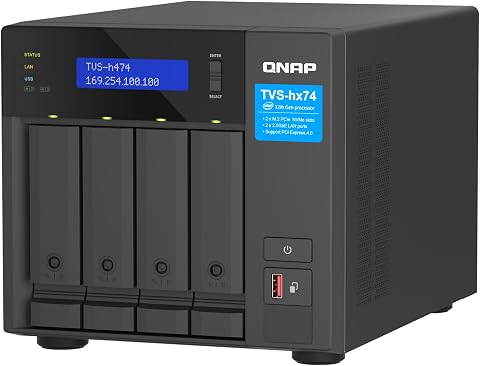
The QNAP TVS-h474-PT-8G-US is a 4-bay desktop NAS featuring an Intel Pentium Gold G7400 2-core processor, 8GB DDR4 RAM (expandable up to 64GB), dual 2.5GbE ports, multiple USB 3.2 Gen 2 ports, and 4K media playback with HDMI output. It offers high-speed data transfer, cache acceleration, and multimedia streaming capabilities suitable for small to medium-sized teams.
Pros:
- Powerful dual-core processor with expandable RAM
- High-speed 2.5GbE networking for fast data transfer
- Supports 4K media playback and real-time transcoding
- Multiple USB ports for versatile connectivity
Cons:
- Diskless setup requires additional drives for storage
- Limited to 4 drive bays, may not suit large storage needs
- No included drives, additional cost for storage
Best for: Home labs seeking a desktop NAS with four listed drive bays.
Not ideal for: Setups that need a different form factor or bay configuration.
Bottom line: Check drive support, backup plans, and network compatibility before setup.
Uninterruptible Power Supply
A UPS can be part of a home lab’s power plan for equipment that needs a managed shutdown or power continuity. The listed pick is the Eaton Tripp Lite SMART1500RMXL2U 1500VA UPS. Its name provides the stated 1500VA rating and 2U form factor; check the manufacturer documentation to understand its connections, operating requirements, and fit for your equipment.
A common buying mistake is selecting a UPS based only on the combined equipment labels or its form factor. List the devices you plan to connect and check their power requirements, then consult the UPS documentation for load limits and expected runtime at your load. Do not treat the rating as a runtime promise: runtime depends on the connected load and the unit’s specifications.
Confirm that the 2U format fits the location and mounting arrangement you have available. Check outlet types, cabling, and how you will connect equipment that needs protection. Consider which devices should remain powered during an outage and how they should shut down. Keep access to the unit clear for installation and maintenance, and follow its documentation when connecting and operating it.
What to look for:
- Add up the requirements of equipment you plan to connect.
- Check load limits and runtime guidance in the UPS documentation.
- Confirm the 2U form factor fits the installation space.
- Match outlet types and connections to your devices.
- Plan which equipment needs power and an orderly shutdown.
Eaton Tripp Lite SMART1500RMXL2U 1500VA UPS

The Eaton Tripp Lite SMART1500RMXL2U is a 1500VA rack-mount UPS with a 1440W capacity, offering pure sine wave output, AVR, noise filtering, and surge protection. It features user-replaceable batteries, expandable runtime with optional battery modules, and remote management capabilities via web card.
Pros:
- High capacity with 1500VA and 1440W power output
- Expandable runtime with additional battery modules
- Supports remote management and monitoring
Cons:
- Requires optional web card for remote management
- Battery replacement may require technical knowledge
- Limited to rack-mount setup
Best for: Setups with compatible equipment and space for a 2U UPS.
Not ideal for: Installations that cannot accommodate its form factor or load requirements.
Bottom line: Check load, runtime guidance, and connections against your equipment list.
Ethernet Cable Tester
Cable verification can help when you are installing or troubleshooting wired network connections. The listed pick is the Fluke Networks MicroScanner2 Copper Cable Verifier with Built-In Intel. Its name identifies a copper cable verifier, so check the product documentation to see which cable types and verification functions it supports before relying on it for a particular job.
A common buying mistake is assuming any tester checks every characteristic you care about. Define whether you need to verify a cable run, identify wiring issues, or confirm another property, then compare those needs with the tool’s documented capabilities. The word “verifier” in a product name does not establish which tests it performs or whether it suits your installation.
Check compatibility with the cables and connectors in your setup, and consider where you will use and store the tester. If you expect to work on many runs, think through how the tool fits your process for labeling and recording results. Consult the product documentation for operation and included accessories, and confirm that any additional items you need are compatible with the tester.
What to look for:
- Check which cable types and tests the verifier supports.
- Match connectors and cables to the tool’s documented compatibility.
- Define the verification tasks before selecting a tester.
- Review operation and accessory requirements.
- Plan how to label and record checked cable runs.
Fluke Networks MicroScanner2 Copper Cable Verifier with Built-In IntelliTone Ton

The MicroScanner2 Cable Verifier tests copper cables for length, wiremap, cable ID, and faults. It supports troubleshooting for RJ11, RJ45, coax, and network speeds up to 10/100/1000Base-T, including VoIP applications.
Pros:
- Comprehensive cable testing features
- Displays cable length and faults on one screen
- Supports multiple cable types and network speeds
Cons:
- Limited to copper cable verification
- No mention of wireless testing capabilities
Best for: Builders who need to verify compatible copper cable runs.
Not ideal for: Workflows that require tests the documentation does not list.
Bottom line: Match the verifier’s documented functions to the cable checks you need.
Build your buying order around the biggest constraint in your current setup. Start with the connections or power needs blocking your lab, then prioritize storage, wireless coverage, and cable verification according to your own plans. Check compatibility and installation requirements before adding each item.
You can upgrade one part at a time and keep notes on interfaces, cabling, and equipment requirements as you go. A clear inventory makes it easier to choose the next component and keep your home lab organized.