In today’s digital world, fiber optics are essential for the backbone of modern data centers. They provide fast, reliable connections that handle increasing data loads and support critical applications. As you consider infrastructure upgrades or system performance, understanding how fiber optics enhance efficiency and scalability can considerably impact your operations. What you learn about their role could shape the future of your data management strategies.
Key Takeaways
- Enable high-speed, reliable data transfer essential for cloud computing, streaming, and real-time analytics.
- Support large bandwidth demands and seamless infrastructure expansion for future scalability.
- Reduce electromagnetic interference, ensuring data integrity across dense electronic environments.
- Improve cable organization and management, facilitating maintenance and troubleshooting.
- Provide a robust backbone that enhances overall data center efficiency, resilience, and security.

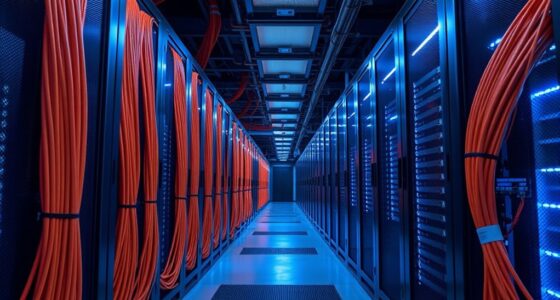
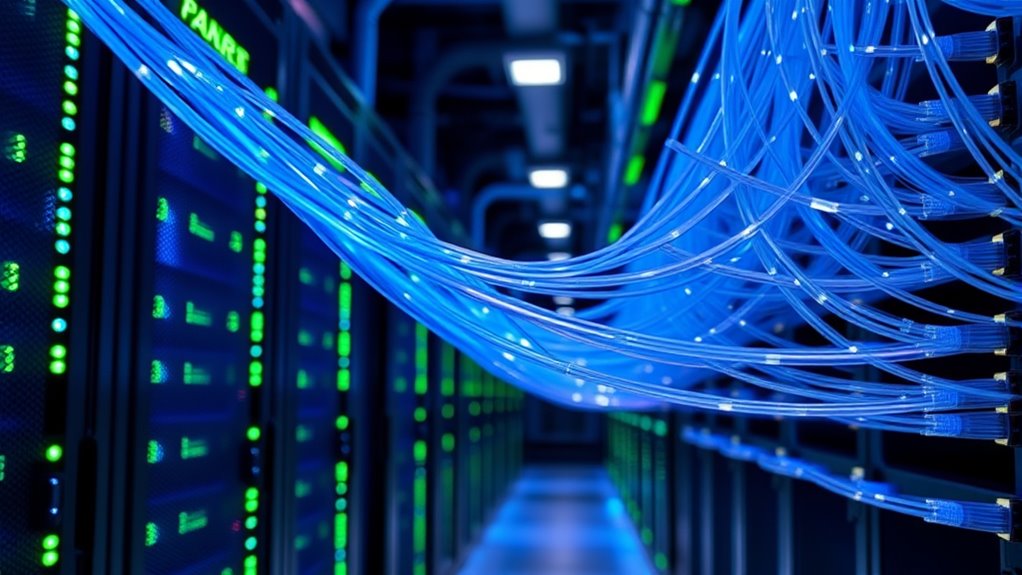
Have you ever wondered how data centers handle vast amounts of information so quickly and reliably? The answer lies in the advanced technology of fiber optics, which has revolutionized data transmission. Fiber optic cables enable lightning-fast data transfer speeds, essential for supporting cloud computing, streaming, and real-time analytics. But to truly harness their potential, proper cable management is essential. In a data center, neatly organized fiber optic cables aren’t just about aesthetics—they prevent tangles, reduce strain, and make maintenance much easier. When cables are properly managed, airflow isn’t obstructed, which helps keep equipment cool and reduces the risk of overheating. Good cable management also minimizes the chance of accidental disconnections or damage, ensuring that data flows smoothly without interruptions.
Signal integrity is another critical aspect that fiber optics excel at, especially in modern data centers where data accuracy is paramount. Unlike traditional copper cables, fiber optics use light to transmit information, which considerably reduces electromagnetic interference (EMI). This means the data remains pure and uncorrupted, even in environments densely packed with electronic devices. Maintaining high signal integrity ensures that the data reaching servers and storage devices is accurate and reliable, which is essential for applications like financial transactions, healthcare records, and cloud services. Additionally, fiber optics support longer cable runs without losing signal quality, giving data centers more flexibility in infrastructure design.
The combination of fiber optics with meticulous cable management creates a robust backbone for data centers. When cables are sorted and labeled properly, technicians can quickly identify and troubleshoot issues, minimizing downtime. It also simplifies upgrades and expansions, as new fiber runs can be integrated seamlessly without disrupting existing infrastructure. This proactive approach to cable management guarantees that the high-speed data flows are uninterrupted, supporting the demanding needs of modern digital operations.
Furthermore, fiber optics provide scalability that traditional cabling simply can’t match. As your data center grows and data demands increase, fiber optic cables can handle higher bandwidths without needing substantial physical upgrades. This future-proofing capability is essential in a rapidly evolving digital landscape. When combined with careful cable management practices, fiber optics deliver not just speed but also reliability and ease of maintenance, keeping your data center efficient and resilient. Ultimately, understanding how to optimize fiber optic deployment—by prioritizing cable management and signal integrity—ensures your data center remains competitive, secure, and capable of supporting tomorrow’s technology needs.
fiber optic cables for data centers
As an affiliate, we earn on qualifying purchases.
As an affiliate, we earn on qualifying purchases.
Frequently Asked Questions
How Does Fiber Optics Compare to Wireless Data Transmission?
Fiber optics outperforms wireless data transmission by offering higher speeds and more reliable connections. Unlike wireless, fiber isn’t affected by signal interference or wireless limitations like range issues, ensuring consistent performance. You’ll notice fewer disruptions and faster data transfer, making fiber ideal for demanding data center environments. Wireless may be convenient, but fiber optics provide the stability and bandwidth needed for modern data demands, making it the superior choice.
What Are the Future Advancements in Fiber Optic Technology?
You’ll see future fiber optic advancements like quantum enhancements that boost data security and speed, transforming how data centers operate. Photonic integration will make components smaller, more efficient, and easier to produce, enabling faster deployment. These innovations will help you achieve higher bandwidths, lower latency, and improved energy efficiency, ensuring your data transmission stays ahead in the rapidly evolving digital landscape.
How Do Fiber Optics Impact Data Center Energy Efficiency?
Fiber optics greatly boost your data center’s energy efficiency by enabling energy savings through reduced power consumption. They also maintain excellent signal integrity over long distances, which means less need for signal boosting or repeaters. This combination ensures your data transmission remains reliable while lowering overall energy costs. As a result, fiber optics help you run a more sustainable, cost-effective data center with improved performance and less environmental impact.
What Are Common Installation Challenges for Fiber Optic Cables?
You often face installation hurdles like tight spaces, complex routing, and delicate handling complexities when installing fiber optic cables. These challenges require careful planning, precise handling, and proper tools to avoid damage and guarantee peak performance. You need to be mindful of bend radius restrictions, connector cleanliness, and proper labeling. Addressing these issues proactively streamlines installation, reduces downtime, and guarantees reliable, high-speed data transmission in your data center.
How Secure Is Fiber Optic Data Transmission in Data Centers?
Fiber optic data transmission in data centers is highly secure when you implement encryption protocols and prioritize physical security. You can protect data from interception by encrypting signals, making it difficult for unauthorized parties to access sensitive information. Additionally, securing fiber optic cables physically—using locked cabinets, restricted access, and monitoring—reduces the risk of tampering or physical breaches, ensuring your data remains safe during transmission.
fiber optic cable management kit
As an affiliate, we earn on qualifying purchases.
As an affiliate, we earn on qualifying purchases.
Conclusion
In today’s data centers, fiber optics are like the nerves that keep everything connected and moving smoothly. They provide the speed and reliability you need to handle massive data flows, just as a highway system keeps traffic flowing seamlessly. By embracing fiber optics, you guarantee your infrastructure stays scalable and future-proof. With these high-capacity cables, you’re building a foundation that’s as resilient and essential as the heartbeat of modern digital life.
high speed fiber optic transceivers
As an affiliate, we earn on qualifying purchases.
As an affiliate, we earn on qualifying purchases.
As an affiliate, we earn on qualifying purchases.