Many believe that plenum and riser cables can be used interchangeably, but that’s not the case. These cables are designed for specific environments and safety standards, which means choosing the wrong type could lead to serious issues. Understanding the differences is essential for compliance and safety, yet it’s a topic that often gets overlooked. So, what exactly sets these cables apart—and why does it matter for your building’s safety?
Key Takeaways
- Plenum and riser cables have different fire-retardant materials tailored to their specific environments.
- They meet distinct safety standards; using one in the other’s space can violate building codes.
- Plenum cables are designed for air handling spaces, while riser cables are for vertical shafts, preventing fire spread.
- Interchanging them compromises fire safety and can increase toxic fumes during a fire.
- Proper cable selection ensures compliance, safety, and optimal performance, making them non-interchangeable.
Many people believe that plenum and riser cables are inherently safer or more reliable than other types of network cables, but this isn’t always true. While these cables are designed with specific fire safety and installation standards in mind, they aren’t interchangeable without considering their unique properties and intended use. Understanding the distinctions is vital to guarantee safety, compliance, and peak performance in your wiring setup.
Plenum cables are constructed with a special fire-retardant jacket that minimizes the release of toxic fumes and smoke if a fire occurs. This makes them the preferred choice for spaces like air ducts, ceiling cavities, and other ventilation pathways, where fire safety is particularly critical. Riser cables, on the other hand, are designed for vertical runs between floors, with a focus on preventing the spread of fire and smoke through vertical shafts. Their jackets meet fire-resistance standards but typically aren’t as flame-retardant as plenum cables.
Plenum cables feature fire-retardant jackets for ventilation spaces; riser cables are designed for vertical floor runs with fire-resistant jackets.
It’s important to realize that these differences are rooted in installation standards set by organizations such as the National Fire Protection Association (NFPA) and the Underwriters Laboratories (UL). These standards specify the materials and construction methods that each cable type must adhere to, ensuring that they perform as intended in fire scenarios. Using plenum cables in riser applications—or vice versa—can violate these standards and compromise fire safety. For example, installing non-compliant cables in ventilation spaces could lead to increased smoke and toxic fumes during a fire, posing serious safety risks.
Additionally, the use of proper cable types is essential for meeting safety regulations and insurance requirements, which are often based on compliance with these standards. Many building codes mandate the use of specific cables in designated environments, and failing to follow these can lead to legal and financial penalties. While it might seem cost-effective to use a generic cable, the potential risks outweigh the savings. Properly matching cable types to their designated environments ensures you’re adhering to installation standards and reducing fire hazards.
In addition, the choice between plenum and riser cables impacts the overall reliability of your network. Although they both transmit data effectively, their fire safety features and compliance with installation standards influence how safely they can be installed in specific environments. You need to evaluate your building’s design and fire safety requirements carefully.

MONK CABLES | CAT6 Plenum Cable 1000ft | UTP, 23AWG, 550MHz | DSX-8000 Certified | Most Certified Cable of The Whole Market (Purple)
👌 𝗠𝗜𝗟𝗜𝗧𝗔𝗥𝗬-𝗚𝗥𝗔𝗗𝗘 𝗤𝗨𝗔𝗟𝗜𝗧𝗬 -> 𝟭𝟬𝟬% 𝗚𝗨𝗔𝗥𝗔𝗡𝗧𝗘𝗘𝗗!: Each & every of our cable is individually tested with a 𝐃𝐒𝐗-𝟖𝟎𝟎𝟎…
As an affiliate, we earn on qualifying purchases.
As an affiliate, we earn on qualifying purchases.
Frequently Asked Questions
Can Plenum Cables Be Used Outdoors Safely?
You shouldn’t use plenum cables outdoors because they lack the necessary outdoor durability and weather resistance. These cables are designed for indoor environments, where they’re protected from moisture, UV rays, and temperature fluctuations. Using them outdoors can lead to damage, safety hazards, and compromised signal quality. Instead, opt for outdoor-rated cables specifically built to withstand weather conditions, ensuring safety and longevity for your installation.
What Are the Cost Differences Between Plenum and Riser Cables?
Imagine walking into a store, and your eyes catch two cables side by side. You notice that plenum cables tend to be more expensive than riser cables due to their special fire-resistant insulation. When you compare costs, riser cables usually fit your budget better, making them a smart choice for budget considerations. The price difference can influence your decision, especially when you’re trying to balance safety standards and cost efficiency.
Are There Fire Safety Regulations Specific to Plenum Cables?
Yes, there are fire safety regulations specific to plenum cables. These cables must meet strict standards because they run through air-handling spaces, so fire safety regulations require them to be fire-resistant and produce minimal smoke and toxic fumes if ignited. You should verify your plenum cables are certified to meet UL 2043 standards or equivalent, to comply with building codes and protect everyone in the building.
How Do Plenum and Riser Cables Differ in Installation Procedures?
When you install plenum and riser cables, you’ll notice different procedures. For plenum cables, you must follow strict safety considerations, making certain they’re properly rated for air-handling spaces and installed in a way that minimizes fire risk. Riser cables, on the other hand, require less rigorous procedures but still need correct routing to prevent damage. Always check manufacturer instructions and safety codes to ensure proper cable installation and compliance.
Do All Network Standards Require Plenum-Rated Cables?
A stitch in time saves nine, and when it comes to fire safety, not all network standards require plenum-rated cables. While some building codes mandate them for specific areas, others allow riser cables if proper fire safety measures are observed. Always check local regulations and installation procedures to ensure compliance. Using the right cables helps prevent fire hazards and ensures your network’s safety and reliability.
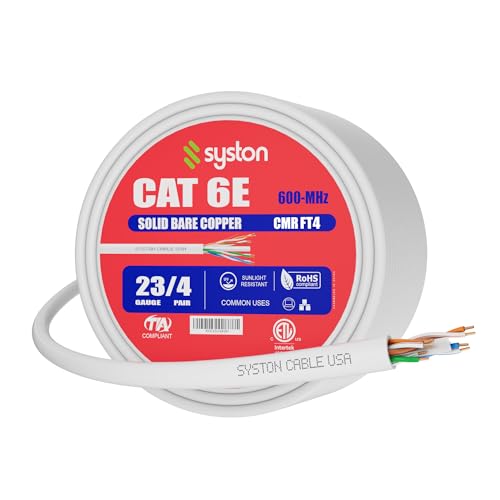
Syston Cable Technology Cat6e Ethernet Internet Cable – 50 FT,600MHz 23AWG Solid Bare Copper Wire Outdoor/Indoor Suit, No Ends 10 Ft to 1000 Ft Available, Heat Resistant Riser Rated – CMR
CMR (Riser-Rated): Our cable is designed with your safety in mind. It features a CMR/CL3R/FPLR (Riser-Rated) flame-retardant rating…
As an affiliate, we earn on qualifying purchases.
As an affiliate, we earn on qualifying purchases.
Conclusion
Don’t let this myth fool you—assuming plenum and riser cables are interchangeable is like trying to fit a square peg in a round hole. Each cable type is crafted for a specific environment, and using the wrong one can turn safety into a ticking time bomb. Always choose the right cable for the job to keep your building safe and compliant. Remember, in the world of fire safety, the devil is in the details.

SYSTON 22/2 Fire Security Burglar Station Sound Alarm Control Cable Wire, Plenum-Rated CMP/CL3P Unshielded Stranded Copper UL/ETL, UV Resistant for Indoor/Outdoor Low Voltage Application Use – 50 FT
Multiple Applications: Wiring Fire Alarm, Security Burglar Alarm, Public Address Systems, Intercoms, Telephone Stations, Communications, Instrumentation, Access Control,…
As an affiliate, we earn on qualifying purchases.
As an affiliate, we earn on qualifying purchases.

Voltive 22/4 Shielded Low Voltage Wire, Plenum CL3P, Black, 500ft – 22AWG, 4 Conductors, Overall Shield, Stranded Bare Copper, UL Listed – V-1265-2
22AWG, 4 CONDUCTORS, SHIELDED, BLACK JACKET, 500FT BOX. 22 gauge, 4 conductor low voltage wire with overall foil…
As an affiliate, we earn on qualifying purchases.
As an affiliate, we earn on qualifying purchases.