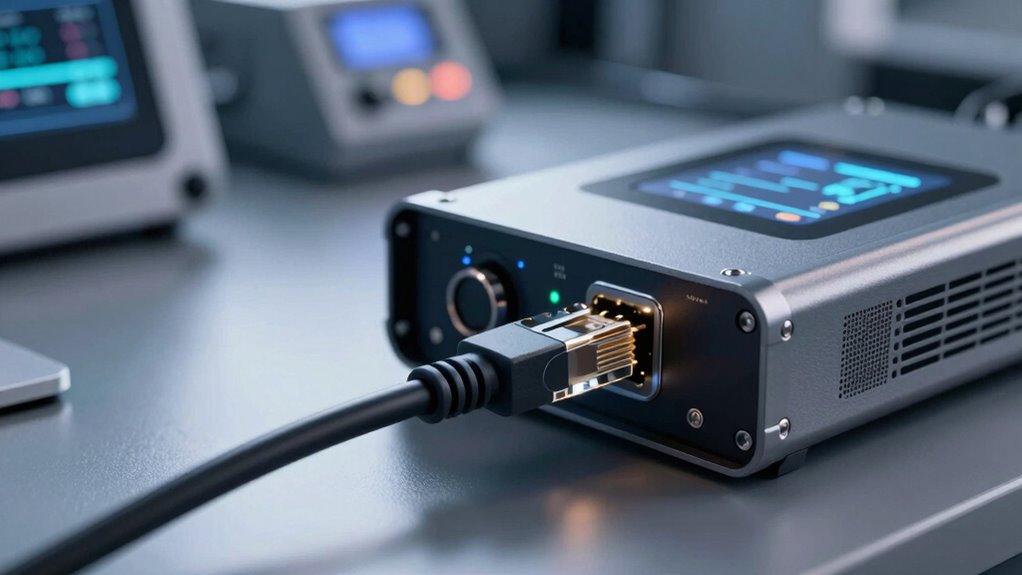

As a team working in industrial automation, you should know that Single Pair Ethernet (SPE) simplifies your network by enabling reliable, high-speed communication between sensors, controllers, and machines over a single twisted pair. It reduces wiring complexity, cuts costs, and enhances data integrity, especially in harsh environments. Plus, SPE supports future-proofing for smart manufacturing, IoT, and high-bandwidth applications. Understanding these use cases will help you harness its full potential as technology evolves.
Play games included with Prime
Start a Prime free trial and play with Amazon Luna on your devices.
As an affiliate, we earn on qualifying purchases.
Key Takeaways
- Single Pair Ethernet (SPE) enables reliable, high-speed data transfer over a single twisted pair for industrial automation.
- SPE simplifies wiring, reduces installation costs, and enhances flexibility in manufacturing environments.
- It supports Power over Ethernet (PoE), allowing sensors and devices to be powered through the same cable.
- SPE ensures robust communication in harsh conditions, maintaining data integrity amid dust, vibrations, and electrical noise.
- It facilitates future-proof, scalable industrial IoT networks by supporting high-bandwidth, real-time applications.

Single Pair Ethernet (SPE) is transforming industrial and automotive networking by providing reliable, high-speed communication over a single twisted pair of wires. If you’re involved in industrial automation or smart manufacturing, understanding how SPE can be applied is essential. This technology simplifies connectivity, reduces cabling costs, and enhances data transfer efficiency, making it a game-changer for modern factories and automation systems.
Single Pair Ethernet boosts industrial and automotive networking with reliable, high-speed data over a single twisted pair.
In industrial automation, SPE enables seamless communication between a wide range of devices—sensors, actuators, controllers, and machines—without the clutter of multiple cables. Its ability to transmit data reliably over long distances supports real-time monitoring and control, which are fundamental in automation processes. When you integrate SPE into your system, you eliminate the need for bulky, complex wiring setups, streamlining installation and maintenance. This not only saves time but also reduces downtime, helping you maintain continuous production flow. Additionally, SPE’s robustness guarantees that industrial environments—often harsh with dust, vibrations, and electrical noise—won’t interfere with data integrity. Robustness in industrial environments is a key factor for dependable industrial communication systems. Furthermore, the use of single twisted pair cables can improve installation flexibility and reduce overall system complexity, contributing to more efficient infrastructure. Incorporating SPE can also help future-proof your network against evolving technological demands, especially as industrial IoT continues to expand.
Smart manufacturing relies heavily on interconnected devices and data-driven decision-making. SPE fits perfectly into this paradigm by providing a standard, high-speed link with minimal wiring. Imagine your factory floor where IoT devices, cameras, and edge computing systems communicate effortlessly over a single pair of wires. This setup allows you to collect vast amounts of data quickly and reliably, which is essential for predictive maintenance, quality control, and process optimization. With SPE, you can deploy sensors across the manufacturing line, knowing they’ll transmit data efficiently without bottlenecks. This connectivity enables you to implement automation solutions that are more flexible, scalable, and responsive to changing production needs.
Furthermore, SPE’s compatibility with industrial Ethernet standards facilitates integration into existing networks, making upgrades smoother. Its ability to support power over Ethernet also means you can eliminate separate power lines for many devices, simplifying infrastructure and reducing costs. Whether you’re designing new automation systems or upgrading existing ones, SPE offers a future-proof solution for high-bandwidth applications in industrial and smart manufacturing settings. Additionally, understanding the reliability and robustness of SPE is crucial for ensuring consistent operation in challenging industrial environments. Recognizing the cost benefits of SPE can also help justify investments in new infrastructure.
Single Pair Ethernet industrial cables
As an affiliate, we earn on qualifying purchases.
As an affiliate, we earn on qualifying purchases.
Frequently Asked Questions
How Does Single Pair Ethernet Compare to Traditional Ethernet in Cost?
Single Pair Ethernet generally costs less than traditional Ethernet because of lower material needs and simplified design, leading to a favorable cost analysis. Its installation complexity is also reduced since it uses thinner cables and fewer components, making setup faster and easier. You’ll find that deploying Single Pair Ethernet can save money upfront and over time, especially in industrial environments where streamlined wiring and maintenance are essential.
What Are the Compatibility Issues With Existing Network Infrastructure?
Like puzzle pieces fitting together, compatibility issues arise when integrating Single Pair Ethernet with your existing network. Legacy devices often lack support, making retrofit challenges unavoidable. You must carefully evaluate whether your current infrastructure can embrace this new technology or if upgrades are necessary. This process can be intricate, requiring attention to connectors, protocols, and power requirements, ensuring seamless communication without disrupting your network’s harmony.
How Secure Is Single Pair Ethernet for Sensitive Data Transmission?
Single Pair Ethernet is quite secure for sensitive data transmission when you implement data encryption and network segmentation. Encryption protects your data from interception, while segmentation isolates sensitive information from other network traffic. By combining these measures, you substantially reduce risks. Keep in mind, though, that regular updates and security practices are essential to maintain high security levels, just like with any other network technology.
Can Single Pair Ethernet Support Future Network Scalability Needs?
You bet S.P.E. can support future network scalability, but it depends on your network topology and bandwidth needs. While Single Pair Ethernet offers simplicity and cost savings, its bandwidth limitations might be a bottleneck as your network grows. Think of it as a highway—initially smooth, but if you’re planning for a rush hour, you’ll need to take into account upgrading to support increased traffic and avoid hitting a dead end later.
What Maintenance Challenges Are Associated With Single Pair Ethernet Systems?
You might face maintenance challenges with Single Pair Ethernet systems, especially around fault tolerance. Troubleshooting procedures can be more complex due to limited bandwidth and simplified wiring. You’ll need to regularly check connections and monitor network performance to identify issues early. Ensuring proper fault tolerance measures are in place helps reduce downtime, but understanding specific troubleshooting steps is key to maintaining reliable, efficient operation of these systems.
PoE industrial Ethernet switches
As an affiliate, we earn on qualifying purchases.
As an affiliate, we earn on qualifying purchases.
Conclusion
Understanding Single Pair Ethernet opens a world of seamless connectivity, like a thread weaving through your entire network. By embracing its use cases, you guarantee your team stays ahead in innovation and efficiency. Think of it as planting a seed today—nurture it, and it grows into a robust network capable of supporting tomorrow’s smart devices. Don’t wait for the storm; prepare your network now and let Single Pair Ethernet be the steady anchor in your digital future.
As an affiliate, we earn on qualifying purchases.
industrial automation sensors Ethernet
As an affiliate, we earn on qualifying purchases.
As an affiliate, we earn on qualifying purchases.
NFL season / tailgating Picks
team gear
As an affiliate, we earn on qualifying purchases.