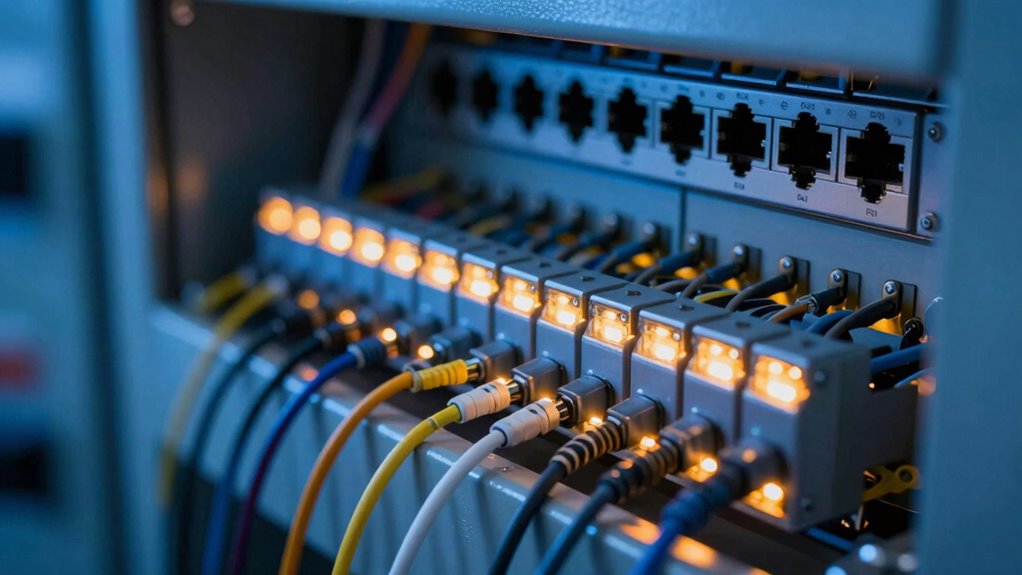

In industrial networks, you care about deterministic traffic because even milliseconds of delay can threaten safety, disrupt critical processes, and cause costly downtime. Ensuring data arrives exactly when needed helps maintain smooth operations, safety, and efficiency. Specialized protocols and network designs prioritize critical information, preventing delays and data loss. If you’re curious about how this works or how security fits in, there’s much more to explore about keeping industrial systems reliable and protected.

Get business pricing on networking and server gear
- Business-only prices and quantity discounts
- Tax-exempt purchasing
- Multiple users, one account, clear invoices
Key Takeaways
- Ensures real-time data delivery critical for safety and operational stability in industrial environments.
- Prevents delays and data loss, maintaining the smooth operation of control systems.
- Supports predictable communication patterns essential for time-sensitive processes.
- Facilitates prioritization and scheduling to meet strict timing requirements.
- Enhances security without compromising low latency and high reliability.

Have you ever wondered how industrial networks guarantee real-time data delivery despite their complex environments? It’s a question that’s essential for maintaining the smooth operation of manufacturing plants, power grids, and other critical infrastructures. The key lies in understanding deterministic traffic, which ensures that data packets arrive precisely when needed, without delays or loss. To achieve this, industrial networks rely heavily on specialized protocols and security measures that prioritize timely and reliable communication.
Wireless protocols play a key role in this ecosystem. Unlike traditional Wi-Fi or Bluetooth, industrial wireless protocols such as WirelessHART, ISA100.11a, and 5G are designed specifically to handle the demanding requirements of industrial environments. These protocols incorporate features like time synchronization, collision avoidance, and prioritized data channels that guarantee deterministic traffic flow. They create a predictable communication pattern that ensures data from sensors, controllers, and actuators reaches its destination without unexpected delays. This predictability is essential for real-time control systems, where even milliseconds can make a difference between efficient operation and costly downtime.
However, guaranteeing deterministic traffic isn’t just about speed; it also involves robust network security. Industrial networks face constant threats from cyberattacks, which can disrupt operations or compromise sensitive data. As such, network security measures are integrated into the communication protocols themselves. This includes encryption, authentication, and intrusion detection systems that protect data in transit without impeding the network’s real-time performance. You need to strike a delicate balance: securing the network while maintaining the low latency and high reliability that deterministic traffic demands. Advanced security features are often designed to operate seamlessly within the time-sensitive environment, ensuring that protective measures do not introduce unwanted delays.
Furthermore, the architecture of industrial networks is often engineered to support deterministic traffic. This involves dedicated communication channels, scheduled data transmissions, and priority queuing mechanisms that keep critical data streams separate from less urgent traffic. By doing so, these networks prevent congestion and ensure that high-priority messages, such as safety alerts or process control commands, are delivered on time every time. This meticulous planning and specialized technology highlight why deterministic traffic is so essential: it directly impacts safety, efficiency, and the overall stability of industrial operations.
In essence, industrial networks care deeply about deterministic traffic because it underpins the reliability and safety of complex systems. Wireless protocols tailored for industrial use and robust network security measures work hand in hand to create a communication environment where data flows predictably and securely. This guarantees that critical commands and information reach their destination exactly when needed, keeping industrial processes running smoothly and securely.
industrial deterministic network switches
As an affiliate, we earn on qualifying purchases.
As an affiliate, we earn on qualifying purchases.
Frequently Asked Questions
How Does Deterministic Traffic Differ From Non-Deterministic Traffic?
Deterministic traffic differs from non-deterministic traffic because it guarantees consistent delivery times through traffic prioritization and network synchronization. You can count on deterministic traffic to arrive within predictable timeframes, which is vital for industrial processes. Non-deterministic traffic, however, can experience delays or variations, making it unsuitable where timing precision matters. By managing traffic prioritization and maintaining network synchronization, industrial networks assure reliable, real-time communication.
What Industries Benefit Most From Deterministic Network Traffic?
Did you know that nearly 70% of manufacturing plants rely heavily on deterministic traffic? Industries like manufacturing, energy, and transportation benefit the most because wireless automation demands precise timing and reliability. These sectors need consistent data flow for safety and efficiency, making network security and deterministic traffic vital. By ensuring predictable network performance, you reduce downtime and prevent costly errors, keeping operations smooth and secure.
Can Existing Networks Be Upgraded to Support Deterministic Traffic?
Yes, existing networks can be upgraded to support deterministic traffic. You do this by implementing network segmentation, which isolates critical processes, and protocol optimization to reduce latency. These steps help prioritize deterministic traffic, ensuring timely data delivery for industrial applications. Upgrading involves updating hardware and software, but it’s essential for maintaining reliability and performance in industrial environments that demand predictable communication.
What Are the Main Challenges in Implementing Deterministic Traffic?
The main challenges in implementing deterministic traffic include managing network congestion and ensuring protocol prioritization. You need to prevent congestion from causing delays, which can disrupt real-time operations. Additionally, you must prioritize critical protocols to guarantee timely data delivery. Balancing these factors requires careful network design and configuration, as well as advanced traffic management techniques, to maintain the predictability essential for industrial environments.
How Is Latency Measured in Deterministic Industrial Networks?
Latency in deterministic industrial networks is measured like a stopwatch, capturing the delay from when data is sent to when it’s received. You focus on network timing and traffic prioritization, ensuring critical data gets through first. By monitoring these parameters, you can identify the precise delays, making sure your system maintains predictable performance. This way, you keep operations smooth and responsive, like a well-oiled machine.
WirelessHART industrial wireless protocol
As an affiliate, we earn on qualifying purchases.
As an affiliate, we earn on qualifying purchases.
Conclusion
You might think all network traffic is the same, but in industrial settings, deterministic traffic is essential. Imagine a factory robot precisely timing its movements—any delay could cause errors or accidents. Without guaranteed delivery times, chaos could unfold, disrupting production and safety. So, next time you see factory automation in action, remember that behind the scenes, deterministic traffic keeps everything running smoothly, like a conductor guiding an orchestra—every note hitting just right, every second counting.
industrial network security devices
As an affiliate, we earn on qualifying purchases.
As an affiliate, we earn on qualifying purchases.
real-time industrial Ethernet switches
As an affiliate, we earn on qualifying purchases.
As an affiliate, we earn on qualifying purchases.
Halloween Picks
halloween
As an affiliate, we earn on qualifying purchases.