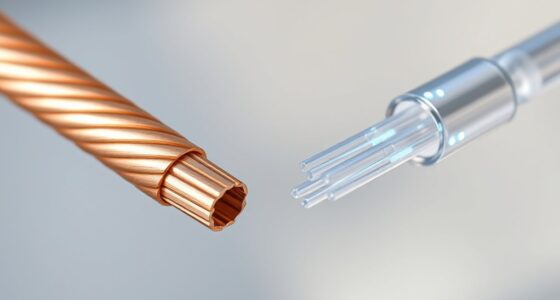
To explain fiber and copper tradeoffs without oversimplifying, focus on their key differences: fiber offers higher speeds, longer distances, and immunity to electromagnetic interference, but comes with higher installation costs and precision needs. Copper is easier and cheaper to install but suffers from limited range and vulnerability to interference. Balancing these factors depends on your environment, budget, and future needs. Keep exploring further details to understand how these tradeoffs impact your network choices.

Get business pricing on networking and server gear
- Business-only prices and quantity discounts
- Tax-exempt purchasing
- Multiple users, one account, clear invoices
Key Takeaways
- Highlight that fiber offers superior immunity to electromagnetic interference, ensuring higher reliability in sensitive environments.
- Emphasize the initial cost and installation complexity of fiber versus the simplicity and lower upfront costs of copper.
- Explain that fiber supports longer distances with less signal degradation, reducing long-term maintenance and upgrade costs.
- Clarify that copper’s bandwidth limitations and susceptibility to interference can increase future expenses.
- Stress the importance of assessing environmental, performance, and budget factors to make an informed, balanced decision.
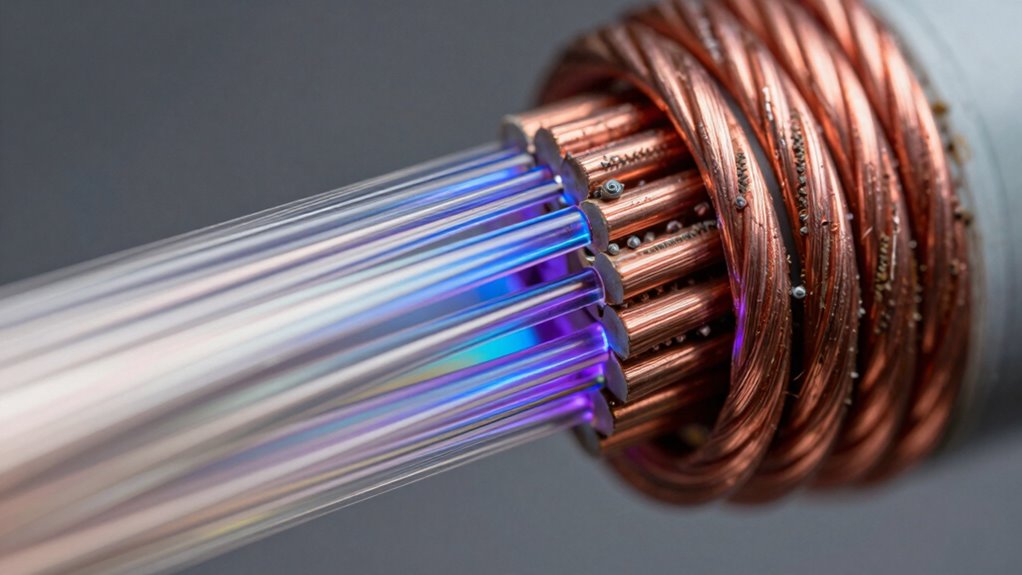
Have you ever wondered whether fiber or copper cables are better suited for your network needs? Making this choice isn’t just about picking the newest technology; it involves understanding the tradeoffs between these options. Fiber optics are known for their ability to transmit data over longer distances without signal degradation, but they come with their own set of challenges. On the other hand, copper cables are more familiar and often less expensive upfront, but they can be more susceptible to signal interference and have limitations in bandwidth and distance. To make an informed decision, you need to weigh these factors carefully without oversimplifying the differences.
One of the key considerations is signal interference. Copper cables rely on electrical signals, which makes them vulnerable to electromagnetic interference from nearby devices or electrical wiring. This interference can cause data corruption or slow down your network, especially in environments with a lot of electronic equipment. Fiber optic cables, however, transmit data using light, making them immune to electromagnetic interference. This distinction is critical in environments like factories, hospitals, or data centers, where signal integrity is paramount. By understanding how interference impacts your network performance, you can determine whether the reliability of fiber optics justifies their higher cost or if copper cables will suffice in your setting.
Copper cables are vulnerable to electromagnetic interference, which can degrade network performance in environments with many electronic devices.
Installation costs are another important factor. Generally, installing fiber optic cables can be more expensive initially due to the specialized equipment and skills required. Splicing and terminating fiber optic cables demand precision and expertise, which can drive up labor costs. Conversely, copper cables are easier and quicker to install because they’re more familiar to most technicians and require less specialized equipment. If you’re on a tight budget or need a quick setup, copper might seem appealing. However, it’s essential to consider long-term expenses. Fiber optics tend to have lower maintenance costs and support higher speeds, which could save you money down the line. As a result, your decision should balance upfront expenses with the total cost of ownership, factoring in performance needs and future scalability. Additionally, understanding the cost-benefit analysis of each option can help clarify the long-term financial implications for your specific deployment. Moreover, considering the technology advancements in fiber optics can influence their cost-effectiveness over time.
Additionally, the distance limitations of copper versus fiber are a significant factor in many network planning decisions. Copper cables typically have a shorter effective range before signal quality diminishes, whereas fiber can carry data over much longer distances without degradation. In essence, explaining the tradeoffs between fiber and copper without oversimplifying means acknowledging their strengths and weaknesses in different contexts. It’s important to recognize that signal degradation can significantly impact performance in copper-based networks, especially over longer distances. It’s about understanding how signal interference can compromise copper’s reliability and how installation costs might influence your budget versus the long-term benefits of fiber. By doing so, you empower yourself to choose the best solution based on your specific needs, environment, and financial constraints. This balanced perspective ensures that you’re making a well-informed decision rather than settling for a quick fix or an overly complex technical explanation.
As an affiliate, we earn on qualifying purchases.
Frequently Asked Questions
How Do Fiber and Copper Compare in Terms of Scalability?
You’ll find fiber is more scalable than copper because it offers higher bandwidth and less signal degradation over long distances. Copper faces bandwidth limitations and signal degradation issues, making it less suitable for growing network demands. Fiber’s ability to handle increased data loads without losing signal quality means it can support future expansion easily, while copper’s limitations may require more upgrades or additional infrastructure as your needs grow.
What Are the Maintenance Requirements for Fiber Versus Copper?
You’ll find that fiber optic cables require less maintenance than copper because they’re immune to signal interference and aren’t affected by electrical issues. Fiber’s physical durability means it resists corrosion and physical damage better, reducing repairs over time. Copper, however, needs more frequent checks for corrosion, signal degradation, and physical wear. While fiber needs careful handling during installation, it generally offers lower ongoing maintenance compared to copper.
How Do Environmental Factors Affect Fiber and Copper Performance?
Environmental factors considerably impact fiber and copper performance. You’ll find fiber’s high environmental resilience, such as resistance to electromagnetic interference and temperature fluctuations, makes it ideal for harsh conditions. Copper, however, faces installation challenges in extreme environments, like corrosion or moisture damage. You should consider these factors when planning deployments, ensuring that your choice aligns with environmental resilience needs and mitigates installation challenges for reliable, long-term connectivity.
What Are the Cost Differences Over the Equipment Lifecycle?
Think of fiber as an oak tree and copper as a maple. In your cost analysis, fiber’s initial investment is higher, but it offers lower maintenance and longer lifespan, making it more cost-effective over the lifecycle. Copper, akin to a maple, costs less upfront but incurs higher repair and replacement costs over time. Lifecycle considerations show fiber’s durability often outweighs its initial expense, while copper’s short-term savings may lead to higher long-term costs.
How Do Fiber and Copper Handle Future Technological Upgrades?
Fiber handles future technological upgrades better because it maintains signal integrity over longer distances and higher bandwidths, making it more adaptable for future needs. While installation complexity can be higher initially, upgrades are simpler since fiber’s capacity allows for easier enhancements without replacing entire infrastructure. Copper, on the other hand, faces limitations in signal integrity and bandwidth, often requiring more frequent upgrades, which can complicate future scalability.
As an affiliate, we earn on qualifying purchases.
Conclusion
In the end, understanding the tradeoffs between fiber and copper is like choosing between a swift, clear stream and a steady, reliable river. While fiber offers blazing speed and future-ready potential, copper provides familiarity and affordability. Your choice depends on your needs today and tomorrow. By carefully weighing these factors, you’ll navigate the tech landscape with confidence, ensuring your network is as resilient and adaptable as a well-tuned orchestra ready to perform.
fiber vs copper network equipment
As an affiliate, we earn on qualifying purchases.
As an affiliate, we earn on qualifying purchases.
network cable installation tools
As an affiliate, we earn on qualifying purchases.
As an affiliate, we earn on qualifying purchases.
Halloween Picks
halloween
As an affiliate, we earn on qualifying purchases.