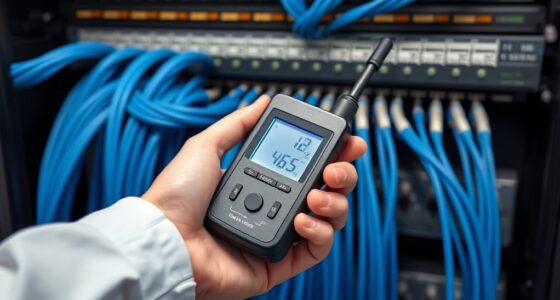
Understanding propagation delay is essential for anyone working with networks, as it directly impacts how quickly data travels between devices. This delay depends on factors like distance and the speed of signals through the medium, affecting everything from basic communication to high-speed data transfers. If you want to grasp how it influences network performance and what can be done to minimize it, there’s more to explore that could change how you approach network design.

Get business pricing on networking and server gear
- Business-only prices and quantity discounts
- Tax-exempt purchasing
- Multiple users, one account, clear invoices
Key Takeaways
- Propagation delay is the time it takes for signals to travel between devices across a communication medium.
- It depends on the physical distance, signal speed in the medium, and network infrastructure.
- Longer distances and slower signal speeds increase propagation delay.
- It affects network performance by causing delays in data transmission, impacting real-time applications.
- Factors like medium type, bandwidth, and signal attenuation influence the overall propagation delay.

Propagation delay refers to the time it takes for a signal to travel from the sender to the receiver across a communication medium. When you send data, it doesn’t arrive instantly; instead, it takes a finite amount of time depending on several factors. One key factor influencing this delay is the physical distance between devices. The longer the distance, the longer it takes for your signal to reach its destination. This delay becomes especially noticeable over vast networks like satellite communications or transoceanic fiber-optic cables.
Propagation delay is the time for signals to travel between devices, increasing with distance.
As your signal travels, it experiences signal attenuation, which is the reduction in signal strength over distance. This attenuation can cause parts of your data to become weaker or distorted, leading to potential errors or the need for retransmission. Bandwidth limitations also play a vital role in propagation delay. If your communication channel has limited bandwidth, it can restrict how much data can be transmitted at once, effectively adding latency to your communication. When bandwidth is constrained, your system may need to send data in smaller chunks or wait longer for the channel to clear, increasing overall delay.
Understanding the relationship between propagation delay and these factors helps you grasp why delays happen and how they impact network performance. For instance, in high-speed networks, even small delays can cause noticeable lags, affecting real-time applications like video calls or online gaming. If the communication medium has high signal attenuation, you might need repeaters or amplifiers to boost the signal, which can add to the overall delay. Similarly, bandwidth limitations mean your data transfer rates are capped, forcing your system to wait longer for data to be sent or received.
Propagation delay isn’t just about the physical distance; it also involves the speed at which signals can travel through the medium. For example, signals move at about two-thirds the speed of light in fiber optic cables but are slower in copper wires. This variation influences the delay experienced, especially in long-distance networks. When designing or troubleshooting networks, you need to think about how propagation delay interacts with signal attenuation and bandwidth constraints. These elements can compound, leading to increased latency, reduced efficiency, and degraded quality of service. Additionally, understanding the type of communication medium used can help optimize network performance and reduce delays.
Top picks for "propagation delay"
As an affiliate, we earn on qualifying purchases.
Frequently Asked Questions
How Is Propagation Delay Measured in Different Communication Systems?
You measure propagation delay in different communication systems by timing how long it takes for a signal to travel from the sender to the receiver, considering factors like transmission latency and signal attenuation. Use tools like oscilloscopes or network analyzers to track the signal’s start and arrival times. This helps you assess system efficiency and identify issues related to signal attenuation or delays caused by transmission media.
What Factors Influence Propagation Delay in Wireless Networks?
In wireless networks, propagation delay is influenced by factors like distance, signal attenuation, and environmental conditions. Longer distances increase delay, while obstacles and interference cause signal attenuation, slowing down transmission. Additionally, the frequency used impacts how quickly signals travel; higher frequencies tend to have more attenuation. In fiber optics, the speed of light and the quality of the fiber also affect delay, but wireless environments are more variable due to physical and atmospheric factors.
How Does Propagation Delay Affect Internet Speed and Reliability?
Imagine a ripple spreading across a pond; that’s how signal latency impacts your internet. Propagation delay causes data transmission to take longer, making your browsing feel sluggish or causing video calls to lag. This delay affects both speed and reliability, especially over long distances or congested networks. When the delay increases, your connection struggles to keep up, leading to buffering, interruptions, and a frustrating online experience.
Can Propagation Delay Be Minimized in Long-Distance Data Transmissions?
Yes, you can minimize propagation delay in long-distance data transmissions by using fiber optics, which offer faster signal travel compared to traditional cables. Additionally, reducing signal attenuation helps sustain signal strength over distance, further decreasing delay. Choosing high-quality fiber optic cables and amplifiers ensures your signals stay strong and reach their destination more quickly, improving overall internet speed and reliability for your long-distance communications.
What Are Common Methods to Compensate for Propagation Delay in Networks?
You can compensate for propagation delay by using fiber optics, which offer faster data transmission and reduced delay. Signal amplification helps strengthen weak signals over long distances, minimizing delay effects. Implementing advanced routing protocols also manages data flow efficiently. Together, these methods guarantee smoother, quicker network performance, especially in long-distance communications. By optimizing hardware and protocols, you effectively reduce the impact of propagation delay on your network.
Conclusion
So, in the grand scheme of your network, propagation delay is like the tiny whisper that can turn into a roaring bottleneck. It can make lightning-fast connections feel sluggish, turning your smooth data flow into a sluggish crawl. If you ignore it, you might as well be sending messages by carrier pigeon! Understanding and managing this delay is your secret weapon to keeping your network blazing at the speed of light—literally!
Halloween Picks
halloween
As an affiliate, we earn on qualifying purchases.