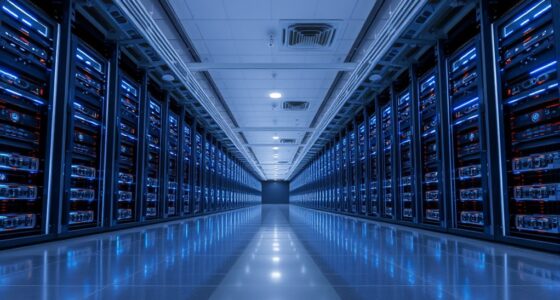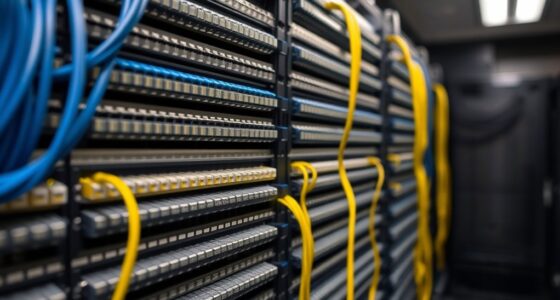
You need to understand that data centers handle massive data flows, requiring high-speed, high-capacity connections and extremely reliable cabling. Their priorities focus on performance, redundancy, and easy maintenance to support critical operations like cloud computing and real-time analytics. In contrast, offices prioritize safety, aesthetics, and flexibility for daily tasks. If you want to learn how these differing priorities shape cabling strategies, keep exploring further.

Get business pricing on networking and server gear
- Business-only prices and quantity discounts
- Tax-exempt purchasing
- Multiple users, one account, clear invoices
Key Takeaways
- Data centers require high-speed, high-capacity cabling to support large data flows and low latency, unlike office environments.
- Proper cable management in data centers ensures quick troubleshooting and maintenance for complex systems, which is less critical in offices.
- Redundancy and resilience are prioritized in data center cabling to minimize downtime, whereas offices focus on safety and aesthetics.
- Data centers need scalable and future-proof cabling systems to accommodate technological advancements and increasing data demands.
- Office cabling emphasizes safety, organization, and flexibility for daily tasks, while data centers focus on performance and operational reliability.
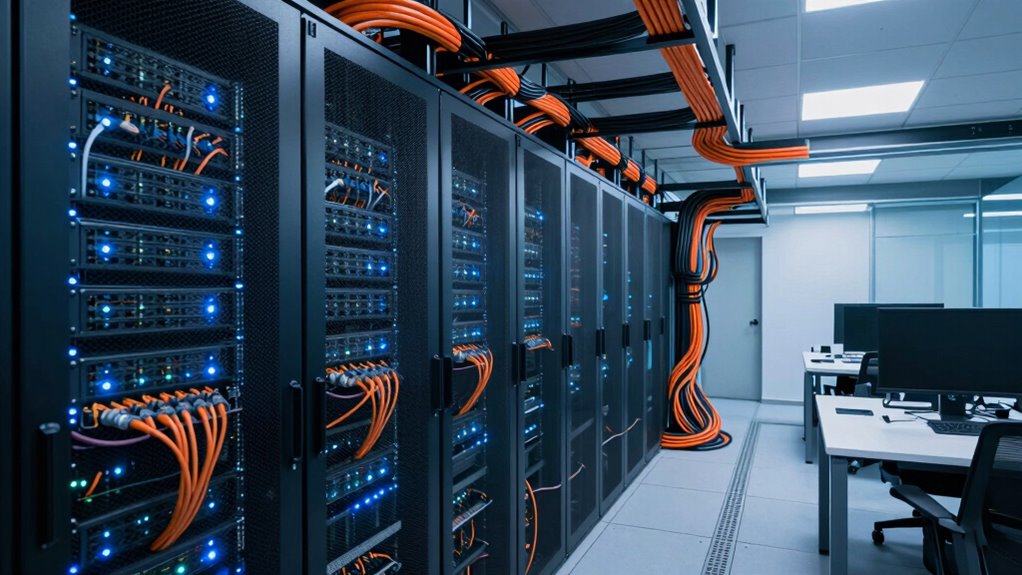
In today’s increasingly digital world, data centers and office environments must prioritize efficient cabling to guarantee reliable connectivity and smooth operations. While both settings require robust cabling systems, their priorities differ significantly due to their unique functions and performance demands. Data centers, for example, handle massive data flows and require high-speed, high-capacity connections, making fiber optics an essential component. Fiber optics provide the bandwidth needed for rapid data transfer, minimal latency, and scalability, which are critical for data-intensive tasks like cloud computing, virtualization, and real-time analytics. In contrast, office environments often focus on supporting day-to-day connectivity for employees, which typically involves less complex cabling infrastructure. Effective cable management becomes especially crucial in data centers, where the sheer volume of cables can quickly become overwhelming without proper organization. You need to plan your cabling layout meticulously, ensuring that fiber optics and other cables are neatly arranged and labeled. Proper cable management not only prevents tangling and accidental disconnections but also simplifies maintenance and future upgrades. When cables are well-organized, technicians can quickly identify issues without disrupting the entire system, minimizing downtime. For example, structured cabling systems help optimize space and facilitate easier upgrades in large-scale environments. Additionally, incorporating standardized installation practices can significantly improve reliability and troubleshooting efficiency. As the scale of data centers continues to grow, understanding cabling infrastructure becomes vital for ensuring long-term performance and resilience. Moreover, staying informed about emerging cabling technologies can give your data center a competitive edge by supporting more advanced and scalable solutions. The integration of advanced cabling technologies further enhances the ability to support evolving data requirements and ensures future-proofing. For office spaces, cable management might not be as complex, but it remains vital for safety, aesthetics, and ease of use. Properly managed cables reduce trip hazards and keep workspaces tidy, which can enhance productivity and morale. Data centers demand a cabling infrastructure that emphasizes redundancy and resilience. You must prioritize cabling routes that minimize interference and allow for easy access in case of repairs or upgrades. High-density racks and structured cabling systems enable you to maximize space and streamline cable routing. With fiber optics, you can achieve longer distances without signal loss, which is advantageous in large-scale data centers. Meanwhile, in office environments, your focus is usually on flexibility and cost-effectiveness. You may employ a simpler cabling approach, but still ensure that cables are organized to prevent clutter and facilitate easy reconfiguration. Ultimately, the differences in cabling priorities between data centers and offices boil down to scale, performance requirements, and operational complexity. Data centers require a resilient, high-capacity, and meticulously managed cabling system centered around fiber optics, which can handle the demands of vast data flows. Offices, by contrast, benefit from straightforward, well-organized cabling that supports reliable, everyday connectivity. Understanding these distinctions helps you design and implement cabling systems tailored to each environment’s specific needs, ensuring efficient, reliable, and scalable connectivity that supports your organization’s goals.
fiber optic cable for data centers
As an affiliate, we earn on qualifying purchases.
As an affiliate, we earn on qualifying purchases.
Frequently Asked Questions
How Do Environmental Factors Differ Between Data Centers and Offices?
You’ll notice environmental factors differ because data centers prioritize environmental controls and cooling systems to prevent overheating. Unlike offices, which mainly focus on air quality and comfort, data centers need constant temperature regulation to keep equipment running efficiently. You must guarantee robust cooling systems and strict environmental controls to protect sensitive hardware from heat damage and maintain ideal performance, making environmental management critical in data centers.
What Security Measures Are Specific to Data Center Cabling?
You should prioritize security measures like encryption protocols and physical barriers for data center cabling, since data is a treasure trove for hackers and insiders alike. By encrypting data during transmission and employing physical barriers such as locked racks and secure cable pathways, you make it harder for unauthorized access or tampering. These measures act like a double lock, safeguarding sensitive information and maintaining the integrity of your data center’s operations.
How Does Cable Management Impact Downtime in Data Centers?
Proper cable management directly reduces downtime by preventing cable damage, which extends cable longevity and guarantees reliable power distribution. When cables are organized, you minimize the risk of accidental disconnections or interference, leading to fewer outages. Efficient cable routing also simplifies troubleshooting, allowing you to quickly identify and resolve issues. Overall, good cable management keeps your data center running smoothly, enhancing stability and reducing costly downtime.
Are There Specific Standards for Data Center Cabling That Differ From Offices?
Think of data center cabling as the nervous system of your infrastructure—requiring specialized standards. You’ll prioritize cabling durability to withstand constant movement and environmental stresses, ensuring longevity. Color coding acts like traffic signals, guiding technicians swiftly and accurately through complex setups. These standards differ from office environments, where flexibility and aesthetics matter more. By adhering to these specific standards, you keep your data center running smoothly, avoiding costly downtime and chaos.
How Does Scalability Influence Cabling Choices in Data Centers?
Scalability influences your cabling choices by ensuring your data center can grow seamlessly. You’ll prioritize bandwidth optimization to handle increasing data loads without bottlenecks, and focus on power efficiency to reduce operational costs as equipment expands. Using flexible, high-capacity cabling solutions allows you to adapt quickly, maintaining performance and minimizing disruptions. This strategic approach helps future-proof your infrastructure, supporting growth while keeping energy consumption and costs in check.
As an affiliate, we earn on qualifying purchases.
Conclusion
Think of your data center as the beating heart of your digital world, where every cable is a crucial pulse ensuring life runs smoothly. Unlike office spaces, where aesthetics and flexibility matter more, your data center demands a focused, strategic approach—like a well-orchestrated symphony. Prioritizing cabling here is like tending to the roots of a mighty tree, anchoring stability and growth. When you get it right, your infrastructure stands tall, resilient, and ready to thrive.
As an affiliate, we earn on qualifying purchases.
cable management accessories for data centers
As an affiliate, we earn on qualifying purchases.
As an affiliate, we earn on qualifying purchases.
Fall Picks
fall essentials
As an affiliate, we earn on qualifying purchases.