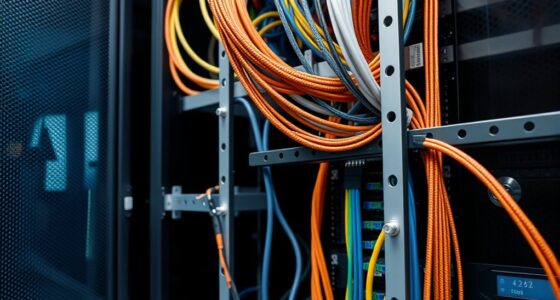
If you’re choosing between SFP28 and QSFP28 transceivers, consider your network needs. SFP28 modules support 25G over individual ports, perfect for upgrades or smaller setups, while QSFP28 transceivers aggregate four 25G channels into 100G, ideal for high-throughput data centers. Compatibility with existing fiber and power requirements also matter. Understanding these differences will help you select the right solution, and you’ll find more details if you continue exploring further.

Get business pricing on networking and server gear
- Business-only prices and quantity discounts
- Tax-exempt purchasing
- Multiple users, one account, clear invoices
Key Takeaways
- SFP28 transceivers support 25G per channel, ideal for individual high-speed links, while QSFP28 aggregates four 25G channels into a 100G port.
- SFP28 modules are compatible with existing infrastructure, whereas QSFP28 requires fiber capable of handling higher aggregate bandwidth.
- Power consumption of QSFP28 is generally higher than SFP28, impacting data center energy and cooling needs.
- SFP28 is versatile for various fiber types and distances; QSFP28 is optimized for high-throughput, short to medium distances.
- Future scalability involves considering higher speeds and existing fiber compatibility to ensure seamless network growth.
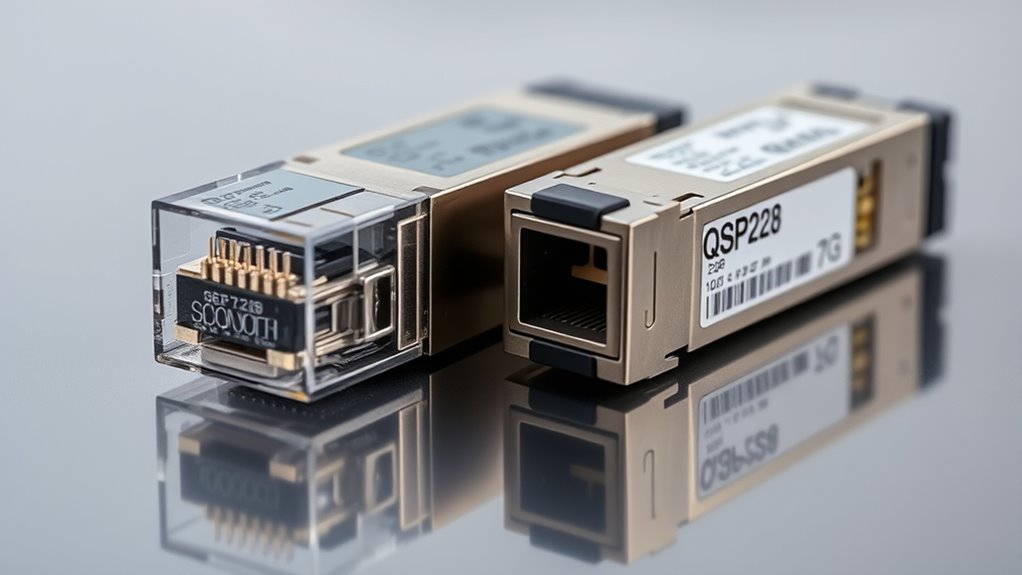
When choosing between SFP28 and QSFP28 transceivers, understanding their differences is essential for optimizing your network’s performance. Both types serve crucial roles in high-speed data transmission, but they vary significantly in design and application. One of the key factors to consider is optical compatibility. SFP28 modules are designed for individual 25G channels, making them highly compatible with existing SFP infrastructure. They typically support a range of fiber types, including both single-mode and multi-mode, allowing you to tailor your setup based on distance and bandwidth needs. QSFP28 transceivers, on the other hand, aggregate four 25G channels into a single 100G port, which means they demand compatible optical fiber cables capable of handling higher throughput. Ensuring optical compatibility is vital because mismatched transceivers and fiber types can lead to signal loss, reduced performance, or even equipment damage. When planning your network, verify that your fiber infrastructure supports the specific wavelength and connector type your transceivers require to maximize efficiency. Additionally, considering the power consumption of each transceiver type is important for managing overall energy costs and cooling requirements in your data center. When deciding, it’s helpful to evaluate not only the current network demands but also future scalability, ensuring your infrastructure can support higher speeds as technology evolves.
As an affiliate, we earn on qualifying purchases.
Frequently Asked Questions
Can SFP28 and QSFP28 Transceivers Be Interchanged in Networks?
You can’t directly interchange SFP28 and QSFP28 transceivers in networks due to compatibility considerations. They have different form factors, electrical interfaces, and data rates, leading to interchangeability limitations. Always check your device specifications and port types before swapping transceivers. Using incompatible modules can cause hardware damage or network failures. Make sure your network equipment supports the specific transceiver type to maintain ideal performance and avoid costly mistakes.
What Are the Key Differences in Power Consumption?
You’ll find that SFP28 transceivers generally consume less power than QSFP28 models, making them more power-efficient for 25G connections. This difference stems from their energy requirements, with SFP28s designed for lower power consumption, which helps reduce overall energy costs. QSFP28 transceivers, supporting higher data rates like 100G, tend to have higher power demands due to their increased bandwidth capabilities.
Are There Compatibility Issues With Existing Switches?
Think of your network as a finely tuned orchestra—compatibility issues can throw off the harmony. When upgrading to new transceivers, you might face switch compatibility challenges that disrupt seamless network integration. Some switches may not recognize newer SFP28 or QSFP28 modules, causing connection hiccups. To keep your network performing smoothly, verify your switches support these transceivers before installation, ensuring a harmonious and efficient upgrade process.
How Do Cost Differences Impact Large-Scale Deployments?
The cost differences considerably impact your large-scale deployments by influencing overall budget and cost efficiency. Choosing more affordable transceivers reduces expenses, allowing you to expand your deployment scale without overspending. While SFP28 transceivers may offer better cost efficiency for smaller setups, QSFP28 options might be more economical at higher speeds in large deployments. Balancing initial costs with long-term performance is key to optimizing your network infrastructure.
What Is the Typical Lifespan of Each Transceiver Type?
You can expect both SFP28 and QSFP28 transceivers to last around 5 to 10 years, depending on usage and environment. Their durability affects maintenance frequency; higher-quality units tend to need less frequent repairs. Regular cleaning and proper handling extend their lifespan. Keep in mind that operating conditions, such as temperature and power cycles, influence how long each transceiver remains reliable, so monitoring performance helps optimize their longevity.
As an affiliate, we earn on qualifying purchases.
Conclusion
Choosing between SFP28 and QSFP28 is like selecting the right tool for the job; each has its own strengths. SFP28 offers compact, cost-effective 25G solutions, perfect for smaller setups. QSFP28, on the other hand, is a powerhouse for 100G needs, ideal for high-bandwidth demands. Consider your network’s future growth and performance needs—like a seasoned captain guiding a ship—your choice should steer your network toward smooth, efficient sailing.
fiber optic transceiver for data center
As an affiliate, we earn on qualifying purchases.
As an affiliate, we earn on qualifying purchases.
As an affiliate, we earn on qualifying purchases.
Halloween Picks
halloween
As an affiliate, we earn on qualifying purchases.