
Network testers with PoE diagnostics range from simple power checkers to cable verifiers that also trace faults and measure cable length. I’d choose the Fluke Networks MicroScanner PoE as the best overall for technicians who need PoE checks alongside dependable copper-cable verification. The PoE Texas voltage and current tester is a more focused pick for quick, battery-free power checks, while the Henkion multifunction tester suits buyers who want a broad set of diagnostic tools in one device. The main tradeoff is whether you need clear PoE information, broader cable troubleshooting, or a low-complexity tool for occasional checks. Read on for how these nine options differ and which type of buyer each one suits.

Get business pricing on networking and server gear
- Business-only prices and quantity discounts
- Tax-exempt purchasing
- Multiple users, one account, clear invoices
Key Takeaways
- The MicroScanner PoE is the strongest all-around fit when PoE diagnostics need to sit alongside copper-cable verification rather than operate as a standalone check.
- The PoE Texas voltage and current models prioritize focused power checks; the no-battery version favors quick setup, while the detector model adds voltage, current, and power readings.
- The Henkion stands apart for breadth, combining PoE++ detection with a touchscreen, TDR, cable length tools, and digital multimeter functions, but its wider feature set may be more than a simple testing job requires.
- The two NF-488 listings appear to target similar continuity, loop, and PoE checks, so buyers should verify the exact included functions and accessories rather than assume the listings describe identical packages.
- Remote testing and cable tracing distinguish the Brileine and several Noyafa options; those functions matter on longer runs or when endpoints are hard to identify, but they are not substitutes for detailed PoE load analysis.
| PoE Texas Power Over Ethernet Detector & Tester for Voltage, Current, and Power |  | Best for Direct PoE Power Diagnostics | Power source: Network powered | Supported IEEE standards: 802.3af/at/bt | Voltage measurement range: 3.5–56V | VIEW ON AMAZON | See Our Full Breakdown |
| Noyafa NF-8209 Network Cable Tester with POE & NCV for CAT5/CAT6 | 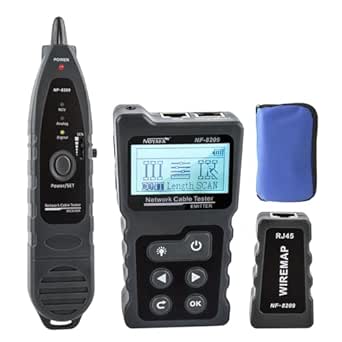 | Best for Cable Tracing Alongside PoE Checks | Power source: Battery powered; rechargeable transmitter | Operating voltage: 9–48V | Measurement types: Continuity, length, voltage, wire mapping | VIEW ON AMAZON | See Our Full Breakdown |
| Henkion Multifunction RJ45 Network Cable Tester, UTP Cable Tester Ethernet Cable Tracer, 4″ IPS Touch Screen, Support Network Tools, Digital Multi-Meter, POE++ Detect, RJ45 TDR, Length, FTP |  | Best for Advanced Multi-Tool Diagnostics | Power source: Rechargeable 4000mAh lithium-ion battery | Supported PoE protocols: IEEE 802.3bt/at/af | Display: 4-inch IPS touchscreen, 800 × 480 resolution | VIEW ON AMAZON | See Our Full Breakdown |
| PoE Texas Power Over Ethernet Voltage & Current Tester – No Battery Needed |  | Best Compact Field Tester | Power source: Network powered | Supported standards: IEEE 802.3af/at/bt | Minimum operating voltage: 3.5V | VIEW ON AMAZON | See Our Full Breakdown |
| NF-488 Network Cable Tester & POE Cable Tester, Cat5e/6, Continuity/Loop |  | Best for Basic PoE and Cable Checks | Power source: Battery powered | Compatible cable types: CAT5, CAT5e, CAT6, CAT6a | Cable fault checks: Shorts, crossovers, open circuits | VIEW ON AMAZON | See Our Full Breakdown |
| MicroScanner PoE Copper Cable Verifier and PoE Tester for RJ-45 Ethernet Cables |  | Best for Detailed PoE and Cable Diagnostics | Measurement type: Voltmeter | Power source: Alkaline batteries | PoE detection: PoE class 1–8 and voltage measurement | VIEW ON AMAZON | See Our Full Breakdown |
| Noyafa NF-488 POE Cable Tester for Power Over Ethernet, Network Cable Continuity Checking, Switch Loop-Back POE Detector |  | Best for Basic PoE and Loop-Back Checks | Measurement type: Voltmeter or power meter | Power source: Battery powered | Stated voltage range: 0–60V | VIEW ON AMAZON | See Our Full Breakdown |
| Brileine Network Cable Tester with POE Detection and 300m Remote Testing | 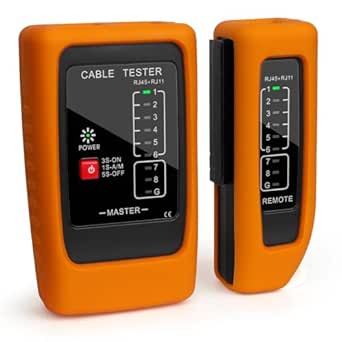 | Best for Long Cable Runs | Power source: 9V battery | Remote testing distance: Up to 300 meters | Connectors: RJ11, RJ12, and RJ45 | VIEW ON AMAZON | See Our Full Breakdown |
| Noyafa Network Cable Tester with POE Wire Checker, Automatic RJ45/RJ11/RJ12 CAT5/CAT6/CAT7 UTP Cables, NF466 |  | Best for Simple Home and Office Cable Checks | Model: NF-466S | Power source: 9V battery | Compatible connectors: RJ45, RJ11, and RJ12 | VIEW ON AMAZON | See Our Full Breakdown |
| network testers with poe diagnostic | Power source | Compatible devices | Weight |
|---|---|---|---|
| PoE Texas Power Over Ethernet | Network powered | Cameras, Wi-Fi access points, tablets, IP phones | 0.06 kg |
| Noyafa NF-8209 Network Cable T | Battery powered; rechargeable transmitter | — | 420 g |
| Henkion Multifunction RJ45 Net | Rechargeable 4000mAh lithium-ion battery | Network devices supporting IEEE 802.3bt/at/af | 300 g |
| PoE Texas Power Over Ethernet | Network powered | PoE cameras, VoIP phones, Wi-Fi installations | 0.06 kg |
| NF-488 Network Cable Tester & | Battery powered | CAT5, CAT5e, CAT6, CAT6a, PoE-enabled devices | — |
| MicroScanner PoE Copper Cable | Alkaline batteries | — | 247 g |
| Noyafa NF-488 POE Cable Tester | Battery powered | PoE switches, network switches, and Ethernet cables | — |
| Brileine Network Cable Tester | 9V battery | — | — |
| Noyafa Network Cable Tester wi | 9V battery | — | — |
More Details on Our Top Picks
PoE Texas Power Over Ethernet Detector & Tester for Voltage, Current, and Power
For buyers focused on what a powered Ethernet line is delivering, this PoE Texas kit puts voltage and current readings ahead of cable tracing or mapping. It supports IEEE 802.3af/at/bt and measures across a 3.5–56V range, so it suits checks on cameras, access points, and phones without adding a battery-dependent tester to the kit. Unlike the Noyafa NF-8209, it does not trace cable runs or measure their length; its narrower job is diagnosing PoE power at the connection. That simplicity also sets its limit: it needs an active PoE source to operate and cannot help with non-PoE power or broader cable faults. I’d choose it when power readings matter more than a toolkit of network tests.
Pros:- Supports IEEE 802.3af/at/bt PoE standards.
- Measures voltage from 3.5–56V and current, with power measurement support described in the product data.
- Runs from the PoE line, so no battery is required.
- Compact 0.06 kg form suits tight installation spaces.
Cons:- Requires an active PoE source to power the tester.
- Does not provide cable tracing, length measurement, or wire mapping.
- Limited to Ethernet and PoE diagnostics rather than other power sources.
Best for: Installers checking PoE voltage and current at cameras, access points, or phones who want a compact tester that draws power from the line.
Not ideal for: Technicians who need cable tracing, length measurement, wire mapping, or a tester that works without an active PoE source.
- Power source:Network powered
- Supported IEEE standards:802.3af/at/bt
- Voltage measurement range:3.5–56V
- Measurement types:Voltmeter, ammeter
- Current/power capacity:Up to 280W at 56V
- Compatible devices:Cameras, Wi-Fi access points, tablets, IP phones
- Weight:0.06 kg
Our verdict“Choose this kit when direct PoE voltage and current checks matter more than cable tracing or broader network testing.”
Noyafa NF-8209 Network Cable Tester with POE & NCV for CAT5/CAT6
The NF-8209 makes more sense than a dedicated power meter when the fault may be somewhere along the cable run. It combines PoE detection with tracing, continuity, wire mapping, and length measurement, giving installers several ways to narrow down a problem before replacing a cable. Its stated live-tracing reach of up to 600m is useful for locating a run, while the listed length measurement limit is 200 meters; those are different functions, so buyers should not treat them as the same range. Compared with the PoE Texas tester, the NF-8209 offers broader cable diagnostics but runs on a battery and has a more involved feature set. I’d pick it for mixed tracing and PoE work, not for someone who only needs quick power readings.
Pros:- Combines PoE detection with continuity, wire mapping, and cable length functions.
- Supports live cable tracing up to 600m.
- Rechargeable transmitter and included accessories support field work.
- Works with CAT5, CAT6, Ethernet, RJ45, and telephone lines.
Cons:- Its multiple functions may feel complicated for basic PoE checks.
- Length measurement is specified to 200 meters, shorter than the live-tracing reach.
- Battery-life details are not provided.
Best for: Field technicians working on CAT5/CAT6 or telephone lines who need PoE detection plus cable tracing, continuity, and wire mapping.
Not ideal for: Installers seeking a simple, battery-free PoE voltage and current tester, or buyers who need a clearly specified long-range length measurement.
- Power source:Battery powered; rechargeable transmitter
- Operating voltage:9–48V
- Measurement types:Continuity, length, voltage, wire mapping
- Maximum length measurement:200 meters
- Live cable tracing:Up to 600m
- PoE support:Yes
- Cable compatibility:CAT5, CAT6, Ethernet, RJ45, telephone line
- Weight:420 g
Our verdict“Pick the NF-8209 if cable location and fault finding are as important as identifying PoE on a run.”
Henkion Multifunction RJ45 Network Cable Tester, UTP Cable Tester Ethernet Cable Tracer, 4″ IPS Touch Screen, Support Network Tools, Digital Multi-Meter, POE++ Detect, RJ45 TDR, Length, FTP
Henkion is the broadest instrument in this group: PoE detection sits alongside TDR testing, cable tracing, length measurement, and a digital multimeter. Its 4-inch IPS screen gives those functions more room to present results than the compact LED-based PoE Texas tester, and the rechargeable 4000mAh battery supports use away from a live PoE connection. The listed length capability reaches 3000 meters, although buyers should check whether that suits their cable type and job requirements rather than assume every measurement mode reaches that distance. Compared with the Noyafa NF-8209, Henkion adds a larger interface and more tool functions, but its interface is likely to take longer to learn. This is a better fit for technicians who will use the extra diagnostic range, not for basic PoE checks.
Pros:- Combines PoE detection with TDR, cable tracing, and other network tools.
- 4-inch, 800 × 480 IPS touchscreen provides a large results interface.
- Rechargeable 4000mAh battery supports operation without relying on PoE line power.
- Lists cable length measurement up to 3000 meters and FTP report support.
Cons:- The range of functions can mean a steeper learning curve than simpler testers.
- At 300g, it is heavier than the 0.06 kg PoE Texas testers.
- Its many features may be unnecessary for buyers who only need PoE voltage or current checks.
Best for: Network technicians who routinely combine PoE checks with TDR, cable tracing, long-run length measurements, and digital-meter tasks.
Not ideal for: Beginners or occasional installers who want simple PoE detection, and technicians prioritizing the lightest, least complicated field tool.
- Power source:Rechargeable 4000mAh lithium-ion battery
- Supported PoE protocols:IEEE 802.3bt/at/af
- Display:4-inch IPS touchscreen, 800 × 480 resolution
- Maximum length measurement:Up to 3000 meters
- Additional functions:TDR testing, FTP report, NCV detection
- Compatible devices:Network devices supporting IEEE 802.3bt/at/af
- Weight:300 g
Our verdict“Choose Henkion when one instrument needs to cover PoE checks and a wider set of network diagnostics.”
PoE Texas Power Over Ethernet Voltage & Current Tester – No Battery Needed
This PoE Texas model is a focused field tool for technicians who want to read voltage, current, and power without carrying a battery-powered tester. It supports 802.3af/at/bt and draws its operating power from the Ethernet line, which keeps the setup simple when checking a live PoE connection. Compared with the NF-488, it avoids battery dependence and covers the newer listed PoE standards, but it does not check cable continuity or faults. The NF-8209 is a stronger choice when tracing and mapping are part of the job; this tester is more direct when the question is whether a PoE connection is supplying power. Its compact build is convenient, but the same narrow scope means it cannot replace a general network cable tester.
Pros:- Measures voltage, current, and power on PoE connections.
- Supports IEEE 802.3af/at/bt standards.
- Powered directly by the Ethernet line, with no battery requirement.
- Compact 0.06 kg design suits portable field kits.
Cons:- Needs an Ethernet connection supplying PoE to operate.
- Does not offer cable mapping, continuity, or data analysis.
- Limited to Ethernet and PoE diagnostics.
Best for: Installers who need quick PoE voltage, current, and power readings at cameras, VoIP phones, or Wi-Fi equipment without carrying batteries.
Not ideal for: Technicians diagnosing opens, shorts, cable length, or wire mapping, or anyone who needs testing away from an active Ethernet power source.
- Power source:Network powered
- Supported standards:IEEE 802.3af/at/bt
- Minimum operating voltage:3.5V
- Measurement types:Voltmeter, ammeter, wattmeter
- Compatible devices:PoE cameras, VoIP phones, Wi-Fi installations
- Dimensions:4 × 4 × 1.5 inches
- Weight:0.06 kg
Our verdict“Choose this compact tester for battery-free PoE power readings, but pair it with a cable tester for fault tracing.”
NF-488 Network Cable Tester & POE Cable Tester, Cat5e/6, Continuity/Loop
The NF-488 bridges simple cable checks and PoE inspection: it can identify shorts, crossovers, and open circuits, while also checking PoE voltage, polarity, and mode. That makes it more useful for basic fault isolation than either PoE Texas tester, which focuses on power measurements rather than cable continuity. It also lists current and power-consumption measurement for DC devices, adding flexibility beyond a basic wire checker. The tradeoff is a narrower cable scope—CAT5e and CAT6 are specified—and battery operation, unlike the network-powered PoE Texas tester. Its diagnostics are practical but not especially deep, so a technician needing long cable tracing or detailed mapping should look toward the NF-8209 instead.
Pros:- Checks shorts, crossovers, and open circuits on supported cables.
- Tests PoE voltage, polarity, and mode.
- Lists current and power-consumption measurement for DC devices.
- Includes an LED lamp for low-light work.
Cons:- Cable compatibility is limited to CAT5e and CAT6 in the product description.
- Requires batteries, unlike the network-powered PoE Texas testers.
- Provides basic checks rather than advanced tracing or detailed cable analysis.
Best for: Small-network installers checking CAT5e/CAT6 continuity and basic PoE voltage, polarity, or mode during routine troubleshooting.
Not ideal for: Technicians who need long-distance cable tracing, advanced fault analysis, or a battery-free tester for PoE power readings.
- Power source:Battery powered
- Compatible cable types:CAT5, CAT5e, CAT6, CAT6a
- Cable fault checks:Shorts, crossovers, open circuits
- PoE checks:Voltage, polarity, and mode
- Measurement types:Voltmeter, ammeter
- Compatible devices:CAT5, CAT5e, CAT6, CAT6a, PoE-enabled devices
- Dimensions:7.48 × 4.33 × 1.77 inches
Our verdict“Choose the NF-488 for straightforward CAT5e/CAT6 continuity and PoE checks, not advanced cable tracing.”
MicroScanner PoE Copper Cable Verifier and PoE Tester for RJ-45 Ethernet Cables
The Fluke Networks MicroScanner PoE earns this spot for buyers who need PoE class and voltage readings alongside cable verification. It also checks wiremap, cable length, and fault location, so it can help distinguish a power issue from a wiring fault without carrying separate basic testers. Its support for networks up to 10G Ethernet gives it a broader speed remit than the Brileine tester, whose standout advantage is remote testing over longer cable runs. The tradeoff is a narrower focus: this model is for Ethernet and PoE, not phone-cable checks or wider network diagnostics. Remote ID locators are sold separately, and battery power means keeping spares on hand. I’d choose it when diagnostic detail matters more than included accessories or a wider range of cable types.
Pros:- Detects PoE class 1–8 and measures voltage
- Supports network speeds up to 10G Ethernet
- Combines wiremap, cable ID, length, and fault-location checks
- Bright backlit LCD makes readings easier to see on site
Cons:- Remote ID locators are sold separately
- Limited to Ethernet cable and PoE-source testing
- Requires alkaline batteries, which are not included
Best for: Network installers and support technicians who need PoE class, voltage, wiremap, length, and fault-location checks on Ethernet runs.
Not ideal for: Buyers who need RJ11/RJ12 testing, remote ID locators included, or broader network diagnostics beyond Ethernet cables and PoE sources.
- Measurement type:Voltmeter
- Power source:Alkaline batteries
- PoE detection:PoE class 1–8 and voltage measurement
- Network speed support:Up to 10G Ethernet
- Cable diagnostics:Wiremap, cable length, cable ID, and fault location
- Weight:247 g
- Warranty:2 years
- Model:5018508
Our verdict“Choose the MicroScanner PoE when detailed PoE and Ethernet fault checks matter more than phone-line support or included remote locators.”
Noyafa NF-488 POE Cable Tester for Power Over Ethernet, Network Cable Continuity Checking, Switch Loop-Back POE Detector
The Noyafa NF-488 is a practical pick for technicians who want PoE, voltage, and power checks in a tester that also handles cable continuity and switch loop-back testing. That combination makes it more focused on quick field checks than the Fluke Networks MicroScanner PoE, which adds cable length, wiremap, and fault-location detail. The NF-488’s backlit LCD and anti-slip casing suit routine work around switches and patch cables, but the provided specifications give little detail about its voltage range beyond 0–60V. I’d favor it for straightforward troubleshooting where a clear reading and basic cable checks are enough; choose the MicroScanner instead when locating cable faults or checking higher-speed installations is part of the job. Battery and manual details are also sparse, so buyers should plan for some setup uncertainty.
Pros:- Combines PoE detection with voltage and power measurement
- Checks network cable continuity and supports switch loop-back testing
- Backlit LCD helps with readings in dim equipment areas
- Anti-slip casing suits handheld field use
Cons:- Voltage specifications are limited, with a stated range only up to 0–60V
- Batteries are not included
- Product information provides little detail about the included manual
Best for: Field technicians who regularly check PoE switches, Ethernet continuity, and basic voltage or power without needing detailed cable-length diagnostics.
Not ideal for: Installers who need documented voltage limits, detailed fault location, cable-length readings, or a clearly specified battery and manual package.
- Measurement type:Voltmeter or power meter
- Power source:Battery powered
- Stated voltage range:0–60V
- Compatible devices:PoE switches, network switches, and Ethernet cables
- Testing functions:PoE detection, continuity checking, voltage and power measurement, and switch loop-back
- Display:Backlit LCD
- Certifications:CE, FCC, ISO 9001, RoHS
- Casing:Durable anti-slip design
Our verdict“Pick the NF-488 for routine PoE, power, and continuity checks, but choose the MicroScanner PoE for richer cable diagnostics.”
Brileine Network Cable Tester with POE Detection and 300m Remote Testing
The Brileine stands out for a specific installation problem: checking cable runs with its included remote unit at distances up to 300 meters. It automatically scans RJ11, RJ12, and RJ45 wiring for continuity, opens, shorts, and crossover faults, with PoE detection adding a useful live-power check. Compared with the Noyafa NF466, which emphasizes automatic cable checks in a compact handheld format, the Brileine is the better fit when the far end of a long run is difficult to reach. Its diagnostics are still narrower than the Fluke Networks MicroScanner PoE’s class, voltage, length, and fault-location information. This is a cable-verification tool with PoE detection, not a detailed power analyzer. It also requires a separate 9V battery and does not offer a rechargeable option.
Pros:- Included remote unit supports testing up to 300 meters
- Automatically checks for continuity, opens, shorts, and crossover faults
- Detects live PoE
- Tests RJ11, RJ12, and RJ45 cables
Cons:- Requires a 9V battery that is not included
- Does not provide the detailed PoE class and cable-fault information offered by the MicroScanner PoE
- No built-in rechargeable battery
Best for: Installers testing long Ethernet or phone-cable runs who want an included remote unit and quick visual fault checks.
Not ideal for: Technicians who need detailed PoE class or power readings, advanced network diagnostics, or a rechargeable tester.
- Power source:9V battery
- Remote testing distance:Up to 300 meters
- Connectors:RJ11, RJ12, and RJ45
- Cable types:Cat5, Cat5e, and Cat6
- Cable tests:Continuity, open, short, and crossover detection
- PoE function:PoE detection
- Included components:Main and remote units
- Dimensions:1.5 x 0.8 x 4.2 inches
Our verdict“Choose the Brileine when long-distance remote cable checks matter more than detailed PoE measurements.”
Noyafa Network Cable Tester with POE Wire Checker, Automatic RJ45/RJ11/RJ12 CAT5/CAT6/CAT7 UTP Cables, NF466
The Noyafa NF466 is the straightforward choice here for automatic cable-wiring checks across common Ethernet and telephone connectors. It checks for continuity, opens, shorts, and miswiring, while its handheld design and indicator lights keep routine troubleshooting simple. That makes it less demanding to use than the Fluke Networks MicroScanner PoE, whose added class, voltage, cable-length, and fault-location readings suit technicians who need more diagnostic detail. The NF466’s listed PoE-related feature is a wire checker; the supplied product information does not specify PoE class or power measurement, so I would not treat it as a substitute for a dedicated PoE analyzer. It also runs on a 9V battery and lacks advanced network diagnostics. For basic cable maintenance at home or in a small office, its simpler approach may be enough.
Pros:- Automatically checks continuity, open circuits, shorts, and miswiring
- Supports RJ45, RJ11, and RJ12 connectors
- Compatible with CAT5, CAT6, and CAT7 UTP cables
- Portable handheld design with clear indicator lights
Cons:- Requires a 9V battery that needs periodic replacement
- Product details do not specify PoE class or power measurement
- Lacks advanced diagnostics such as cable length and fault location
Best for: Home network maintainers and small-office support staff who need automatic checks for common cable wiring faults across Ethernet and phone leads.
Not ideal for: PoE installers who need class, voltage, or power readings, or technicians diagnosing complex network and cable faults.
- Model:NF-466S
- Power source:9V battery
- Compatible connectors:RJ45, RJ11, and RJ12
- Compatible cable types:CAT5, CAT6, and CAT7 UTP
- Cable tests:Continuity, open circuit, short circuit, and miswiring
- Display:Indicator lights
- Dimensions:6.69 x 2.76 x 1.38 inches
- Color:Red/Black
Our verdict“Choose the NF466 for simple automatic cable checks, but select the MicroScanner PoE if you need measured PoE and richer fault diagnostics.”

How We Picked
I ranked these network testers with PoE diagnostics by how well their stated functions address common field decisions: whether a cable carries power, whether its conductors are continuous and correctly mapped, and how readily a technician can locate or characterize a fault. I gave more weight to tools that pair useful PoE information with broader copper-cable checks, because that combination can reduce the need to carry separate testers. Ease of use, power source, stated cable reach, and the difference between a focused checker and a multifunction instrument also shaped the order.
The ranking reflects feature scope and practical fit, not a claim that every model provides the same depth of PoE measurement. A voltage or PoE-presence check is not equivalent to evaluating performance under load, and a continuity tester does not certify network throughput. I placed specialized, straightforward tools lower when their narrower scope suits fewer troubleshooting jobs, while still calling out where that simplicity is an advantage. Product names and listed functions are the basis for this comparison; buyers should confirm exact capabilities and included accessories for the specific listing they plan to purchase.
| network testers with poe diagnostic | Compatible devices |
|---|---|
| PoE Texas Power Over Ethernet | Cameras, Wi-Fi access points, tablets, IP phones |
| Noyafa NF-8209 Network Cable T | — |
| Henkion Multifunction RJ45 Net | Network devices supporting IEEE 802.3bt/at/af |
| PoE Texas Power Over Ethernet | PoE cameras, VoIP phones, Wi-Fi installations |
| NF-488 Network Cable Tester & | CAT5, CAT5e, CAT6, CAT6a, PoE-enabled devices |
| MicroScanner PoE Copper Cable | — |
| Noyafa NF-488 POE Cable Tester | PoE switches, network switches, and Ethernet cables |
| Brileine Network Cable Tester | — |
| Noyafa Network Cable Tester wi | — |
Factors to Consider When Choosing Network Testers With Poe Diagnostics
Choose a tester around the fault you need to diagnose, not the longest feature list. The right tool depends on whether you are checking PoE availability, finding a wiring fault, tracing a run, or verifying a link before handoff. These distinctions also help prevent paying for advanced functions that your work rarely uses.
Decide What PoE Diagnosis Means for Your Work
PoE detection can mean little more than indicating that power is present, or it can include readings such as voltage, current, and power. Those outputs answer different questions: presence helps identify an energized port, while electrical readings offer more detail about the supply. Do not assume a basic PoE indicator measures how a device behaves under its real operating load. If you troubleshoot powered access points or cameras, check the product documentation for the exact measurement method and supported PoE types. A simpler detector can be the sensible choice for quick checks, while more detailed measurements matter when power delivery itself is in question. Match the tool to the decision you need to make at the cable end.
Separate Cable Verification From Performance Certification
Continuity, wire-map, and length functions help find opens, shorts, crossed pairs, and other physical cabling problems. They do not automatically certify that a run meets a particular Ethernet performance category or passes a full standards-based qualification test. This distinction matters when a client asks for documented acceptance results: a handheld troubleshooting tool may identify faults without producing certification records. Before buying, decide whether your work calls for fast fault isolation or formal installation sign-off. Multifunction models can cover more troubleshooting tasks, but buyers should not treat a large feature list as proof of certification capability. Confirm the test modes and reporting features against the job requirements.
Think Through Remote Access and Cable Length
Remote testing helps when a cable’s far end is unattended, in a ceiling, or spread across a building. A remote unit can let one person check a run without repeatedly walking between endpoints, but the convenience depends on having the right remote accessories and using them correctly. Stated distance limits also need context: a tool may claim long-range testing while offering only basic continuity or identification at that reach. Consider the longest runs you actually service and whether you need to identify one cable among a bundle. For short patch leads, remote range may add little value. For structured cabling work, tracing and remote identification can save more time than extra PoE readouts.
Choose Simplicity or an All-in-One Interface
A focused tester usually has fewer modes to learn and can be easier to hand to a colleague for a quick check. A touchscreen multifunction unit may combine cable tracing, length measurement, TDR, and electrical tools, reducing the number of devices in a kit. The tradeoff is a more involved interface and a greater chance that a rarely used mode drives the purchase without helping daily work. Think about who will operate the tester, how often, and whether clear labels or guided steps matter on site. A broader instrument is most useful when several of its functions replace tools you already carry. For occasional PoE checks, a dedicated, direct-reading device may be a better fit.
Check Power, Accessories, and the Cost of Downtime
Battery requirements affect readiness: a battery-free tester can be convenient for brief checks, while a powered instrument may support a wider set of functions. Confirm whether the package includes remotes, probes, adapters, and batteries rather than assuming every pictured accessory is included. Also think about maintenance: more complex tools may require charging, careful storage, or familiarization before they are useful in a time-sensitive fault call. The least expensive tool to operate is not always the one with the fewest features; repeated trips to retrieve a second tester can cost more time than carrying one capable unit. Balance kit simplicity against the kinds of faults that cause the most disruption in your work.
Frequently Asked Questions
Can a PoE detector tell me whether a device is receiving enough power?
Not always. A tester that detects PoE or reports voltage confirms something about the supply, but that alone may not show how the circuit performs while a device draws power. Check whether the tool measures current or power and how those readings are taken. For a fault that appears only under load, compare the tester’s documented method with the device’s power requirements. If the tool offers only PoE presence detection, treat it as a screening aid rather than a full power-delivery diagnosis.
Should I buy a PoE tester or a cable verifier with PoE detection?
Pick a dedicated PoE tester if your recurring question is whether a port supplies power and you want focused electrical readings. A cable verifier with PoE detection makes more sense when you also need wire mapping, continuity checks, or cable-fault troubleshooting in the same visit. The MicroScanner PoE represents the broader verification approach in this roundup, while the PoE Texas options focus more directly on electrical checks. Neither category automatically replaces a certification instrument. Start with the faults you diagnose most often, then add a separate tool only if your work needs a function the first one lacks.
Do these testers confirm that a cable meets Cat5e or Cat6 performance requirements?
A tester listing support for Cat5e or Cat6 cable does not by itself mean it certifies performance to that category. Many handheld units check continuity, wiring order, length, or faults, which can catch installation problems but do not provide the same evidence as a certification test. Look for explicit documentation about qualification or certification and any required test limits or reports. If a project requires formal compliance records, confirm that requirement before choosing a general-purpose cable tester. For routine troubleshooting, basic verification may be enough.
Is a battery-free PoE tester a good choice as my only network tester?
It can be a useful primary tool if your work is mostly quick PoE voltage or current checks and you rarely troubleshoot cable wiring. The no-battery design reduces one source of downtime, but it does not provide the broader cable tracing and verification functions found on multifunction testers. If you often deal with open conductors, pair faults, or unidentified runs, you may need a second device. Compare the time saved by simple setup with the extra trips caused by missing diagnostics. Your work pattern matters more than the convenience of avoiding batteries alone.
When is a touchscreen multifunction tester worth choosing over a simpler model?
A touchscreen tool makes more sense when you will regularly use several of its functions, such as TDR, cable length testing, tracing, and PoE++ detection. Combining those tasks in one instrument can reduce kit changes and help with varied service calls. It is a weaker fit when you only need to confirm PoE presence or check a short patch cable, since extra modes can add complexity without solving a recurring problem. Before choosing, verify that the functions you need are clearly specified and that the interface suits the people who will use it. The Henkion is the broadest-featured option here, but its range is most valuable to buyers with varied diagnostic needs.
Conclusion
For one tool that pairs PoE checks with wider copper-cable verification, I’d choose the Fluke Networks MicroScanner PoE as the best overall. The best value in function-specific terms is the PoE Texas voltage and current tester if your work centers on direct power readings; choose its battery-free counterpart when simple setup matters more than a broader diagnostic set. The Henkion is my best premium-style multifunction pick for buyers who will use its touchscreen, TDR, length, and multimeter features, while the straightforward PoE Texas tester is the best fit for beginners who mainly need clear power checks. For long or hard-to-access runs, look at the Brileine or a Noyafa model with the remote or tracing functions that match your workflow. Before ordering, confirm the exact PoE measurements, cable tests, and accessories included in the specific listing.
Halloween Picks
halloween
As an affiliate, we earn on qualifying purchases.