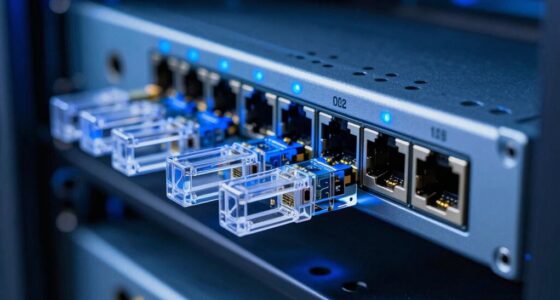
As data demands continue to grow, the future of Ethernet is shifting towards 400G and 800G standards, driven by the need for faster, more reliable connections. Fiber optics play a key role in this evolution, offering higher bandwidth and longer reach. Understanding how these advancements will impact network infrastructure and your organization’s ability to stay competitive is essential—there’s more to contemplate as technology pushes these boundaries further.

Get business pricing on networking and server gear
- Business-only prices and quantity discounts
- Tax-exempt purchasing
- Multiple users, one account, clear invoices
Key Takeaways
- The shift to 400G and 800G Ethernet standards is driven by increasing data speed demands in modern networks.
- Fiber optics are essential for supporting these high data rates over longer distances with greater bandwidth.
- Advanced components like WDM enable scalable, multi-channel transmission on a single fiber, enhancing network capacity.
- Future Ethernet networks will prioritize fiber optic scalability for seamless expansion and infrastructure upgrades.
- Investing in fiber optic technology ensures networks are robust, adaptable, and ready for next-generation high-speed applications.

As the demand for higher data speeds continues to grow, Ethernet technology is rapidly evolving to meet these needs. The shift toward 400G and 800G Ethernet standards is driven by the need for faster, more reliable data transmission, especially as data centers and enterprise networks handle increasing volumes of traffic. One of the key factors enabling this leap in performance is the integration of fiber optics. Fiber optic cables allow for greater bandwidth and longer transmission distances compared to traditional copper cables, making them essential for high-speed Ethernet deployments. As you upgrade your network, you’ll find that fiber optics not only support the increased data rates but also enhance network scalability, allowing your infrastructure to grow seamlessly without bottlenecks.
Fiber optics enable higher data rates and scalable, reliable Ethernet networks for future growth.
The push toward higher speeds like 400G and 800G isn’t just about raw data transfer rates; it’s also about future-proofing your network. Fiber optics play a crucial role here because they provide the scalability needed to support expanding network demands. With fiber optics, you can increase your network’s capacity without overhauling the entire infrastructure. This flexibility is vital as data centers and enterprise networks expand their reach, incorporate new technologies, and require more bandwidth. The inherent scalability of fiber optics means you can add more channels or upgrade existing ones easily, ensuring your network remains efficient and capable of handling the next wave of data-intensive applications.
Moreover, as Ethernet standards evolve toward these higher speeds, you’ll notice a shift in how networks are designed and managed. The use of advanced fiber optic components, such as wavelength division multiplexing (WDM), allows multiple data channels to coexist on a single fiber, further boosting network scalability. This means you can maximize existing infrastructure investments while preparing for future growth. The combination of fiber optics and cutting-edge Ethernet standards ensures your network can adapt quickly to new challenges without costly disruptions or extensive rewiring.
In essence, the future of Ethernet at 400G and 800G is closely tied to fiber optics’ capabilities to deliver high bandwidth and scalable solutions. As you plan your network upgrades, prioritizing fiber optic technology will help you stay ahead in an increasingly data-driven world. It offers the agility and capacity needed to support the rapid growth of data traffic, ensuring your network remains robust and scalable for years to come. Whether for data centers, cloud services, or enterprise applications, embracing fiber optics as part of your Ethernet upgrade is a strategic move to meet tomorrow’s connectivity demands today. Advanced fiber optic technology is a key enabler in achieving these high-performance standards.
Products Worth Considering

DJI Osmo Mobile 8 Gimbal with Mic Mini Transmitter, Infinity Black

Samsung 32-Inch Odyssey OLED G8 (G80SH) 4K Gaming Monitor

LG UltraGear 27-Inch QHD OLED Gaming Monitor, 240Hz, 0.03ms, G-SYNC Compatible, FreeSync Premium Pro, HDMI 2.1
As an affiliate, we earn on qualifying purchases.
Frequently Asked Questions
How Will 400G and 800G Impact Existing Network Infrastructure Costs?
You’ll find that 400G and 800G Ethernet can reduce your network costs by enabling higher data throughput with fewer hardware upgrades. However, you might face deployment challenges, such as upgrading existing infrastructure and ensuring compatibility. Despite these hurdles, long-term cost reduction is achievable as these speeds streamline your network, decrease maintenance, and support growing data demands more efficiently.
What Industries Will Benefit Most From Ultra-High-Speed Ethernet?
Imagine lightning-fast highways for data—ultra-high-speed Ethernet transforms industries. You’ll see data centers benefit most, needing rapid data transfer for cloud computing and storage. These speeds enable seamless streaming, real-time analytics, and big data processing. Industries like finance, healthcare, and tech will thrive, leveraging this connectivity for innovation. If you work in these fields, expect a boost in efficiency and performance as Ethernet speeds skyrocket, opening new horizons.
Are There Any Environmental Concerns With Deploying These High-Speed Networks?
You should consider that deploying high-speed Ethernet can raise environmental concerns, mainly due to increased energy consumption and material use. These networks may require more power to operate efficiently, impacting energy resources. Additionally, sourcing sustainable materials for manufacturing hardware is essential to reduce environmental footprints. By focusing on energy efficiency and material sustainability, you can help minimize the ecological impact of adopting 400G and 800G Ethernet technologies.
How Will Latency Be Affected at 400G and 800G Speeds?
At 400G and 800G speeds, you’ll notice that latency improves due to enhanced latency optimization techniques and faster data flow. These high speeds reduce transmission delays, ensuring smoother and more responsive network performance. However, to fully benefit, you need to implement advanced network management and hardware capable of handling the increased data rates efficiently. Overall, these speeds aim to minimize latency, making your network more reliable and faster for demanding applications.
What New Challenges Will Network Hardware Manufacturers Face?
You’ll face scaling challenges as network hardware manufacturers push toward 400G and 800G speeds, requiring more sophisticated components and power management. Interoperability issues may arise as new standards emerge, making it hard to guarantee seamless compatibility across devices and vendors. Staying ahead means addressing these hurdles with innovative designs, robust testing, and collaborative efforts to create a unified ecosystem that supports higher data rates efficiently and reliably.
Conclusion
As you build your network, think of fiber optics as the highway to tomorrow’s data demands. Just like a highway expanding to accommodate more traffic, 400G and 800G Ethernet standards guarantee your infrastructure stays ahead. Investing now is like laying down the best asphalt—future-proof and ready for the fast lanes of innovation. With these advancements, your network will smoothly carry the digital world’s growing traffic, keeping you connected today and tomorrow.