
DWDM and CWDM are key fiber-optic technologies that increase network capacity by using different channel spacing techniques. DWDM packs more channels into the same bandwidth with tightly spaced signals, boosting spectral efficiency for long-distance, high-capacity links. CWDM uses wider channel spacing, making it simpler and more cost-effective for shorter networks. Understanding how these technologies operate helps you optimize network design—stay with us to explore more about their differences and applications.

Get business pricing on networking and server gear
- Business-only prices and quantity discounts
- Tax-exempt purchasing
- Multiple users, one account, clear invoices
Key Takeaways
- DWDM and CWDM are methods to multiplex multiple signals over a single fiber, increasing network capacity.
- DWDM offers higher spectral efficiency with closely spaced channels, suitable for long-distance, high-capacity links.
- CWDM uses wider channel spacing, simplifying system design and reducing costs for short-range applications.
- DWDM typically requires precise wavelength control and advanced equipment, while CWDM is more cost-effective and easier to deploy.
- Choice between DWDM and CWDM depends on capacity needs, distance, technical complexity, and budget considerations.
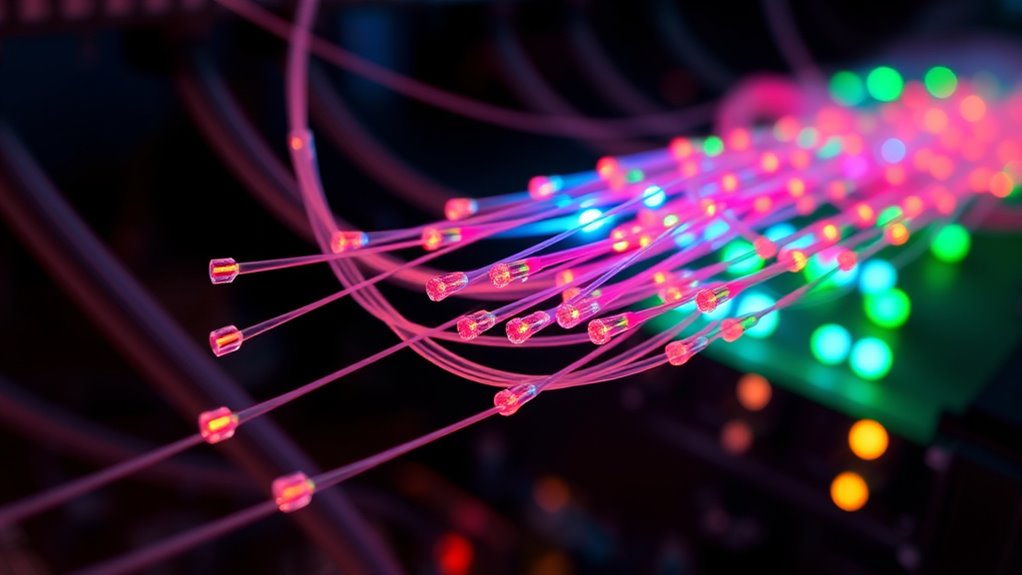
Have you ever wondered how modern fiber-optic networks transmit so much data so quickly? The secret lies in how these networks efficiently pack multiple signals onto a single fiber. This is where dense wavelength division multiplexing (DWDM) and coarse wavelength division multiplexing (CWDM) come into play. Both techniques use different strategies to maximize the amount of data transmitted over a single fiber, with spectral efficiency and channel spacing being key factors in their performance.
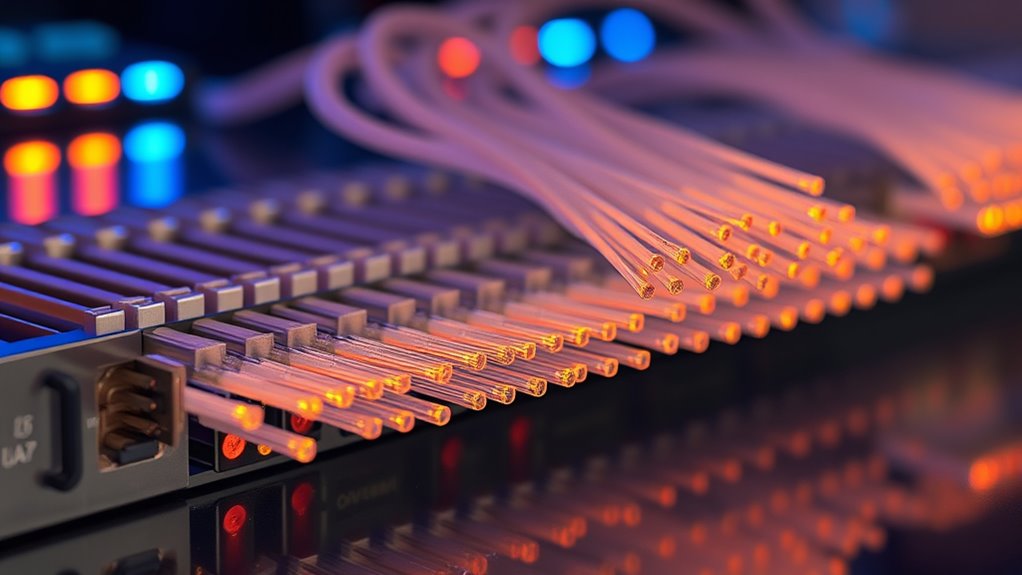
Spectral efficiency refers to how effectively a system uses the available optical spectrum to transmit data. In fiber networks, higher spectral efficiency means more channels can coexist within a given bandwidth, boosting capacity without laying additional fibers. DWDM systems typically achieve higher spectral efficiency because they pack signals very tightly together, often using advanced modulation formats. This tight packing relies on precise control over channel spacing—the distance between the central wavelengths of adjacent channels. Narrower channel spacing allows for more channels in the same spectral band, considerably increasing the total data throughput. However, reducing channel spacing demands more sophisticated equipment and precise wavelength stabilization to prevent crosstalk and interference, which can degrade signal quality.
Higher spectral efficiency in fiber networks enables more channels in the same bandwidth by tightly packing signals with precise channel spacing.
In contrast, CWDM employs wider channel spacing, usually around 20 nanometers, making it easier and less expensive to implement. This wider spacing reduces the risk of interference and simplifies system design, but it also limits how many channels can fit into the spectrum, resulting in lower spectral efficiency compared to DWDM. CWDM systems are often used for shorter distances or less capacity-intensive applications where cost and simplicity are more critical than maximum spectral utilization.
When choosing between DWDM and CWDM, consider your network’s capacity needs and budget. If you need to transmit vast amounts of data over long distances and want to maximize spectral efficiency, DWDM is the better choice, despite its higher initial costs and complexity. Its ability to operate with narrow channel spacing allows for more channels within the same spectral bandwidth, making it ideal for backbone networks and data centers. Conversely, if your requirements are more modest, or you’re building a cost-effective, short-range network, CWDM offers a simpler and more economical solution with wider channel spacing, which reduces technical complexity and overall costs.
Understanding how spectral efficiency and channel spacing influence the performance of DWDM and CWDM helps you make informed decisions for your fiber-optic network. By balancing these factors against your specific needs, you can optimize your data transmission capacity while managing costs and complexity effectively. Additionally, selecting natural materials such as glass fibers enhances the overall performance and durability of your network infrastructure.
As an affiliate, we earn on qualifying purchases.
Frequently Asked Questions
How Do DWDM and CWDM Compare in Cost?
You’ll find that DWDM systems generally cost more than CWDM solutions due to their advanced technology and higher capacity. A pricing analysis shows DWDM’s premium reflects its ability to support longer distances and more channels. Market trends indicate CWDM is more budget-friendly for short-range applications, making it ideal for smaller networks. Your choice depends on your capacity needs and budget constraints, but overall, CWDM offers a cost-effective option for many users.
What Are the Environmental Requirements for Deploying DWDM and CWDM?
You need to guarantee temperature stability and manage power requirements when deploying DWDM and CWDM. DWDM systems demand strict temperature control and stable power sources due to their high-density channels, while CWDM tolerates wider temperature variations with less power. Both require proper environmental conditions, such as clean, dust-free spaces, but DWDM’s sensitivity means better climate control is essential for peak performance.
Can DWDM and CWDM Technology Be Integrated Into Existing Networks?
Yes, you can integrate DWDM and CWDM technology into existing networks, but you’ll need to take into account network compatibility and potential infrastructure upgrades. Assess your current fiber infrastructure to confirm it supports the new equipment, and plan for any necessary upgrades to connectors or amplifiers. Proper integration allows you to expand capacity efficiently, making the most of your existing network while enhancing data transmission capabilities.
What Is the Typical Lifespan of DWDM and CWDM Equipment?
Typically, DWDM and CWDM equipment last about 10 to 15 years, but their longevity depends on usage and maintenance. You should regularly monitor performance and perform necessary maintenance to extend equipment longevity. Proper care and timely upgrades can guarantee your network remains efficient, reducing the risk of failures. Ultimately, proactive maintenance considerations help maximize the lifespan of your DWDM and CWDM systems, keeping your fiber network reliable over time.
How Do Signal Amplification Methods Differ Between DWDM and CWDM?
You’ll find that signal boosting methods differ between DWDM and CWDM. In DWDM systems, optical amplification typically uses erbium-doped fiber amplifiers (EDFAs) to boost multiple wavelength channels simultaneously, ensuring minimal signal degradation over long distances. CWDM systems, on the other hand, often rely on inline amplifiers or optical repeaters because they handle fewer channels and shorter spans. Both methods optimize signal quality through effective optical amplification.
CWDM wavelength division multiplexing modules
As an affiliate, we earn on qualifying purchases.
As an affiliate, we earn on qualifying purchases.
Conclusion
By now, you can see that DWDM and CWDM are the backbone of modern fiber networks, each with its own strengths. Think of them as the lanes on a highway—DWDM is like a multilane motorway, carrying vast amounts of data at once, while CWDM is a simpler, less crowded street for smaller loads. Comprehending these technologies helps you navigate the complex web of fiber optics and guarantees your network runs smoothly like a well-oiled machine.
fiber optic network equipment for DWDM and CWDM
As an affiliate, we earn on qualifying purchases.
As an affiliate, we earn on qualifying purchases.
high capacity fiber optic multiplexers
As an affiliate, we earn on qualifying purchases.
As an affiliate, we earn on qualifying purchases.
Halloween Picks
halloween
As an affiliate, we earn on qualifying purchases.