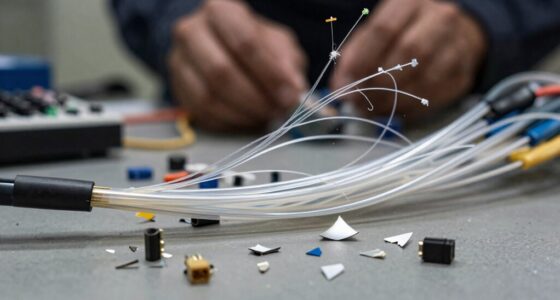
Imagine a single beam of light splitting into many streams, illuminating an entire city block without losing strength. That’s the essence of Passive Optical Networks (PON)—a technology that efficiently delivers high-speed internet directly to homes and businesses. Its passive design means fewer components and less maintenance, making it reliable and cost-effective. But how does this system achieve such performance while remaining simple? The answer lies in understanding the core principles of PON.
Key Takeaways
- PON uses fiber optic cables and passive splitters to deliver high-speed internet directly to users efficiently.
- It eliminates active equipment at endpoints, reducing costs and simplifying network architecture.
- The network features an OLT at the central office that manages multiple ONUs/ONTs at user locations.
- PON offers high data rates, low latency, and supports symmetrical upload and download speeds.
- Its scalable design allows easy expansion and upgrades without extensive infrastructure changes.

Passive Optical Networks (PONs) are a cost-effective and efficient way to deliver high-speed internet and telecommunications services. When you’re considering how to improve network infrastructure, fiber deployment plays an essential role. PON technology relies on fiber optic cables to connect service providers directly to your home or business, eliminating the need for expensive active equipment at every endpoint. This approach simplifies the overall network architecture, making it easier to manage and scale as demand grows.
Passive Optical Networks use fiber to connect providers directly to homes, simplifying architecture and reducing costs.
In a typical PON setup, fiber deployment starts at a central office, where an Optical Line Terminal (OLT) acts as the main controller. From there, fiber optic cables extend outward to multiple endpoints, known as Optical Network Units (ONUs) or Optical Network Terminals (ONTs). These are installed directly at your location, providing a direct fiber link that supports high data transfer rates. The network architecture of PONs is designed to be passive, meaning it doesn’t require electrical power in the distribution network between the OLT and ONUs. Instead, passive splitters divide the signal from a single fiber into multiple streams, allowing a single fiber to serve numerous users efficiently.
This passive split architecture not only reduces costs but also enhances reliability since fewer active components mean fewer points of failure. When you get connected via a PON, your data travels along a shared fiber infrastructure that’s optimized for bandwidth and low latency. The network architecture supports symmetrical upload and download speeds, making it ideal for high-demand applications like streaming, gaming, and remote work. Because fiber deployment is at the core of PONs, you benefit from future-proof infrastructure capable of supporting growing bandwidth needs without frequent upgrades.
Implementing PONs requires careful planning of fiber deployment routes and the strategic placement of splitters to maximize coverage and performance. The architecture is scalable, so service providers can add more users or increase bandwidth as demand increases, simply by upgrading the OLT or adjusting splitter configurations. This flexibility makes PONs a smart investment for expanding network reach without substantial infrastructure overhaul. Additionally, fiber deployment is a crucial aspect that impacts the overall performance and scalability of PON networks.
Frequently Asked Questions
How Does PON Compare to Traditional Fiber-Optic Networks?
You’ll find that PONs are more cost-effective and easier to maintain than traditional fiber-optic networks. PONs use fiber splitters to divide signals among multiple users, creating a simplified network topology that reduces infrastructure costs. Unlike point-to-point setups, PONs share a single fiber among many users, making them more efficient. This shared architecture streamlines deployment, lowers expenses, and offers scalable bandwidth for growing demands.
What Are the Main Advantages of PON for Consumers?
You benefit from PON’s main advantages through its cost efficiency and ease of installation. It reduces your costs by sharing infrastructure with other users, lowering your monthly bills. Plus, installation is quicker and simpler since it requires less equipment and fewer disruptions. This means you get high-speed internet with minimal hassle, making PON a smart choice for reliable, affordable connectivity in your home.
How Secure Is Data Transmission in a PON System?
Your data transmission in a PON system is quite secure because it uses strong encryption protocols to protect your information from unauthorized access. Additionally, the system maintains data integrity, ensuring that your data isn’t tampered with during transfer. While no system is completely invulnerable, PON’s advanced security measures make it a reliable choice for safe, private internet connections.
Can PON Technology Support Future Bandwidth Demands?
Think of PON technology as a highway that keeps expanding; it’s built for fiber scalability and can support the bandwidth evolution you’ll need. As demand for data grows—like when streaming 8K videos or virtual reality becomes routine—PON systems adapt with upgrades to split ratios and wavelength division multiplexing. This flexibility makes certain your network remains future-proof, handling increasing bandwidth demands without major overhauls.
What Are the Typical Costs Involved in Deploying PON Infrastructure?
You’ll find that deploying PON infrastructure involves costs like a detailed cost analysis and equipment pricing. The main expenses include optical line terminals (OLTs), optical network terminals (ONTs), and fiber optic cables. Installation costs vary depending on the size of the area and existing infrastructure. While initial investments can be significant, the long-term benefits of scalable, high-speed connectivity often justify the costs for providers and consumers alike.
Conclusion
In the world of fast, reliable internet, PON stands out by being both simple and sophisticated. It’s like a quiet hero—passive, yet powerful—delivering high speeds without the complexity of active components. You get the best of both worlds: ease of scalability and dependable performance. So, as technology advances and demands grow, PON remains a smart choice—quietly efficient, effortlessly reliable, and ready to connect your world seamlessly.