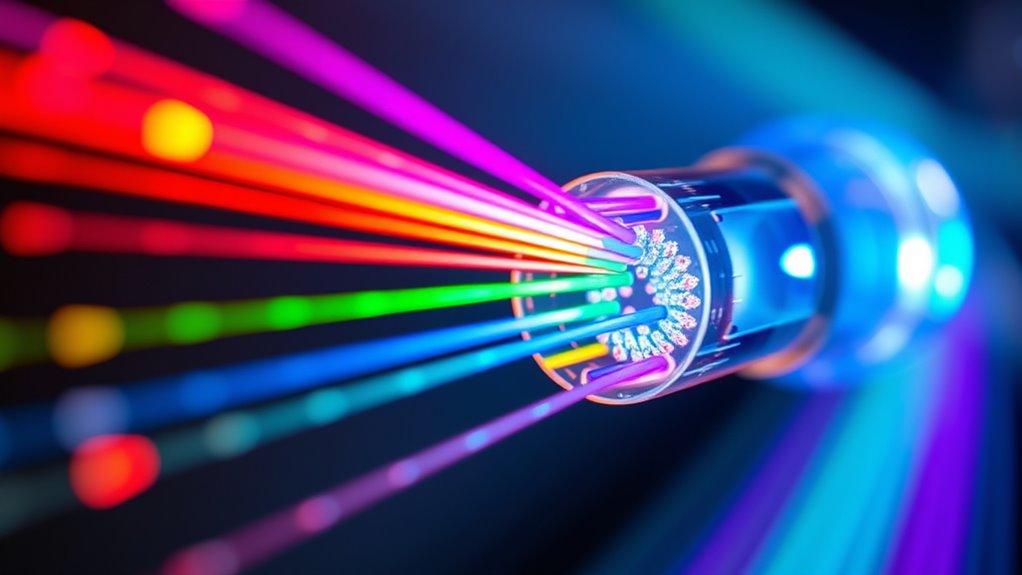

Wavelength-Division Multiplexing (WDM) is a key technology that allows you to send multiple signals over a single optical fiber by using different light wavelengths. This approach increases capacity and efficiency without needing new cables. Understanding how WDM works can help you optimize network performance and plan for future bandwidth needs. But how exactly does this technology separate and combine these signals so precisely?
Key Takeaways
- WDM transmits multiple signals simultaneously over a single fiber by using different light wavelengths.
- It employs lasers and optical filters to generate, combine, and separate wavelength channels.
- DWDM and CWDM are two main types, differing in channel density and spectral range.
- WDM increases network capacity efficiently without additional fiber deployment.
- Proper wavelength management prevents crosstalk and ensures reliable high-speed data transfer.

Wavelength-Division Multiplexing (WDM) is a technology that allows multiple signals to be transmitted simultaneously over a single optical fiber by using different wavelengths of light. This innovative approach leverages the core capabilities of fiber optics, enabling high-capacity data transmission with remarkable efficiency. Instead of sending one signal at a time, WDM divides the fiber’s bandwidth into multiple channels, each carrying its own data stream. These channels are distinguished by their unique wavelengths, making it possible to multiplex numerous signals into a single fiber and then demultiplex them at the receiving end.
WDM enables multiple signals to travel simultaneously over a single fiber using different wavelengths.
As someone working with fiber optics, you’ll find that signal multiplexing through WDM substantially boosts network capacity without the need to lay additional fibers. This is particularly valuable in telecommunications, data centers, and internet backbones, where bandwidth demands are ever-increasing. The technology works by using precise optical filters and lasers to generate different wavelengths, each representing a separate data channel. When these signals are combined, they form a composite signal that traverses the fiber. Once it reaches its destination, the process is reversed using demultiplexers, which separate the wavelengths back into individual signals for processing or delivery.
You’ll notice that WDM systems come in two main types: dense WDM (DWDM) and coarse WDM (CWDM). DWDM allows for a larger number of channels within a narrow spectral range, making it ideal for long-haul and high-capacity networks. CWDM, on the other hand, supports fewer channels over a broader wavelength spectrum, suitable for shorter distances and less demanding applications. Both types rely on the same fundamental principle of signal multiplexing but differ in their channel density and application scope.
Understanding fiber optics is essential when working with WDM, because the entire system depends on the fiber’s ability to transmit multiple wavelengths with minimal loss and interference. Proper management of the wavelength channels, including avoiding overlap and crosstalk, ensures reliable data transfer. WDM’s efficiency allows network providers to maximize existing infrastructure, increase bandwidth, and reduce costs since it minimizes the need for additional fibers. This makes it a powerful tool for expanding network capacity while maintaining high-speed, high-quality data transmission. Additionally, advancements in wavelength stabilization technology help improve the reliability and performance of WDM systems in demanding environments.

One Pair of 1.25G SFP WDM SC Bidi Transceiver 1000Base-BIDI SingleMode Simplex Fiber Module SMF 1310nm/15500nm DDM up to 20 km for Cisco GLC-BX-D, Ubiquiti UniFi UF-SM-1G-S, Mikrotik and More
1000BASE-BIDI SC TRANSCEIVER: 1.25G SC WDM SFP optical transceiver module supports 1.25Gbps data transmission rate over single mode…
As an affiliate, we earn on qualifying purchases.
As an affiliate, we earn on qualifying purchases.
Frequently Asked Questions
How Does WDM Compare to Other Multiplexing Techniques?
Compared to other multiplexing techniques, WDM offers higher spectral efficiency by allowing multiple channels to coexist within the same fiber using different wavelengths. You benefit from tighter channel spacing, which maximizes bandwidth without interference. Unlike time-division multiplexing, WDM transmits signals simultaneously, increasing capacity. This makes WDM ideal for high-speed data transfer, providing a scalable and efficient solution for modern fiber optic networks.
What Are the Primary Challenges in Implementing WDM Systems?
Implementing WDM systems can be as challenging as taming a wild beast. You’ll face issues with wavelength stability, which can cause signal overlap or loss, and guaranteeing proper channel isolation to prevent crosstalk. Precise equipment calibration and maintaining stable environmental conditions are essential. These challenges demand meticulous management, but overcoming them ensures reliable, high-capacity data transmission, making your WDM system a powerhouse in optical communications.
How Is WDM Affected by Fiber Optic Cable Imperfections?
Fiber imperfections, like fiber loss and modal dispersion, can substantially impact WDM systems. Fiber loss weakens signals, reducing the available power for each wavelength, while modal dispersion causes different modes to travel at varying speeds, leading to signal overlap and distortion. These issues can decrease data transmission quality and limit bandwidth. To mitigate this, you should use high-quality fibers, optimize signal amplification, and employ dispersion management techniques.
What Are the Future Trends in WDM Technology?
You’ll see future WDM advancements driven by quantum enhancements and integrated photonics. These trends will boost data capacity, improve efficiency, and reduce costs. Quantum technologies will enable ultra-secure communication and higher spectral efficiency, while integrated photonics will miniaturize components and streamline manufacturing. Together, they’ll transform WDM systems into faster, more reliable, and more scalable solutions, shaping the next era of high-speed optical networks.
How Does WDM Impact Network Security?
WDM enhances your network security by allowing you to implement robust encryption protocols directly on individual wavelengths, making data harder to intercept. It also simplifies intrusion detection, as you can monitor each wavelength separately for suspicious activity. By isolating traffic and enabling targeted security measures, WDM helps you better protect your network from cyber threats, ensuring data integrity and confidentiality across high-capacity optical channels.

MUSYSHOW DS001 Audio Switch SPDIF Coaxial Optical Digital Signal Optimization Corrector Support 4 Input 1 Output multiplexer Splitter Digital Switch Selector Box
4-in-1 Signal Switching (3×SPDIF Coaxial + 1×TOSLINK Inputs → 1×Coaxial Output)
As an affiliate, we earn on qualifying purchases.
As an affiliate, we earn on qualifying purchases.
Conclusion
In essence, WDM is like having multiple lanes on a highway, allowing you to send more data simultaneously over a single fiber. By dividing light into different wavelengths, you maximize your network’s capacity and efficiency. It’s a game-changer for high-speed communications, turning a single fiber into a bustling superhighway. When you harness WDM, you’re really opening the floodgates for faster, more reliable data transmission—making your network ready to handle the future.

Ultra Spec Cables CWDM Single Device Wavelength Filter Cable, 1470nm, 900um Loose Tube, SC/UPC – 1 Meter
Supports High Channel Isolation
As an affiliate, we earn on qualifying purchases.
As an affiliate, we earn on qualifying purchases.

Jonard Tools FOD-2000 Fiber Optic Drop Cable Slitter for 0.250" Flat Cable, Blue
AWARD WINNING DESIGN: Simplifies the slitting of 0.250" (and other) flat drop cable jackets at mid span or…
As an affiliate, we earn on qualifying purchases.
As an affiliate, we earn on qualifying purchases.