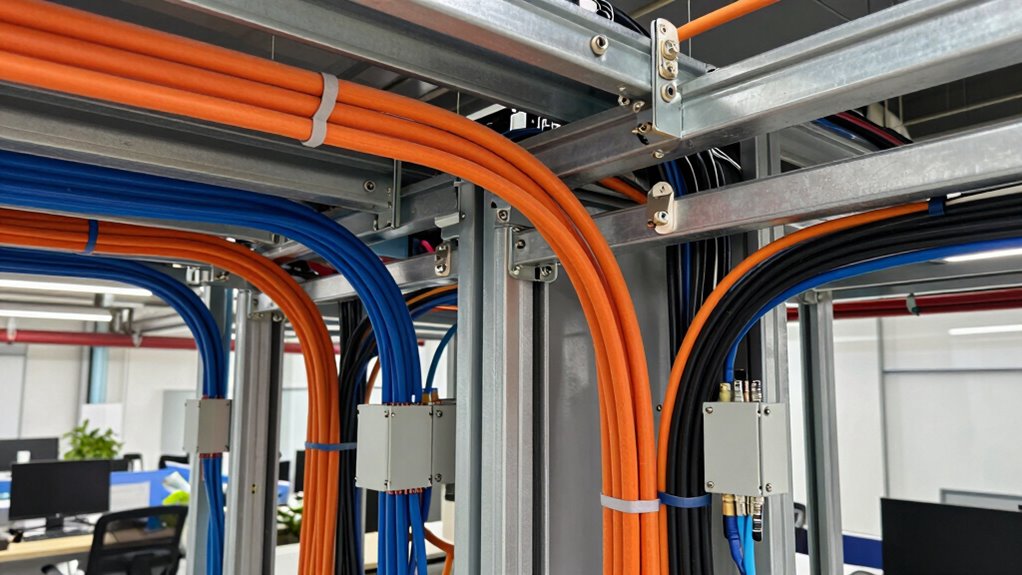

When working with cabling in mixed office and industrial settings, you need to balance flexibility, durability, and safety. Use organized, high-quality cables suited for each environment’s conditions—ranging from neat Cat6 cables for offices to rugged, resistant cables for harsh industrial zones. Proper installation, labeling, and adherence to safety standards are essential for reliable performance and safety. To guarantee your network remains efficient and protected, understanding these key considerations will help you succeed.
Key Takeaways
- Use appropriate cables with environmental ratings suitable for both office and industrial conditions to ensure durability and performance.
- Implement separate pathways and shielding to prevent electromagnetic interference and signal degradation across environments.
- Follow safety standards and select fire-resistant or rugged cables to comply with safety regulations and prevent hazards.
- Organize and label cabling clearly to facilitate maintenance, troubleshooting, and future upgrades efficiently.
- Plan infrastructure for scalability and easy upgrades, supporting high-speed data transfer and wireless integration in both settings.
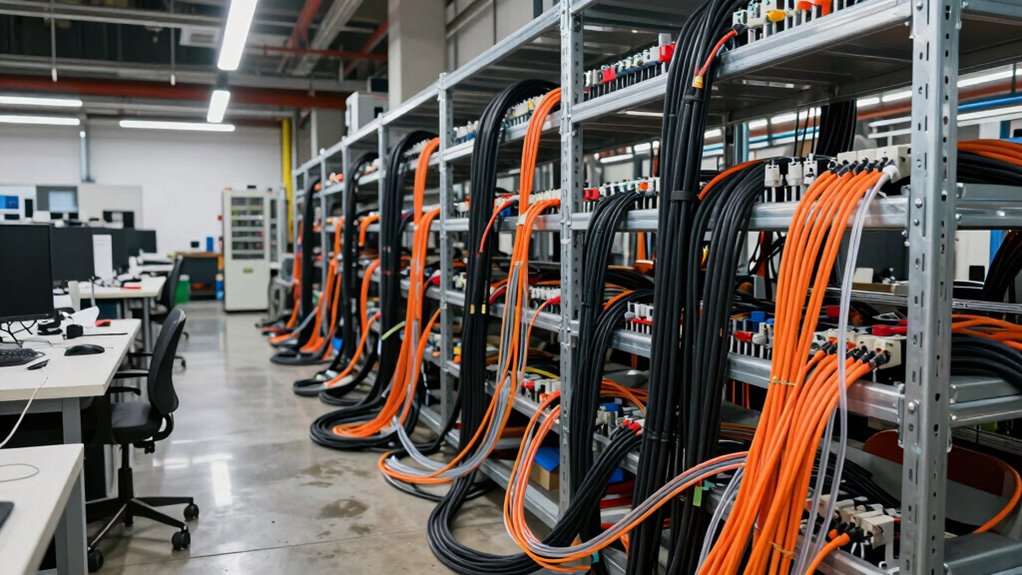
In today’s diverse IT landscapes, cabling in mixed environments can be a complex task, but understanding the fundamentals makes it manageable. When you’re dealing with both office and industrial spaces, you need to consider how different environments impact your cabling choices, especially with wireless integration and safety compliance in mind. Office areas typically demand neat, organized cabling that supports high-speed data transfer and seamless wireless connectivity. Industrial zones, on the other hand, require rugged, durable cabling capable of withstanding harsh conditions like extreme temperatures, moisture, and electromagnetic interference. Balancing these needs involves selecting the right cables and infrastructure to ensure reliable performance across the board.
Balancing office and industrial cabling needs ensures reliable, safe, and high-performance network infrastructure.
Wireless integration plays a crucial role in modern mixed environments. You want your wired infrastructure to complement wireless systems, providing a backbone that supports high bandwidth and low latency. Proper cabling ensures your wireless access points operate efficiently, delivering consistent coverage without dead zones. For industrial settings, this means using shielded or armored cables that minimize electromagnetic interference, which can disrupt wireless signals. In office areas, standard Cat6 or Cat7 cables are often sufficient, but they should be installed neatly to prevent interference and facilitate future upgrades. When planning your cabling, consider future-proofing by choosing higher-specification cables to support emerging wireless standards, ensuring smooth scalability. Additionally, understanding the impact of softener brine on cable insulation can help prevent corrosion and degradation over time. Employing proper installation techniques can further enhance the longevity and safety of your cabling infrastructure. Moreover, selecting cables with appropriate environmental ratings ensures they perform reliably under varying temperature and humidity conditions, especially in industrial zones.
Safety compliance is another critical factor you can’t overlook. Industrial environments are subject to strict safety standards because of the potential hazards involved, such as electrical faults or fire risks. You need to ensure your cabling is properly rated, installed, and protected according to local electrical codes and safety regulations. This includes using fire-resistant cables where necessary, securing cables to prevent tripping hazards, and avoiding cable spaghettis that could obstruct emergency exits or machinery. Office spaces, while generally less hazardous, still require adherence to safety standards, particularly for fire safety and electrical grounding. Proper labeling, organized routing, and secure fastenings help prevent accidents and make future maintenance easier.
Finally, integration between office and industrial cabling systems should be seamless. Use separate pathways when needed to prevent interference, and ensure your infrastructure allows for easy upgrades and troubleshooting. By understanding the specific demands of each environment—whether it’s supporting wireless integration, maintaining safety compliance, or ensuring durability—you set the foundation for a robust, flexible, and safe cabling system. Proper planning and adherence to standards will save you time and costs down the line, making your mixed environment both efficient and compliant.
industrial shielded Ethernet cables
As an affiliate, we earn on qualifying purchases.
As an affiliate, we earn on qualifying purchases.
Frequently Asked Questions
How Do Cabling Requirements Differ Between Office and Industrial Settings?
In mixed office and industrial settings, cabling needs differ considerably. You’ll require more durable, industrial-grade cables for harsh environments, while offices can prioritize aesthetic considerations with sleek, concealed wiring. As wireless alternatives become more viable, you might reduce cabling but still need robust connections for industrial equipment. In both, prioritize safety, flexibility, and future-proofing to guarantee reliable performance and minimal disruption.
What Safety Standards Apply to Industrial Cabling Installations?
You must follow strict safety standards for industrial cabling, focusing on fire safety and environmental compliance. Guarantee cables are rated for high temperatures and potential chemical exposure, and install proper grounding to prevent electrical fires. Use compliant, durable materials that reduce environmental impact, and regularly inspect installations for damage or wear. Adhering to these standards helps protect personnel, minimizes fire risks, and meets environmental regulations effectively.
How Can Cable Interference Be Minimized in Mixed Environments?
To minimize cable interference in mixed environments, you should focus on reducing electromagnetic interference (EMI). Use cable shielding, such as foil or braided shields, to protect data signals from EMI. Keep power cables separate from data cables, especially around high-powered equipment, and use proper grounding techniques. Additionally, route cables carefully, avoiding areas with heavy electromagnetic fields, to maintain signal integrity and guarantee reliable operation.
What Are the Best Practices for Maintenance in Such Cabling Systems?
To maintain your cabling systems effectively, regularly perform cable testing to identify issues early. Use shielding techniques to protect sensitive signals from interference, especially in mixed environments. Keep cables organized, labeled, and away from sources of electrical noise. Inspect connectors and insulation for wear or damage, and replace faulty components promptly. Consistent maintenance guarantees reliable performance, minimizes downtime, and extends the lifespan of your cabling infrastructure.
How to Future-Proof Cabling Infrastructure in Mixed-Use Spaces?
To future-proof your cabling infrastructure, you should prioritize scalable solutions that support wireless integration and robust power management. Install high-capacity cabling that can handle increased data demands, and choose versatile connectors for easy upgrades. Incorporate wireless access points and smart power systems now, so your space remains adaptable for evolving technology needs. Planning ahead guarantees your infrastructure stays relevant and efficient as your business grows.
fire-resistant Cat6 network cables
As an affiliate, we earn on qualifying purchases.
As an affiliate, we earn on qualifying purchases.
Conclusion
Managing cabling in mixed office and industrial environments can seem daunting, but it’s like balancing two worlds—precision and resilience. While sleek office cables prioritize aesthetics and speed, industrial cables demand durability and safety. Embrace the challenge, and you’ll create a seamless network that’s both efficient and robust. After all, in a space where technology meets toughness, your cabling choices define the flow of work and the strength of your infrastructure—bridging elegance with endurance.
As an affiliate, we earn on qualifying purchases.
high-speed data cabling for office and industrial use
As an affiliate, we earn on qualifying purchases.
As an affiliate, we earn on qualifying purchases.