
TL;DR

Get business pricing on networking and server gear
- Business-only prices and quantity discounts
- Tax-exempt purchasing
- Multiple users, one account, clear invoices
Home automation builder Spencer Kittleson says his home’s essential systems keep working when the internet is unplugged, using locally controlled devices and software. His account is a personal report, not a broad test of smart home products, but it shows how cloud outages and vendor API changes can disable features and why offline operation matters.
Home automation builder Spencer Kittleson says his home’s essential systems continue working without internet access, after about a decade of designing them to run locally rather than depend on vendors’ servers. His report describes a Raspberry Pi-based setup and rules intended to keep everyday controls available during outages or when an online service changes.
Kittleson says the core of his system runs on hardware he owns: devices using Tasmota firmware, an MQTT message broker and Node-RED automation software on a Raspberry Pi. Those tools let devices and routines communicate within the home. He says lights and other core functions do not depend on a vendor’s cloud connection to operate.
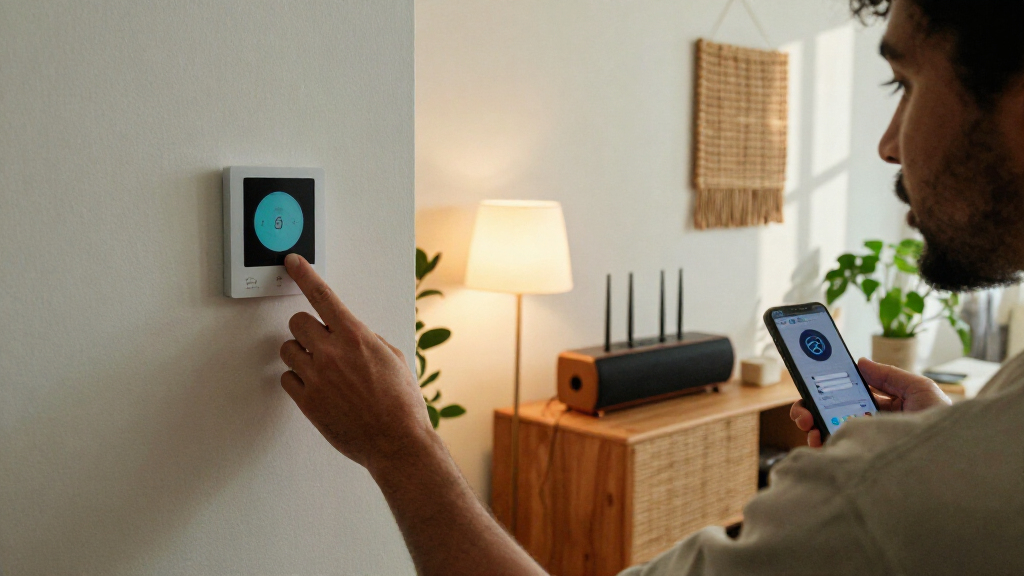
He still uses cloud services, including Amazon Alexa and some AWS services, but describes them as optional ways to control devices rather than the only way. Wall switches and a wall-mounted dashboard provide alternatives, he says. His approach also calls for keeping an existing control method when adding a new one, so a smart feature does not make ordinary use harder.
The report gives examples of failures that influenced those rules. Kittleson says a Nest integration stopped working after Google changed an API, and describes a Samsung refrigerator that displayed a TLS certificate error and a Camp Chef grill controller that required Wi-Fi to show its temperature. These are his reported experiences; the article does not independently test the products or establish how broadly the problems affect users.
Keeping Home Controls Available Offline
When household controls rely on an internet connection or an outside service, a connection failure or a vendor-side change can affect what users can do at home. Local control can reduce that dependency for functions such as switching lights, checking sensors or running an automation. The practical value depends on the device and setup: Kittleson’s account illustrates one approach, but does not show that every locally controlled system will be more reliable or easier to maintain.
There is also a trade-off in setup and upkeep. Kittleson says configuring hardware and software he controls takes more work than installing a cloud-connected device. In return, he can choose how components interact and keep multiple ways to perform a task. For readers choosing devices, the key question is not simply whether a product is “smart,” but whether its basic functions remain usable if the internet or the maker’s service is unavailable.
Products Worth Considering

Bose Lifestyle Ultra Wireless Home Speaker, White Smoke

Bose Smart Soundbar 700 with Alexa, Black

Jackery Explorer 1000 v2 Portable Power Station, 1070Wh, 1500W
As an affiliate, we earn on qualifying purchases.
From Cloud Integrations to Local Rules
Kittleson presents the report as a continuation of talks about his home automation projects. Its central rule is that core functions should work with the internet unplugged. Other principles include preserving familiar controls, making systems inexpensive to change as household needs shift, and reviewing automations so multiple schedules do not conflict.
His examples include a garage cooling routine that checks whether the door is closed before opening it and turning on a fan, and a sprinkler controller built around a Tasmota device. He says the system records sensor information and can send alerts. The report also recommends keeping configuration in one place rather than across several vendor apps, and says cloud-connected devices should provide an API with logs. Those are the author’s design preferences, not industry-wide standards.
“No internet, no problem.”
— Spencer Kittleson, in the report
Limits of One Household’s Account
The report documents one person’s setup and experiences; it does not include independent testing, reliability statistics or a comparison of local and cloud-connected products. It is also unclear which specific device models and software versions were involved in the cited failures, and whether the reported problems have since been fixed. The article does not establish that all functions in Kittleson’s home remain available during every type of outage: local power, network equipment and device hardware can fail even when internet access is not required.
Local control can also involve trade-offs that vary by product, including more setup, maintenance or technical knowledge. The report does not quantify those costs or assess privacy and security across the different configurations. Its claims should be read as an account of one design approach, rather than a guarantee about smart home systems generally.
Check Offline Behavior Before Buying
Kittleson’s report does not announce a product launch, policy change or scheduled follow-up; it describes rules he already uses and projects he has built. For consumers, the immediate next step is to check manufacturers’ documentation for what a device can do without internet access, and whether local control depends on a separate hub or app. Buyers may also want to confirm that a manual switch or another control method remains available if an online account or service cannot be reached.
As connected devices and vendor services change, the question is whether manufacturers will clearly explain which features work locally and which depend on the cloud. Kittleson’s account offers a practical set of questions to ask, but broader evidence would be needed to compare products’ offline performance and long-term support.
Key Questions
What does it mean for a smart home device to work offline?
It means at least some functions—such as operating a switch or running a local automation—remain available without an internet connection. Which features continue depends on the specific device and setup.
What system does Spencer Kittleson use?
He says his local setup uses Tasmota-equipped devices, MQTT and Node-RED on a Raspberry Pi. He also uses cloud services, including Alexa, as optional controls.
Why does Kittleson favor local control?
He says vendor API changes and internet-dependent features have caused problems in his experience. Local operation is intended to keep core household functions available even when those services cannot be reached.
Does the report prove that local smart home devices are always more reliable?
No. It is a personal account and does not provide independent tests or broad reliability data. Local systems can still be affected by power, hardware or in-home network failures.
Source: docodethatmatters.com