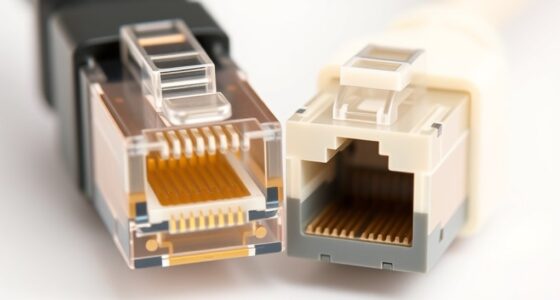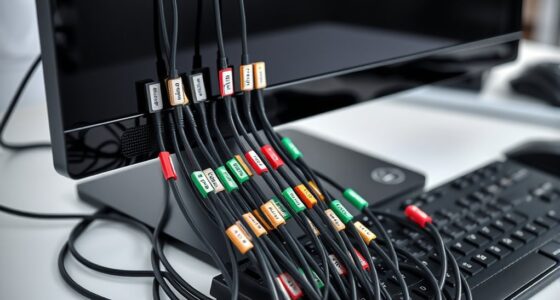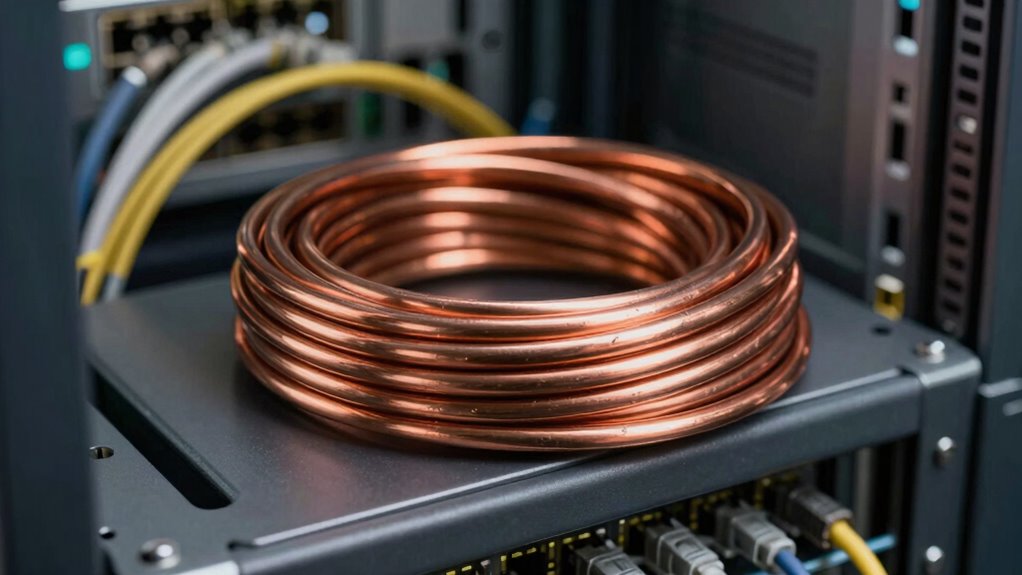

Copper still plays a key role in high-performance networks because it’s reliable, cost-effective, and widely available. It easily integrates with legacy systems, reducing upgrade costs and complexity. Copper cabling also resists environmental factors and supports features like Power over Ethernet, making it versatile for various applications. Its high data transfer rates and compatibility with existing infrastructure guarantee performance and ease of use. Continue exploring to discover more about its ongoing innovations and future potential.

Get business pricing on networking and server gear
- Business-only prices and quantity discounts
- Tax-exempt purchasing
- Multiple users, one account, clear invoices
Key Takeaways
- Copper offers a cost-effective and readily available solution, reducing deployment time and upgrade costs.
- Its environmental resistance and compatibility with legacy systems facilitate seamless network integration.
- Copper supports Power over Ethernet (PoE), enabling direct powering of devices like access points and cameras.
- High data transfer rates and low interference over short distances make copper suitable for data centers and enterprise networks.
- Ongoing advancements, such as shielded twisted pair cables, enhance copper’s performance, ensuring its relevance alongside fiber and wireless technologies.

Although fiber optics often steal the spotlight, copper remains an essential component in high-performance networks due to its reliability, cost-effectiveness, and widespread availability. While fiber alternatives like fiber optic cables offer impressive speed and bandwidth, copper’s proven track record and ease of deployment keep it relevant. Copper cabling, especially twisted pair cables, continues to serve as the backbone for many existing networks because it’s familiar, affordable, and simple to install. Its resistance to environmental factors and compatibility with legacy systems mean you can leverage copper infrastructure without the hefty costs or technical challenges associated with upgrading to fiber optics.
Copper remains a reliable, cost-effective backbone, easy to install, and compatible with existing systems.
Moreover, copper’s role isn’t diminishing entirely; instead, it complements newer technologies. Wireless integration, for example, benefits from copper’s stability. In many high-performance network setups, copper cabling acts as a reliable foundation for wireless access points and antennas. You can connect wireless devices seamlessly to a wired network through copper, creating a hybrid system that maximizes coverage and performance. This combination is particularly advantageous in scenarios where laying fiber isn’t feasible or cost-effective. Copper’s ability to support Power over Ethernet (PoE) further enhances its value, enabling you to power devices like security cameras, VoIP phones, and wireless access points directly through the same cable used for data transmission. This reduces clutter and simplifies installation, making copper an ideal choice for high-density or complex environments.
In terms of performance, copper still offers high data transfer rates suitable for many high-performance applications. While fiber optics excel at ultra-long distances and massive bandwidth, copper cables can handle substantial loads over shorter distances with minimal interference. This makes copper an excellent choice for data centers, enterprise networks, and campus environments where high speed and low latency are critical but fiber’s reach isn’t necessary. Additionally, copper’s widespread availability means you won’t face supply chain issues or delays when deploying new network segments. Its compatibility with existing infrastructure allows you to upgrade incrementally without overhauling your entire system. Additionally, the familiarity of copper cabling simplifies training and maintenance for IT staff, reducing overall operational costs.
Furthermore, ongoing advancements in copper technology continue to improve its performance capabilities, ensuring it remains a competitive option. Innovations like shielded twisted pair cables are helping to reduce electromagnetic interference and boost data integrity. Understanding copper’s strengths can help you make informed decisions about integrating it into your high-performance network environment. In short, copper remains a viable, cost-effective, and reliable part of high-performance networks. With fiber alternatives advancing and wireless integration becoming more prevalent, copper’s role isn’t shrinking but evolving. You can leverage its strengths alongside newer technologies to build flexible, robust networks that meet your current and future needs. Copper’s proven durability and straightforward deployment ensure it continues to be a valuable asset in the ever-changing landscape of high-performance networking.
Cat6 Ethernet cable shielded twisted pair
As an affiliate, we earn on qualifying purchases.
As an affiliate, we earn on qualifying purchases.
Frequently Asked Questions
How Does Copper Compare to Fiber in Long-Distance Data Transmission?
Copper is less effective than fiber for long-distance data transmission because it’s more prone to signal interference, which can degrade performance over extended runs. However, copper offers installation flexibility, making it easier to set up in complex environments. While fiber provides higher speeds and longer distances, copper remains useful for shorter links where its affordability and ease of installation outweigh the limitations.
What Are the Environmental Impacts of Copper Cable Production?
Copper cable production impacts the environment through toxic emissions and resource extraction. You can help reduce these effects by supporting recycling initiatives, which repurpose old copper and lower the demand for mining new ore. Recycling minimizes toxic emissions during manufacturing and decreases the environmental footprint. By choosing recycled copper, you contribute to lessening harmful environmental impacts, promoting sustainability, and encouraging responsible industry practices.
Can Copper Cables Support Future High-Speed Network Upgrades?
Yes, copper cables can support future high-speed network upgrades. They effectively minimize electromagnetic interference, ensuring signal integrity at higher speeds. Plus, their installation flexibility allows you to adapt easily to different building layouts and changing network demands. While fiber optics offer higher bandwidths, copper remains a reliable choice for upgrading existing infrastructure, providing a cost-effective and versatile solution that accommodates evolving high-performance network requirements.
How Do Copper Connections Influence Network Security?
Copper connections influence network security by supporting encryption protocols that safeguard data during transmission. However, they’re vulnerable to physical tampering, which can compromise sensitive information. You need to implement strong physical security measures, like sealed enclosures, and use advanced encryption to protect data integrity. Monitoring for signs of tampering and regularly inspecting cables help detect threats early, ensuring your network remains secure against both digital and physical attacks.
What Are the Cost Differences Between Copper and Alternative Cabling Options?
Think of copper cabling as the reliable, budget-friendly workhorse of networking. It’s generally more cost-efficient than fiber, especially for short distances, due to lower material and installation costs. Copper’s ease of installation means fewer headaches and faster setup, saving both money and time. While fiber may offer higher speeds, copper remains an economical choice for many high-performance networks, making it a practical, cost-effective solution.
Power over Ethernet (PoE) network switch
As an affiliate, we earn on qualifying purchases.
As an affiliate, we earn on qualifying purchases.
Conclusion
So, as you consider your network options, it’s almost poetic how copper’s enduring presence unexpectedly aligns with the needs of high-performance systems. Its reliability, cost-effectiveness, and simplicity often coincide with the demands of modern infrastructure. In this surprising intersection, copper proves it’s still relevant, quietly supporting your network’s growth while other technologies evolve. Sometimes, the most understated solutions hold the greatest staying power—reminding you that tradition and innovation can truly coexist.
As an affiliate, we earn on qualifying purchases.
High-performance copper data cable
As an affiliate, we earn on qualifying purchases.
As an affiliate, we earn on qualifying purchases.
Fall Picks
fall essentials
As an affiliate, we earn on qualifying purchases.