
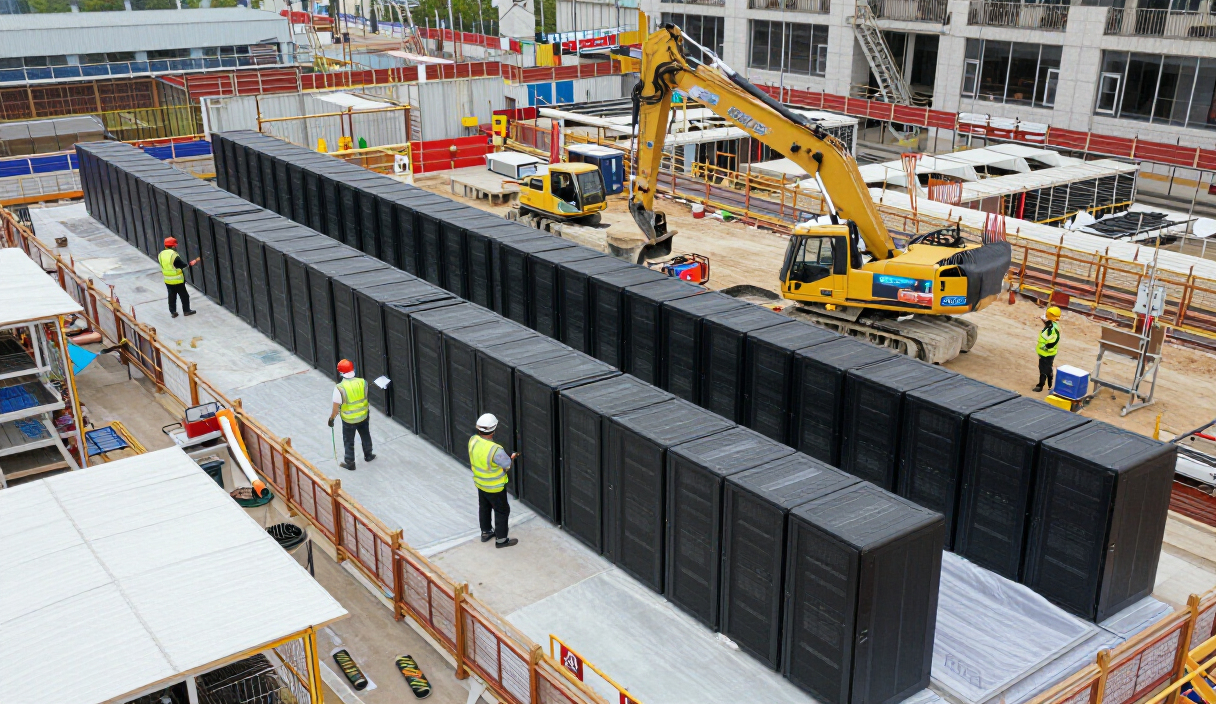
Data-centre construction compresses almost every difficult coordination problem in the industry into one project. Many trades work in parallel. Deadlines are tight. Field teams, coordinators and third parties all need access to information that remains useful beyond the meeting or site walk in which it was first captured. When a decision is made, it cannot remain buried in minutes or an undifferentiated action list. It needs to become a set of trade-sorted tasks immediately.

Get networking and server gear delivered free — and shop member deals
- Fast, free delivery on millions of items
- Access to Prime Big Deal Days deals on October 6–7
- Prime Video, Amazon Music and more included
Cloud & Hosting · Data-centre delivery
The missing layer is coordination, not documentation.
On a hyperscaler-style build, decisions must move from meetings and site walks into trade-sorted action while parallel work continues. Gewerkton Cloud is designed to connect that passage across field activity, browser-based plans and models, and third parties.
“On site, what counts is what’s proven.”
Voice-first dictation becomes evidence, defects, daywork reports and takt information.
Plans and models live in the browser; site teams can create a model when none exists.
Operations and model data connect Field, Studio and organisations outside both environments.
EU, US and APAC teams can work in their own languages while the evidence original remains unambiguous.
Bring-your-own keys and regional selection across the EU, US and Asia, including mainland China.
Customers can choose an EU cloud deployment or run the platform on their own infrastructure.
GAEB, REB, XRechnung and DATEV anchor the global platform in detailed construction workflows.
The aim is not to put every role into one interface. It is to preserve the meaning of field evidence as it moves into plans, models, task lists and third-party workflows across project boundaries.
Public beta planned. Gewerkton is currently in beta and should be assessed as an emerging platform whose direction—voice-first capture, browser model work and cloud coordination—is already defined.
That is the operational problem addressed by Gewerkton Cloud. It coordinates operations and model data between field teams using Gewerkton Field, browser-based work in Gewerkton Studio and third parties. For infrastructure professionals accustomed to the demands of a hyperscaler build, the distinction matters: Cloud is not presented as another isolated site application, but as the product line responsible for connecting the work taking place across the wider Gewerkton environment.
Gewerkton is currently in beta. A public beta is planned for fall 2026. That status should be understood plainly when assessing the platform. Its direction is already clear, however: voice-first capture on site, browser-based plan and model work, and an operational coordination layer designed to connect field activity with the people and data around it.
construction site coordination software
As an affiliate, we earn on qualifying purchases.
As an affiliate, we earn on qualifying purchases.
The data-centre problem is operational, not merely documentary
On a data-centre project, documentation is only valuable if it can keep pace with the site. The number of participating trades and the pressure of the programme make delays in interpretation especially costly. A decision made in a coordination meeting has to reach the appropriate trades as a usable task list. Evidence gathered in the field must remain connected to the work it describes. Plans, models and site observations cannot be treated as separate worlds.
This is why the division between Gewerkton’s three product lines is useful. Gewerkton Field is the voice-first construction-site application. It turns dictation into evidence, defects, daywork reports and takt information, and includes a portal. Gewerkton Studio is the browser workspace for plans and models. Where no model exists, the site team can create one in the browser. Cloud sits across that activity, coordinating operations and model data between Field, Studio and third parties.
The product structure reflects three different places where construction information has to work. Field is concerned with capture and action at the site. Studio provides the browser environment in which plans and models can be handled. Cloud carries the coordination story: it connects what is recorded in the field, what is organised in the browser and what must be shared with organisations outside those two product environments.
That separation is particularly relevant in data centres and industrial plants, where many trades advance concurrently. The central challenge is not a shortage of information. It is turning information into the right operational form while work continues. Meeting decisions must become trade-sorted task lists, and the supporting field record must remain intelligible to the people responsible for acting on it.
As an affiliate, we earn on qualifying purchases.
Voice-first capture meets trade-sorted execution
Gewerkton describes itself as a voice-first construction documentation and defect management platform for global markets. Voice is important here because the source of much project knowledge is the site itself: a person describing what has been installed, identifying a defect, recording daywork or documenting an instruction. Field is designed around that reality, moving from dictation to evidence and the construction records that follow from it.
The platform’s marketing line is concise: “On site, what counts is what’s proven.” For data-centre work, that principle reaches beyond collecting more files. A field record has to retain meaning as it passes into coordination. The observation may originate with one person in one language, but the resulting task can involve another trade, a browser-based plan or model, and a third party operating elsewhere in the project structure.
Cloud is the layer that addresses this passage from capture to coordinated work. It handles operations and model data between Field, Studio and third parties. The promise is therefore not that every role should work in the same interface. It is that the three parts of the branded product house have distinct responsibilities while remaining connected around the project.
For teams working without an existing model, Studio adds another practical route: the site team can create a model in the browser. That matters because the absence of a model does not remove the need to coordinate site information spatially. Gewerkton’s stated approach is to provide the browser workspace for plans and models while allowing the field team to create a model where none exists.
cloud-based construction management tools
As an affiliate, we earn on qualifying purchases.
As an affiliate, we earn on qualifying purchases.
Cloud coordination across project boundaries
Data-centre delivery often involves participants working across different companies, regions and languages. Gewerkton supports 27 content languages and positions cross-border work as a core deployment field. EU, US and APAC teams can work on the same project in their own languages while the evidence original remains unambiguous. For projects in Asia, the platform supports multilingual work from capture to report for Chinese, Korean and Vietnamese crews, with data residency selected by the customer.
The distinction between translation and the evidence original is significant. A multilingual project needs information to be usable by different teams without allowing the underlying record to become unclear. Gewerkton’s stated model keeps the evidence original unambiguous while enabling each team to work in its own language. In a project environment with parallel trades and regional participants, that gives the coordination layer a genuinely international role.

The wider platform is global in scope but was born in the German market. Its deepest commercial integration remains German, covering GAEB, REB, XRechnung and DATEV. Those integrations sit alongside the 27 content languages and a choice of regional AI providers across the EU, US and Asia, including mainland China. The combination reflects a product that starts from detailed construction workflows while addressing projects whose teams and infrastructure cross national boundaries.
For data-centre owners and delivery teams, this global framing should be read alongside the limits of the current status. Gewerkton is in beta, not a finished generally available platform. The public beta is planned for fall 2026. Its present significance lies in the operational model it is building: field capture, browser-based plan and model work, and cloud coordination between internal product lines and third parties.
voice dictation devices for construction
As an affiliate, we earn on qualifying purchases.
As an affiliate, we earn on qualifying purchases.
Data residency is a design choice
Cloud and infrastructure professionals will look beyond workflow and ask where project data resides. Gewerkton’s answer is direct: customers can choose an EU cloud or their own infrastructure. Data residency is therefore treated as a deliberate deployment choice rather than something to be considered after field and coordination workflows have already been established.
This choice is especially relevant to projects that span regions. Gewerkton supports regional AI-provider selection across the EU, US and Asia, including providers in mainland China. Its bring-your-own-AI approach covers 13 AI providers, allows customers to bring their own keys and avoids dependence on a single provider. Region selection and provider choice are part of the stated model.
These options do not collapse the differences between regions. They acknowledge them. A cross-border team may need multilingual capture and reporting, an unambiguous evidence original, and an AI provider selected for the region in which the work is taking place. A project may choose the EU cloud or deploy on its own infrastructure. Cloud coordination consequently sits within a broader set of choices about where data and AI services are located.
What the platform brings together
- Field capture through a voice-first application for evidence, defects, daywork reports, takt and portal access.
- A browser workspace for plans and models, including model creation by the site team when no model exists.
- Operations and model-data coordination between Field, Studio and third parties.
- Twenty-seven content languages for projects involving teams across the EU, US and APAC.
- Thirteen AI providers, bring-your-own keys and selectable regions covering the EU, US and Asia, including mainland China.
- A choice between an EU cloud deployment and the customer’s own infrastructure.
Built for more than a single construction category
Data centres and industrial plants provide the sharpest version of the coordination problem because many trades work in parallel under tight deadlines. They are not the only sites addressed by the platform. Gewerkton also identifies wind farms and renewables, housing and building construction, infrastructure and tunnels, cross-border teams and projects in Asia as deployment fields.
Each setting puts different pressure on the same basic chain between capture, evidence and coordinated action. Wind farms and renewable projects involve distributed sites, rotating crews, field acceptance and offline capture in dead zones. Housing and building construction requires defects with photographs and deadlines, dictated daywork reports, and signatures on the available device at handover. Infrastructure and tunnel projects run over long periods, generate many change orders and require instructions backed by original audio.
Cross-border teams add the language dimension. EU, US and APAC participants may work on one project while using their own languages. Projects in Asia can involve Chinese, Korean and Vietnamese crews, requiring multilingual handling from initial capture through to the report. Across these environments, data residency remains a matter of choice.
The common thread is not a claim that every type of construction operates identically. It is that records begin in the field and then have to survive contact with plans, models, commercial processes, other trades and external organisations. Cloud’s place in the product house is to coordinate that movement between Field, Studio and third parties.

An unusual development model, with explicit testing claims
Gewerkton is being built by a solo founder directing a fleet of coding agents using Codex and Claude. In one night, that fleet shipped 21 software packages. The packages were verified with negative controls and mutation tests. This development model is unusual enough to warrant attention, but it does not change the product’s current status: the platform remains in beta, with the public beta planned for fall 2026.
For prospective users, the development story is best considered as context rather than a substitute for product evaluation. It shows the scale and speed at which the founder is using coding agents, together with the stated verification methods. The relevant operational question remains whether the resulting Field, Studio and Cloud workflows match the realities of the project in which they would be used.
The public-facing operation follows a similarly deliberate technical approach. Gewerkton’s marketing site is available in 27 languages, uses zero trackers, has no cookie banner and runs on a fully egress-free architecture. A media bank contains more than 51 self-produced clips and posters. These details concern the marketing environment, but they reinforce the company’s emphasis on language coverage and controlled data movement.
Why Cloud carries the data-centre story
Field capture is essential, and browser-based model work is essential, but neither resolves the data-centre coordination problem by itself. The defining challenge is what happens between them and beyond them. A meeting creates decisions. Those decisions must become tasks arranged by trade. Site observations need to become evidence and defects. Plans and models must remain part of the operational picture. Third parties cannot be left outside the flow of relevant information.
That is why Cloud carries the story for this sector. Its role is to coordinate operations and model data between Field, Studio and third parties. The architecture of the product house gives field teams a voice-first application, browser users a workspace for plans and models, and the project a cloud layer concerned with coordination across those boundaries.
For infrastructure teams, the most interesting aspect may be the combination of this operational model with deployment choice. Gewerkton offers an EU cloud or the customer’s own infrastructure. It also supports bring-your-own AI keys, 13 providers and region selection across the EU, US and Asia, including mainland China. Those decisions are presented as part of the platform rather than as a single fixed provider path.
The complete Gewerkton platform is still at an early stage, and the beta label matters. Yet its intended answer to data-centre construction is already specific. Capture the record where work happens. Handle plans and models in the browser, creating a model there when necessary. Coordinate operations and model data across Field, Studio and third parties. Give international teams language, provider-region and data-residency choices. On projects where many trades move at once and every meeting decision must become an actionable, trade-sorted list, that is the coordination problem worth solving.
Halloween Picks
halloween
As an affiliate, we earn on qualifying purchases.