Cloud, hosting, and infrastructure are often discussed as separate topics, but they are parts of the same system. Applications may run in a public cloud, on a hosted server, inside a private data center, or on equipment at home. In every case, reliability depends on more than computing power. Networks must carry traffic efficiently, storage must protect and deliver data, power must reach critical devices, and administrators must be able to monitor and recover systems when something fails.
This hub provides a practical orientation to that full landscape. It explains the major infrastructure layers, shows how they fit together, and points to deeper guides for selecting equipment. Whether you are improving a home lab, supporting a growing business, or planning data-center capacity, the goal is the same: build an environment that is understandable, maintainable, secure, and appropriate for the workload.
Start With the Workload, Not the Hardware
Infrastructure planning should begin with what the system needs to accomplish. A media server has different priorities from a public website, a surveillance network, or a virtualization cluster. Before comparing equipment, document the workload’s users, applications, data volume, traffic patterns, uptime needs, and expected growth.
It helps to divide requirements into a few categories:
- Performance: processing demand, storage speed, network throughput, and acceptable latency.
- Availability: how much downtime is tolerable and which services must remain accessible during a failure.
- Capacity: current data, user, port, and bandwidth requirements plus realistic room for growth.
- Security: who may access the system, where trust boundaries sit, and what must be logged or isolated.
- Operations: how equipment will be monitored, updated, backed up, powered, and repaired.
- Budget: both the initial purchase and the ongoing costs of power, support, connectivity, and administration.
These requirements make later decisions easier. They reveal whether a simple hosted service is sufficient, whether local storage is necessary, and whether faster switching or redundant power would solve a real problem rather than merely add complexity.
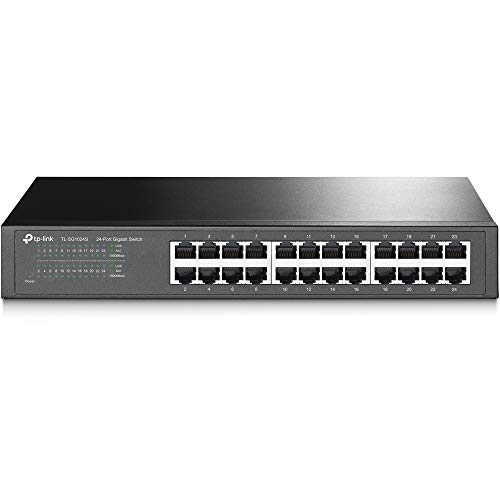
TP-Link 24 Port Gigabit Ethernet Switch Desktop/ Rackmount Plug & Play Shielded Ports Sturdy Metal Fanless Quiet Traffic Optimization Unmanaged (TL-SG1024S)
- 24 Gigabit Ethernet Ports: Supports auto negotiation and MDI/MDIX
- Energy-Efficient Technology: Reduces power consumption and saves energy
- Reliable and Quiet Operation: Fanless design with flow control for stability
As an affiliate, we earn on qualifying purchases.
As an affiliate, we earn on qualifying purchases.
Choose the Right Hosting Model
Public Cloud and Managed Hosting
Public cloud platforms provide computing, storage, networking, and managed services without requiring customers to own the underlying equipment. They are useful when rapid provisioning, geographic reach, or flexible capacity matters. Managed hosting goes further by shifting some server administration and maintenance to the provider.
Convenience does not remove the need for architecture. Teams still need to control access, monitor resource use, protect data, plan backups, and understand how services depend on one another. Cloud resilience also requires deliberate design; placing every component in one failure domain can leave an application vulnerable even when the provider’s overall platform is highly distributed.
On-Premises and Private Infrastructure
Locally operated infrastructure offers direct control over hardware, network design, storage, and data location. It can suit predictable workloads, specialized equipment, local services, and environments with strict operational requirements. The tradeoff is responsibility: the owner must handle capacity, maintenance, replacement, physical security, cooling, connectivity, and recovery.
Hybrid Environments
Many practical deployments combine both approaches. A business might host a public application in the cloud while keeping large datasets locally. A home lab might use local servers for experimentation and an external service for off-site backups. Hybrid designs can be flexible, but they make identity, connectivity, monitoring, and data movement especially important. Each connection between environments should have a defined purpose and a clear security policy.

CyberPower ST425 Standby UPS Battery Backup and Surge Protector
- Power Capacity: 425VA/260W standby UPS
- Output Waveform: Simulated sine wave
- Outlet Count: 8 NEMA 5-15R outlets
As an affiliate, we earn on qualifying purchases.
As an affiliate, we earn on qualifying purchases.
Build the Network as the Infrastructure Foundation
Servers and storage cannot perform well if the network between them is congested, poorly segmented, or difficult to troubleshoot. A sound design distinguishes edge connectivity, internal switching, high-speed aggregation, management access, and any networks reserved for storage, cameras, phones, or guest devices.
Routing, Firewalls, and the Network Edge
The router connects networks and determines where traffic should go. Firewall functions enforce rules about which traffic may cross a boundary. In a small environment, both roles may exist in one appliance. Larger environments often separate them to gain more capacity, control, or redundancy.
Selection should account for internet speed, the number of users and devices, virtual private network requirements, segmentation features, update policies, and management complexity. The guide to routers with built-in firewalls for enhanced security is a useful starting point for comparing integrated options.
A firewall is only one part of security. Secure configuration, timely updates, strong administrator authentication, restricted management access, and useful logging matter just as much. Rules should follow documented needs rather than allowing broad access indefinitely.
Switching From the Access Layer to the Core
Access switches connect endpoints such as workstations, servers, cameras, wireless access points, and storage devices. Distribution and core switches aggregate that traffic and move it between major parts of the network. As scale increases, port density, uplink capacity, redundancy, management features, and forwarding performance become more significant.
For a home lab or connected household, the guide to PoE switches for home networks covers options that combine data connectivity with device power. At the other end of the spectrum, organizations designing a high-capacity backbone can consult the guide to enterprise core switches for data centers.
A good switching plan leaves space for additional ports and faster uplinks while avoiding unnecessary layers. Document virtual LANs, trunk connections, link aggregation, and management addresses so the network can be understood during an outage.
Moving to 10 Gigabit Ethernet
Faster networking can help when multiple systems regularly move large files, access shared storage, replicate virtual machines, or perform backups. Upgrading only one component, however, will not remove every bottleneck. The server interface, switch ports, cabling or optics, storage, and receiving system must all support the intended path.
For servers and workstations that accept expansion cards, compare interface compatibility, operating-system support, port type, cooling needs, and available PCI Express capacity. The overview of PCIe 10 Gb network interface cards provides a focused next step.
As an affiliate, we earn on qualifying purchases.
Plan Storage Around Access, Protection, and Recovery
Infrastructure storage ranges from local server disks to network-attached storage, storage-area networks, and cloud object storage. The correct choice depends on how data is accessed, how quickly it must be delivered, how much capacity is required, and how recovery will work.
Network-Attached Storage
A NAS can centralize files, media, backups, and shared application data. For household streaming and personal media libraries, the guide to home media server NAS devices explores systems intended for that use case.
When evaluating any NAS, look beyond raw capacity. Consider drive compatibility, expansion options, network interfaces, supported file-sharing protocols, user permissions, update practices, and the applications it needs to run. Media workloads may also depend on client compatibility and whether content needs to be converted during playback.
Redundancy Is Not a Backup
Disk redundancy can keep a storage system operating after certain drive failures, but it does not protect against accidental deletion, malware, theft, fire, or a damaged file that is replicated across the array. Important data needs separate backups, ideally with at least one copy isolated from the primary environment.
A workable recovery plan identifies what is backed up, how often copies are created, where they are stored, how long they are retained, and who verifies them. Restoration tests are essential because a completed backup job does not automatically prove that files, databases, permissions, or entire systems can be recovered correctly.

Gaobige Network Tool Kit for Cat5 Cat5e Cat6, 11 in 1 Ethernet Crimper Kit
- Complete Network Tool Kit: Includes crimper, tester, stripper, and more
- Professional Ethernet Crimper: 3-in-1 crimping, cutting, stripping tool
- Cable Tester Functionality: Tests telephone and network cables
As an affiliate, we earn on qualifying purchases.
As an affiliate, we earn on qualifying purchases.
Deliver Power and Maintain Remote Control
Power Over Ethernet
Power over Ethernet allows compatible devices to receive data and electrical power through the network connection. It is commonly used for access points, cameras, phones, sensors, and other devices that would otherwise need a nearby outlet. Centralized power can simplify installation and make it easier to support network devices with backup power.
Successful planning requires checking both sides of the connection. The power source and powered device must be compatible, and the total switch or injector power budget must cover the attached equipment. Cable length, conductor quality, heat, and installation conditions also deserve attention, particularly with devices that draw more power.
If a full PoE switch is unnecessary or an individual link needs additional power capability, consult the guide to high-wattage PoE injectors for reliable power delivery. An injector should be chosen for the actual device and deployment rather than by wattage alone.
Rack Power and Out-of-Band Recovery
Remote administration is valuable until a frozen device stops responding over the network. Controllable rack power can provide another recovery path by allowing authorized administrators to cycle specific outlets without visiting the site. This can be useful in remote offices, unattended equipment rooms, labs, and hosted racks.
The guide to remote power switches for racks can help narrow the available approaches. These devices should be treated as sensitive management equipment. Access should be restricted, credentials protected, and the management path separated from ordinary user traffic where practical. Outlet labels and dependency records also help prevent someone from power-cycling the wrong system.
Install and Troubleshoot the Physical Layer
Cloud services may feel abstract, but every connection ultimately relies on physical infrastructure. Copper cables, fiber links, transceivers, patch panels, connectors, and power feeds all influence reliability. A damaged connector or contaminated fiber end can create intermittent faults that appear to be software or configuration problems.
Good physical-layer practice includes consistent labeling, suitable bend radius, protected cable routes, clean terminations, documented patching, and tested links. Separate symptoms from assumptions during troubleshooting: identify what changed, determine the affected path, compare working and failing links, and inspect counters or optical measurements before replacing unrelated equipment.
Testing Fiber Links
An optical time-domain reflectometer helps technicians analyze a fiber link and locate events such as connections, splices, sharp losses, or breaks. The tool must match the fiber type and testing requirements, while the operator must understand launch conditions, test parameters, and trace interpretation.
For field work and distributed sites, the guide to portable OTDR testers for precise fiber-optic testing outlines equipment intended for mobile diagnostics. Test records are especially valuable when captured during installation because they provide a baseline for later comparison.
Make Security Part of Every Layer
Infrastructure security is strongest when it is distributed across the design rather than concentrated at the perimeter. Start with an inventory of devices, services, accounts, software versions, and data. Unknown assets are difficult to patch, monitor, or protect.
- Use individual administrator accounts and strong authentication.
- Restrict management interfaces to trusted networks or secured remote-access paths.
- Segment users, servers, storage, guests, and device networks according to their roles.
- Apply updates through a documented process and retain configuration backups.
- Collect logs that can support troubleshooting and incident investigation.
- Remove unused services, default accounts, and obsolete firewall rules.
- Encrypt sensitive connections and protect stored secrets.
Segmentation reduces the reach of mistakes and compromised devices, but only when the rules between segments are intentional. Document allowed flows, review them periodically, and avoid relying on network location as the sole proof of trust.
Design for Operations, Not Just Deployment
Infrastructure spends far more time being operated than installed. A maintainable environment has diagrams, equipment inventories, address records, configuration backups, renewal dates, and clear recovery procedures. Monitoring should cover availability, capacity, errors, temperature, power, storage health, backup status, and certificate expiration where relevant.
Alerting needs restraint. Notifications should identify conditions that require action, provide enough context to begin diagnosis, and route to someone able to respond. Excessive low-value alerts teach administrators to ignore the system.
Capacity planning should also be routine. Track trends in storage use, bandwidth, port availability, power consumption, and compute demand. Gradual growth is easier to address before it becomes an outage. Replacement planning matters too: unsupported operating systems, unavailable spare parts, and aging drives can create operational risk even while everything still appears to work.
A Practical Path Forward
Begin by mapping the infrastructure you already have: internet edge, network segments, switches, servers, storage, power, management paths, and external services. Then identify the workloads that matter most and the failures that would cause the greatest disruption.
Prioritize improvements that reduce clear risks. That might mean creating tested backups, isolating management access, replacing an undersized switch, adding remote power control, documenting fiber links, or upgrading a heavily used server connection. Use the linked guides to investigate equipment only after the underlying requirement is understood.
Reliable cloud, hosting, and infrastructure environments are not defined by their size or by owning the most advanced hardware. They succeed because their components fit the workload, their dependencies are visible, and recovery has been considered before trouble occurs. Build in layers, document decisions, validate backups, monitor capacity, and keep the design simple enough for its operators to understand.