
When searching for the best PCIe 10Gb NICs, the options can feel overwhelming. The IPolex 10Gb Network Card stands out as the overall best choice due to its robust Intel X550-T1 controller and broad compatibility. For those seeking affordability, the VunLink 10GbE RJ45 Ethernet Card offers solid performance at a lower price point, while the ASUS XG-C100C provides a simple plug-and-play experience with reliable throughput. The main tradeoffs involve balancing cost against features like port count, compatibility, and advanced management options. Continue reading for a full breakdown of these top picks and what makes each unique.

Get business pricing on networking and server gear
- Business-only prices and quantity discounts
- Tax-exempt purchasing
- Multiple users, one account, clear invoices
Key Takeaways
- The top-performing NICs tend to feature Intel or Marvell controllers for stability and broad OS support.
- Port count varies from single-port cards to dual-port options, impacting scalability and use cases.
- More advanced features like QoS, WOL, and multi-gig support are typically found in premium models.
- Compatibility with Linux, Windows, and virtualization platforms remains a key consideration for flexibility.
- Price differences often reflect port count, controller quality, and additional features—buyers should prioritize based on their specific needs.
| ipolex 10Gb Network Card Intel X550-T1 Ethernet Card PCIe v3.0 x4 with Intel X550-AT Controller |  | Best Overall for Reliable Enterprise Connectivity | Controller: Intel X550-AT | Network Speeds: 100M/1G/2.5G/5G/10G | Port: Single RJ45 | VIEW ON AMAZON | See Our Full Breakdown |
| 10Gb PCIe Network Card, VunLink 10GbE RJ45 Ethernet Card with Realtek RTL8127AT, Multi-Gig 10G/5G/2.5G/1G NIC Adapter for PC, NAS & Server, PCIe 4.0 x1 |  | Best Value for Multi-Gig Home and Small Business Use | Hardware Interface: PCI Express x1, PCI Express x16, PCI Express x4, PCI Express x8 | Compatible Devices: Desktop | Data Link Protocol: Ethernet | VIEW ON AMAZON | See Our Full Breakdown |
| TP-Link 10GB PCIe Network Card (TX401) – PCIe to 10 Gigabit Ethernet Adapter |  | Best for High-Speed Internet and Local Data Transfer | Speed: Up to 10 Gbps | Compatibility: Windows 11/10/8.1/8/7, Windows Server 2019/2016/2012 R2, Linux | Cable Included: 1.5 m CAT6A Ethernet Cable | VIEW ON AMAZON | See Our Full Breakdown |
| TRENDnet 10G PCIe Network Adapter TEG-10GECTX |  | Best for Enterprise and Server Environments | Hardware Interface: 1 x 10Gbps RJ-45 Ethernet port | Supported Speeds: 10Gbps / 5Gbps / 2.5Gbps / 1Gbps / 100Mbps | Supported Standards: IEEE 802.3ab, IEEE 802.3bz, IEEE 802.3an | VIEW ON AMAZON | See Our Full Breakdown |
| 10G Base-T PCI-e Network Card with Marvell AQC113 Controller, Support WOL, 10Gb Ethernet Adapter for Windows 10/11, Linux, Server |  | Best for Versatile Desktop and Server Use | Controller: Marvell AQC113 | Speed: Up to 10 Gbps | Interface: PCIe (X4/X8/16) | VIEW ON AMAZON | See Our Full Breakdown |
| GLOTRENDS ST7315 10G SFP+ Network Card with Intel 82599EN Controller |  | Best for Enterprise and Data Center Environments | Controller: Intel 82599EN (X520-DA1) | Interface: PCIe 2.0 x4 | Network Speed: 10Gbps | VIEW ON AMAZON | See Our Full Breakdown |
| 10Gb PCIe NIC Network Card with Single RJ45 Port, Aquantia AQC107 Ethernet LAN Controller for Windows, Linux, ESX |  | Best for Multi-Gigabit Home and Business Use | Speed Support: 10Gbps, 5Gbps, 2.5Gbps, 1Gbps, 100Mbps | Interface: PCIe 3.0 x4 | Port: 1 RJ45 | VIEW ON AMAZON | See Our Full Breakdown |
| ASUS XG-C100C 10G Network Adapter PCI-E x4 Card with RJ-45 Port and QoS |  | Best for Desktop Users Requiring Seamless Compatibility | Network Speed: 10Gbps | Compatibility: Windows 10/8.1/8/7, Linux Kernel 4.4/4.2/3.6/3.2 | Port: RJ-45 | VIEW ON AMAZON | See Our Full Breakdown |
| 10G PCIe Network Card with Realtek RTL8127AT Controller |  | Best for Home and Small Business with Compatibility Needs | Network Speed: Up to 10Gbps | Controller: Realtek RTL8127AT | Interface: PCIe 4.0 x1 | VIEW ON AMAZON | See Our Full Breakdown |
| 10G PCIe Network Card with Marvell AQC113 Controller, 10Gbps Ethernet Adapter for Windows and Linux |  | Best for Versatile, High-Speed Multi-Gig Networking | Chipset: Marvell AQC113 | Interface: PCIe 4.0 x1 | Supported Speeds: 10G, 5G, 2.5G, 1G | VIEW ON AMAZON | See Our Full Breakdown |
| StarTech 2-Port 10Gb PCIe NIC Ethernet Card (ST20000SPEXI) |  | Best Overall for High-Performance Dual-Port Networking | Ports: 2 | Speed: 10Gbps | Chipset: Intel X540 | VIEW ON AMAZON | See Our Full Breakdown |
| Vogzone 10Gb PCI-E NIC Network Card for Intel X520-DA1, 10GbE Single SFP+ Port |  | Best for Versatile, High-Speed Data Center Connectivity | Controller: Intel 82599EN | Data Rate: 100MbE/1GbE/10GbE | Port: Single SFP+ | VIEW ON AMAZON | See Our Full Breakdown |
| 10Gtek 10Gb PCI-E NIC Network Card with Intel X550-AT2 Controller | 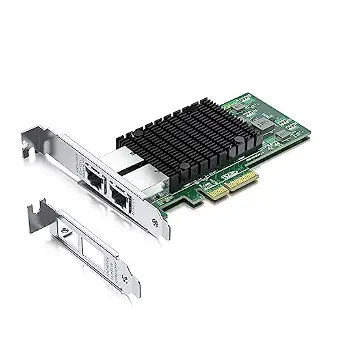 | Best for Dual Copper Ports with Versatile Compatibility | Controller: Intel X550-AT2 | Ports: 2x RJ45 | Supported Speeds: 100M/1G/2.5G/5G/10G | VIEW ON AMAZON | See Our Full Breakdown |
| pcie10gb nic review | Interface | Form Factor | Compatibility |
|---|---|---|---|
| ipolex 10Gb Network Card Intel | PCIe v3.0 x4 | Standard and low profile brackets | Windows Server 2008/2019, Linux, FreeBSD 9/10, UEFI 2.1/2.3, VMware ESXi 5.5 |
| 10Gb PCIe Network Card | — | — | — |
| TP-Link 10GB PCIe Network Card | PCIe | Low-profile and Full-Height brackets | Windows 11/10/8.1/8/7, Windows Server 2019/2016/2012 R2, Linux |
| TRENDnet 10G PCIe Network Adap | — | — | Windows, Windows Server |
| 10G Base-T PCI-e Network Card | PCIe (X4/X8/16) | — | — |
| GLOTRENDS ST7315 10G SFP+ Netw | PCIe 2.0 x4 | Low Profile | — |
| 10Gb PCIe NIC Network Card wit | PCIe 3.0 x4 | — | Windows 11/10, Windows Server 2022/2019, Linux Kernel 3.10 to 6.x |
| ASUS XG-C100C 10G Network Adap | — | PCI-E x4 | Windows 10/8.1/8/7, Linux Kernel 4.4/4.2/3.6/3.2 |
| 10G PCIe Network Card with Rea | PCIe 4.0 x1 | — | — |
| 10G PCIe Network Card with Mar | PCIe 4.0 x1 | — | Windows 10/11, Linux |
| StarTech 2-Port 10Gb PCIe NIC | — | PCIe | Windows, Linux, ESXi |
| Vogzone 10Gb PCI-E NIC Network | PCIe v2.0 x8 | PCIe | — |
| 10Gtek 10Gb PCI-E NIC Network | PCIe v3.0 | Full height / Low profile | — |
More Details on Our Top Picks
ipolex 10Gb Network Card Intel X550-T1 Ethernet Card PCIe v3.0 x4 with Intel X550-AT Controller
This card stands out for its robust support of multi-rate Ethernet speeds, including 10G, 2.5G, and 5G, making it a versatile choice for data centers and enterprise setups. Compared with the VunLink 10GbE, it offers broader OS compatibility and more reliable multi-speed negotiation, though it does lack firmware update support, which can limit future flexibility. Its inclusion of both standard and low profile brackets enhances installation options, ensuring compatibility with a range of server chassis. However, manual configuration may be necessary for optimal 2.5G/5G operation, and firmware updates are not supported, which could impact long-term maintenance.
Pros:- Supports multi-rate Ethernet speeds up to 10G, including 2.5G and 5G
- Compatible with a wide range of operating systems including Windows Server, Linux, and FreeBSD
- Includes both standard and low profile brackets for versatile installation
- Industry-leading support and warranty coverage
Cons:- Does not support firmware updates, limiting future feature enhancements
- Limited functionality on some VMware systems requiring manual configuration
Best for: IT professionals managing enterprise servers requiring stable multi-speed Ethernet, especially in data centers.
Not ideal for: Home users or small office setups where plug-and-play simplicity and extensive firmware support are more critical.
- Controller:Intel X550-AT
- Network Speeds:100M/1G/2.5G/5G/10G
- Port:Single RJ45
- Interface:PCIe v3.0 x4
- Form Factor:Standard and low profile brackets
- Compatibility:Windows Server 2008/2019, Linux, FreeBSD 9/10, UEFI 2.1/2.3, VMware ESXi 5.5
Our verdict“This card is ideal for enterprise environments where stability and multi-speed support are priorities, even if firmware flexibility is limited.”
10Gb PCIe Network Card, VunLink 10GbE RJ45 Ethernet Card with Realtek RTL8127AT, Multi-Gig 10G/5G/2.5G/1G NIC Adapter for PC, NAS & Server, PCIe 4.0 x1
The VunLink 10GbE offers a compelling blend of speed and affordability, supporting speeds up to 10Gbps and compatible with both Windows and Linux. Compared to the TP-Link TX401, it provides broad OS support and multi-gig auto-negotiation, making it suitable for demanding NAS and server upgrades. Its PCIe 4.0 x1 interface ensures good performance in small form factor systems, though it demands compatible PCIe slots and appropriate cabling for full speed. As it’s limited to Windows and Linux, it’s less suitable for users on other operating systems or those needing wireless features.
Pros:- Supports ultra-fast 10Gbps network speeds suitable for data-intensive applications
- Compatible with multiple operating systems including Windows and Linux
- Supports multi-gig auto-negotiation for flexible network upgrades
- Compact PCIe 4.0 x1 interface fits in small systems
Cons:- Requires compatible PCIe slots and cabling for maximum performance
- No included accessories or cables, adding to setup complexity
- Potential driver and compatibility issues with older or proprietary systems
Best for: Enthusiast home users or small business owners upgrading NAS or server hardware for high-speed data transfers.
Not ideal for: Users with older systems lacking PCIe 4.0 slots or those needing plug-and-play network solutions without manual setup.
- Hardware Interface:PCI Express x1, PCI Express x16, PCI Express x4, PCI Express x8
- Compatible Devices:Desktop
- Data Link Protocol:Ethernet
- Data Transfer Rate:10 Gigabits Per Second
- Compatible Operating System Family:Linux, Windows
- Minimum Required OS Version:Windows 10
Our verdict“This card offers excellent value for small-scale high-speed networking, provided the system supports PCIe 4.0 x1 slots and proper cabling.”
TP-Link 10GB PCIe Network Card (TX401) – PCIe to 10 Gigabit Ethernet Adapter
The TP-Link TX401 excels at delivering up to 10Gbps data transfer, making it ideal for fast internet connections and local backups. Compared with the ipolex X550, it includes a high-quality CAT6A Ethernet cable for immediate use, simplifying setup. Its compatibility with a broad range of Windows and Linux OS versions, along with both low-profile and full-height brackets, offers flexible installation options. However, it requires a compatible PCIe slot and depends heavily on the existing network infrastructure to realize full speeds. For basic internet tasks, this might be overkill, but in demanding environments, it offers clear advantages.
Pros:- Supports extremely fast 10 Gbps transfer speeds
- Compatible with a wide range of operating systems including Windows and Linux
- Includes a 1.5 m CAT6A Ethernet cable for immediate setup
- Flexible installation options with low-profile and full-height brackets
Cons:- Requires compatible PCIe slots and infrastructure for maximum performance
- Overkill for basic internet use or casual browsing
- Performance depends on network hardware and cabling
Best for: Power users needing rapid local data transfers or high-speed internet with straightforward setup.
Not ideal for: Casual internet users or systems with limited PCIe slots or older network infrastructure that can’t support full 10G speeds.
- Speed:Up to 10 Gbps
- Compatibility:Windows 11/10/8.1/8/7, Windows Server 2019/2016/2012 R2, Linux
- Cable Included:1.5 m CAT6A Ethernet Cable
- Form Factor:Low-profile and Full-Height brackets
- Interface:PCIe
Our verdict“This card is best suited for advanced users seeking maximum local transfer speeds or high-speed internet, assuming infrastructure supports it.”
TRENDnet 10G PCIe Network Adapter TEG-10GECTX
The TRENDnet TEG-10GECTX offers a reliable, straightforward way to add 10Gbps Ethernet to Windows servers and workstations. Its support for speeds from 1Gbps up to 10Gbps, along with compliance to standards like IEEE 802.3bz, makes it suitable for demanding enterprise networks. Compared to the VunLink, it boasts NDAA and TAA compliance, appealing to government and secure environments. The inclusion of standard and low-profile brackets enhances versatility. Its primary tradeoff is the platform limitation to Windows and Windows Server, which excludes Linux or other OS users.
Pros:- Supports high-speed 10Gbps Ethernet connections
- Compatible with various Windows operating systems and Windows Server
- Includes standard and low-profile brackets for flexible installation
- NDAA and TAA compliance for government projects
Cons:- Limited to Windows and Windows Server platforms
- No wireless or multi-protocol support included
- Requires PCIe 3.0 x4 slot, not universally available
Best for: IT managers seeking a stable, compliant solution for Windows-based enterprise or server networks.
Not ideal for: Home or Linux users who need cross-platform compatibility or wireless options.
- Hardware Interface:1 x 10Gbps RJ-45 Ethernet port
- Supported Speeds:10Gbps / 5Gbps / 2.5Gbps / 1Gbps / 100Mbps
- Supported Standards:IEEE 802.3ab, IEEE 802.3bz, IEEE 802.3an
- Compatibility:Windows, Windows Server
- Protection:3-year manufacturer support
Our verdict“This adapter delivers enterprise-grade reliability for Windows environments, with compliance and support tailored for professional deployments.”
10G Base-T PCI-e Network Card with Marvell AQC113 Controller, Support WOL, 10Gb Ethernet Adapter for Windows 10/11, Linux, Server
The Marvell AQC113-based card provides a balanced mix of high-speed performance and broad compatibility, including Wake-on-LAN for remote management. Compared with the ipolex X550, it offers similar speeds but emphasizes heat dissipation and flexible compatibility across Windows, Linux, and Windows Server. Its support for backward compatibility and WOL makes it suitable for desktops and workstations where remote management or stability under load are priorities. The main tradeoff is that it requires PCIe slots and may need some configuration for optimal WOL operation, which may be less straightforward for casual users.
Pros:- Supports high-speed 10 Gbps Ethernet performance
- Compatible with Windows, Linux, and Windows Server
- Supports Wake-on-LAN for remote management
- Good heat dissipation for continuous operation
Cons:- Requires available PCIe slots; not compatible with PCI slots
- May need manual configuration for WOL and optimal performance
- No built-in wireless features
Best for: Power users or IT administrators needing reliable 10Gbps connectivity with remote management features.
Not ideal for: Users lacking PCIe slots or those seeking plug-and-play solutions without configuration needs.
- Controller:Marvell AQC113
- Speed:Up to 10 Gbps
- Interface:PCIe (X4/X8/16)
- Supported OS:Windows 10/11, Linux, Windows Server
- Features:WOL, heat dissipation
Our verdict“This card is best suited for environments requiring high-speed network stability with remote management, assuming system compatibility with PCIe slots.”
GLOTRENDS ST7315 10G SFP+ Network Card with Intel 82599EN Controller
This model stands out for its enterprise-grade features, including support for virtualization and remote boot options, making it ideal for data centers needing reliable, high-speed connectivity. Compared with the ASUS XG-C100C, the GLOTRENDS card offers more advanced network protocols and virtualization support, but it requires manual setup on Windows 11 and lacks detailed driver instructions. Its SFP+ port is perfect for fiber connections, although this may limit ease of use for typical home setups. The low-profile form factor allows installation in compact server environments, but the absence of clear driver guidance could pose challenges for less experienced users. Overall, this pick makes the most sense for IT professionals managing enterprise-grade infrastructure.Pros:- Supports high-speed 10Gbps fiber connections via SFP+ port
- Enterprise-grade virtualization acceleration features
- Supports multiple remote boot options for flexible deployment
Cons:- Requires manual driver configuration on Windows 11
- Limited driver installation guidance available
Best for: IT managers and data center administrators seeking high-performance fiber-optic connectivity with virtualization features
Not ideal for: Home users or small-scale enthusiasts who need plug-and-play simplicity or basic Ethernet connections
- Controller:Intel 82599EN (X520-DA1)
- Interface:PCIe 2.0 x4
- Network Speed:10Gbps
- Port Type:SFP+
- Jumbo Frames:up to 15.5KB
- Supported OS:Windows Server 2008–2019, Windows 7/8/10, Linux, ESXi
- Form Factor:Low Profile
Our verdict“This card is best suited for enterprise environments where fiber connectivity and virtualization are priorities over ease of setup.”
10Gb PCIe NIC Network Card with Single RJ45 Port, Aquantia AQC107 Ethernet LAN Controller for Windows, Linux, ESX
This card is designed for demanding users who want reliable 10Gbps over a familiar RJ45 connection. Compared to the ASUS XG-C100C, it offers broader OS compatibility and includes features like VLAN tagging and Energy-Efficient Ethernet, making it versatile for both home and small business networks. Its PCIe 3.0 x4 interface requires a compatible slot, which could be a limitation on older systems. While it supports multi-gig speeds up to 10Gbps and jumbo frames, it lacks bundled accessories, and overkill for casual home users who only need basic internet speeds. Still, for those needing a dependable, multi-purpose network card, this delivers excellent performance and flexibility.Pros:- Supports multi-gigabit speeds up to 10Gbps
- Compatible with Windows, Linux, and ESX environments
- Includes low-profile and standard brackets for flexible installation
- Advanced features like VLAN tagging and QoS
Cons:- Requires PCIe x4, x8, or x16 slot for installation
- No accessories included, which may add to setup complexity
Best for: Small businesses or power users seeking multi-gig support with advanced network management features
Not ideal for: Basic home internet users with standard speeds and limited PCIe slots
- Speed Support:10Gbps, 5Gbps, 2.5Gbps, 1Gbps, 100Mbps
- Interface:PCIe 3.0 x4
- Port:1 RJ45
- Compatibility:Windows 11/10, Windows Server 2022/2019, Linux Kernel 3.10 to 6.x
- Cabling:Supports Cat6a up to 100m, Cat5e/Cat6 up to 5Gbps
- Features:Jumbo Frames up to 16KB, VLAN tagging, QoS, Energy-Efficient Ethernet
Our verdict“Ideal for users who need flexible, multi-gig support with enterprise-level features in a versatile form factor.”
ASUS XG-C100C 10G Network Adapter PCI-E x4 Card with RJ-45 Port and QoS
The ASUS XG-C100C offers a straightforward solution for those needing ultra-fast 10Gbps Ethernet in a familiar PCIe form factor. Compared to the Aquantia AQC107-based card, it emphasizes broad OS compatibility and QoS features for bandwidth management. Its PCIe x4 interface makes it suitable for most modern desktops, but it may be overkill for users who only require basic internet speeds. The absence of included cables or extra accessories could require additional purchases. This card makes sense for users who want reliable, fast networking with minimal fuss and broad OS support, especially on Windows and Linux systems.Pros:- Supports 10Gbps data transfer speeds
- Compatible with Windows 10/8.1/8/7 and Linux Kernel 3.2+, ensuring broad OS support
- Built-in QoS for bandwidth prioritization
- Standard PCIe x4 form factor for easy compatibility
Cons:- Requires PCIe x4 slot, which might not be available on all desktops
- No included cables or accessories, adding to setup costs
Best for: Power users or professionals seeking a reliable, easy-to-install 10Gbps Ethernet card with QoS
Not ideal for: Casual home users or those with older PCIe slots or limited budgets
- Network Speed:10Gbps
- Compatibility:Windows 10/8.1/8/7, Linux Kernel 4.4/4.2/3.6/3.2
- Port:RJ-45
- Form Factor:PCI-E x4
- TAA Compliant:Yes
Our verdict“A reliable choice for desktop users who want fast, manageable network connectivity with broad OS support.”
10G PCIe Network Card with Realtek RTL8127AT Controller
This Realtek RTL8127AT-based card is designed for straightforward 10Gbps networking, supporting common Ethernet cables and Wake-on-LAN. Compared with the Marvell AQC113 model, it offers similar high-speed capabilities but with broader backward compatibility for older systems. Its PCIe 4.0 x1 interface may limit bandwidth on some systems, and it only supports Windows 11 and newer Linux kernels, which could restrict use in legacy environments. Its included brackets and durability make it a practical choice for small-scale setups, though lacking advanced features like VLAN support. This card fits well for users upgrading existing systems without demanding enterprise features.Pros:- Supports 10Gbps network speeds over standard Ethernet cables
- Compatible with a wide range of Ethernet cables including Cat5e and Cat6A
- Includes both full-height and low-profile brackets for flexible installation
- Supports Wake-on-LAN for remote management
Cons:- Requires PCIe 4.0 x1 slot, which may not be available in older systems
- Limited OS support—only Windows 11 and recent Linux kernels
Best for: Home users or small office setups needing reliable 10Gbps support with broad cable compatibility
Not ideal for: Power users or enterprise environments requiring advanced network management features
- Network Speed:Up to 10Gbps
- Controller:Realtek RTL8127AT
- Interface:PCIe 4.0 x1
- Cable Compatibility:Cat5e, Cat6, Cat6A, Cat7
- Supported OS:Windows 11, Linux kernel up to 6.12
- Features:Wake-on-LAN, hardware checksum offload
Our verdict“This card is suitable for home or small business users looking for dependable 10Gbps Ethernet with broad cable support.”
10G PCIe Network Card with Marvell AQC113 Controller, 10Gbps Ethernet Adapter for Windows and Linux
This card supports a range of speeds from 1Gbps up to 10Gbps, making it a flexible option for varied networking needs. Compared with the Realtek RTL8127AT, the Marvell AQC113 version offers broader compatibility and auto-negotiation, which simplifies setup. Its PCIe 4.0 x1 interface is suitable for most modern systems, but may be limiting for users with older hardware. The dual brackets facilitate installation in different case sizes, adding to its versatility. While it provides reliable low-latency performance, it might be unnecessary for users who only need basic Ethernet speeds. Overall, this makes a strong choice for those wanting multi-gig support with flexible configuration options.Pros:- Supports multiple speeds including 10G, 5G, 2.5G, and 1G
- Compatible with Windows 10/11 and Linux
- Dual brackets allow flexible case compatibility
- Supports Wake-on-LAN and auto-negotiation for easy setup
Cons:- Requires PCIe 4.0 x1 slot, which may not be available everywhere
- Overkill for basic home internet users who only need 1Gbps
Best for: Power users or gamers seeking multi-speed Ethernet with easy setup and flexible installation
Not ideal for: Casual users with basic internet needs or older PCIe slots
- Chipset:Marvell AQC113
- Interface:PCIe 4.0 x1
- Supported Speeds:10G, 5G, 2.5G, 1G
- Compatibility:Windows 10/11, Linux
- Form Factors:Full-height, Low-profile
- Features:Wake-on-LAN, Auto-negotiation
Our verdict“A versatile, multi-gig card suitable for advanced users wanting adaptable speeds and straightforward installation.”
StarTech 2-Port 10Gb PCIe NIC Ethernet Card (ST20000SPEXI)
This dual-port 10Gb Ethernet card stands out for its reliable performance and native support for link aggregation, making it ideal for demanding environments. Compared with the GLOTRENDS ST7315, it offers more flexibility with multiple operating systems and virtualization support, but it requires a free PCIe slot and may be overkill for simple setups. The Intel X540 chipset ensures solid compatibility and high throughput, yet the card’s dual-port design can be unnecessary for users needing only a single connection. It’s best suited for advanced users who need dependable, high-capacity network links without complex configuration.
Pros:- Supports high-speed 10Gbps connectivity with dual ports
- Includes native link aggregation without third-party software
- Compatible with Windows, Linux, and VMware
Cons:- Requires a free PCIe slot, which may be limited on small systems
- Overkill for simple or low-bandwidth applications
Best for: IT professionals managing enterprise or data center networks requiring dual 10GbE ports and high reliability
Not ideal for: Home users or small office setups with basic networking needs, as the card’s advanced features are unnecessary and it demands PCIe slot availability
- Ports:2
- Speed:10Gbps
- Chipset:Intel X540
- Standards:IEEE 802.3/u/ab
- Compatibility:Windows, Linux, ESXi
- Form Factor:PCIe
- Supported Features:Link aggregation
Our verdict“This card is best for users who need robust dual-port 10GbE connectivity and have the necessary PCIe slots, but it may be too advanced for casual users.”
Vogzone 10Gb PCI-E NIC Network Card for Intel X520-DA1, 10GbE Single SFP+ Port
The Vogzone card is tailored for data center environments, offering a single SFP+ port that supports 10GbE, 1GbE, and 100MbE speeds. Unlike the StarTech dual-port solution, it focuses on a single high-performance connection, which makes it more suitable for servers needing a compact, reliable card. Its Intel 82599EN controller ensures stable operation, though the absence of included SFP+ adapters requires additional purchase. Its backward compatibility with PCIe v2.0 x8 makes it flexible for older systems, but the lack of hot-swapping support limits ease of maintenance. This pick is ideal for users who prioritize a proven, stable single-port setup in a server or data center context.
Pros:- Supports high-speed 10GbE with broad OS compatibility
- Uses a proven Intel 82599EN controller for stability
- Flexible PCIe v2.0 x8 interface for various systems
Cons:- SFP+ adapter not included, adding extra cost
- Limited to a single port, less flexible for multi-connection setups
- No hot-swapping support
Best for: Server administrators or data center managers seeking a reliable, single-port 10GbE NIC for high-throughput workloads
Not ideal for: Environments needing multiple Ethernet ports or hot-swappable features, due to its single port and fixed design
- Controller:Intel 82599EN
- Data Rate:100MbE/1GbE/10GbE
- Port:Single SFP+
- Interface:PCIe v2.0 x8
- Supported Operating Systems:Windows, Linux, VMware, FreeBSD, UEFI, Red Hat
- Form Factor:PCIe
Our verdict“Best suited for data centers or servers where a single, dependable 10GbE connection is needed with proven Intel controller technology.”
10Gtek 10Gb PCI-E NIC Network Card with Intel X550-AT2 Controller
The 10Gtek card features the Intel X550-AT2 controller, offering dual copper RJ45 ports that support speeds from 100Mbps up to 10GbE. Compared to the StarTech model’s dual-port design, this card emphasizes versatility with multiple supported speeds and compatibility across many operating systems, including Windows Server, Linux, and VMware ESXi. Its full-height and low-profile brackets provide flexible installation options. However, it lacks firmware update support, which could pose limitations for future security or performance enhancements. Its hot-swapping feature is also absent, meaning system uptime could be affected during maintenance. This card fits best for users needing a reliable dual-port 10GbE solution with broad OS support in server environments.
Pros:- Supports high-speed 10GbE with dual copper RJ45 ports
- Compatible with multiple operating systems and server setups
- Includes both full-height and low-profile brackets for flexible deployment
Cons:- No firmware update support, limiting future enhancements
- Hot-swapping not supported, increasing maintenance downtime
Best for: Data center or enterprise users who need a stable, dual copper port card with broad OS compatibility and flexible form factors
Not ideal for: Users seeking features like firmware updates or hot-swappable hardware, or those with limited PCIe slots, due to hardware constraints
- Controller:Intel X550-AT2
- Ports:2x RJ45
- Supported Speeds:100M/1G/2.5G/5G/10G
- Interface:PCIe v3.0
- Form Factor:Full height / Low profile
- Hot Swapping:Not supported
Our verdict“Ideal for enterprise environments requiring dual 10GbE copper ports with versatile installation options, but not suitable for those needing firmware updates or hot-swap support.”

How We Picked
In evaluating these PCIe 10Gb NICs, I focused on performance consistency, build quality, and broad compatibility across operating systems and virtualization environments. Ease of installation and management features also influenced the ranking, especially for users new to high-speed networking hardware. Price-to-value ratio was a critical factor, ensuring that each recommended model offers reliable performance relative to its cost. The products were compared based on controller quality, port options, and extra features like QoS or Wake-on-LAN support, which can significantly impact usability in different setups.| pcie10gb nic review | Form Factor |
|---|---|
| ipolex 10Gb Network Card Intel | Standard and low profile brackets |
| 10Gb PCIe Network Card | — |
| TP-Link 10GB PCIe Network Card | Low-profile and Full-Height brackets |
| TRENDnet 10G PCIe Network Adap | — |
| 10G Base-T PCI-e Network Card | — |
| GLOTRENDS ST7315 10G SFP+ Netw | Low Profile |
| 10Gb PCIe NIC Network Card wit | — |
| ASUS XG-C100C 10G Network Adap | PCI-E x4 |
| 10G PCIe Network Card with Rea | — |
| 10G PCIe Network Card with Mar | — |
| StarTech 2-Port 10Gb PCIe NIC | PCIe |
| Vogzone 10Gb PCI-E NIC Network | PCIe |
| 10Gtek 10Gb PCI-E NIC Network | Full height / Low profile |
Factors to Consider When Choosing Pcie10gb Nic Review
Choosing the right PCIe 10Gb NIC depends on several key factors that go beyond raw speed. Understanding these will help you avoid common pitfalls and select a card that fits your specific environment, whether for gaming, data transfer, or server use. Consider your current hardware, future scalability needs, and budget to make a balanced decision.Controller Quality and Compatibility
The controller chipset is the heart of a NIC, impacting stability, driver support, and performance. Intel controllers tend to offer the broadest compatibility with Windows, Linux, and VMware, often translating to fewer issues during setup. Marvell and Aquantia controllers are also reliable but may have limited Linux support or require additional configuration. Ensuring the controller is well-supported is essential for a hassle-free experience, especially in enterprise or virtualization environments.
Port Count and Network Needs
Decide how many ports you need based on your network topology. Single-port cards are suitable for most desktop setups, but dual-port models are better for server configurations or link aggregation. More ports often mean a higher price, but they provide scalability and redundancy. If future expansion is planned, investing in a dual-port or multi-gig capable card can save money and effort down the line.
Supported Network Speeds and Standards
While 10Gbps is the main focus, some cards support multi-gig speeds (2.5G, 5G) or feature backward compatibility with 1G networks. This flexibility can be valuable if your network infrastructure is evolving or if you want to future-proof your setup. Be cautious about buying a card that only supports 10G, as it may limit usability with older switches or routers that don’t support its full speed.
Features and Management
Advanced features like Quality of Service (QoS), Wake-on-LAN (WOL), and support for virtualization platforms can enhance your network experience. These features are more common in higher-end models but can be worth the extra cost if you need fine-grained control or remote management. Consider whether these extras align with your use case to avoid paying for unnecessary features.
Price and Value
Price varies widely based on controller quality, port count, and included features. While it might be tempting to go for the cheapest option, a budget card lacking robust driver support or build quality can cause headaches later. Conversely, premium models often justify their higher price with better stability, longevity, and advanced features. Aim for a balanced choice that meets your performance needs without overspending on features you won’t use.
Frequently Asked Questions
Will my existing network infrastructure support 10Gb Ethernet?
Not all home or office networks are equipped for 10Gb Ethernet. To fully utilize a 10Gb NIC, you’ll need compatible switches or routers that support 10G speeds. Many consumer-grade network devices still operate at 1G, which can bottleneck your connection. Upgrading your entire network infrastructure is necessary to realize the benefits of a 10Gb NIC, making it a worthwhile investment only if your network hardware supports it.
Do I need a dual-port 10Gb NIC for typical home use?
For most home users, a single-port 10Gb NIC is sufficient, especially if you’re connecting to a single NAS or high-speed switch. Dual-port options are more relevant for server environments, network redundancy, or link aggregation. If you plan to connect multiple high-speed devices or want maximum flexibility, a dual-port card can be advantageous, but for straightforward setups, a single port often offers better value.
How important is driver support for Linux or virtualization platforms?
Driver support is essential if you plan to run Linux, VMware, or other virtualization platforms. Some controllers, like Intel’s, tend to have mature, well-supported drivers, reducing setup time and ongoing issues. In contrast, less common controllers may require additional configuration or may not be fully supported, leading to potential stability or performance problems. Confirm compatibility before purchase if you rely on these platforms.
Is multi-gig support worth paying extra for?
Multigig support offers flexibility, allowing you to connect to a wider range of network hardware, including 2.5G or 5G switches. If your network infrastructure is not yet 10G-ready, a card with multi-gig support can extend your investment’s lifespan by enabling faster speeds at lower costs. However, if your environment is already equipped with 10G gear, focusing on pure 10G support may be more straightforward and beneficial.
Should I prioritize a card with additional features like QoS or WOL?
Features like Quality of Service (QoS) and Wake-on-LAN (WOL) can improve network management and remote control, especially in server or enterprise settings. For typical desktop users, these features may not provide noticeable benefits but can add convenience if you need remote access or traffic prioritization. Weigh these extras against the cost to decide whether they justify the investment for your specific use case.
Conclusion
For general users seeking reliable performance, the IPolex 10Gb Network Card offers a solid overall experience. Those on a budget should consider the VunLink 10GbE RJ45 Ethernet Card for good value, while professionals needing maximum throughput and features might prefer the ASUS XG-C100C or a dual-port model like the 10Gtek 10Gb PCIe NIC. Beginners should look for cards with easy driver support and straightforward installation, whereas enterprise users will benefit from robust controllers and advanced management options. Carefully match your network environment and future plans with these options to select the best fit.
Halloween Picks
halloween
As an affiliate, we earn on qualifying purchases.