
TL;DR
Mistral is betting on European AI sovereignty with open weights, local deployment, and enterprise controls. While it offers unique advantages, questions remain about its technical edge and market competitiveness.
In the world of AI, size often feels like everything. But Mistral is trying a different play. It’s betting on sovereignty, on European control, and on a niche that values independence more than outright model supremacy.
At its recent AI Now Summit in Paris, the company made it clear: they’re not just building models—they’re building a full-stack AI infrastructure designed for enterprises that must keep data inside borders. This isn’t about beating ChatGPT in a reasoning contest; it’s about owning the entire AI pipeline, from hardware to deployment.
But is this strategy enough? Or is Mistral already a step behind, fighting a losing battle against giants like OpenAI and Chinese open weights? That’s the question that’s shaping the conversation among AI insiders and skeptics alike.
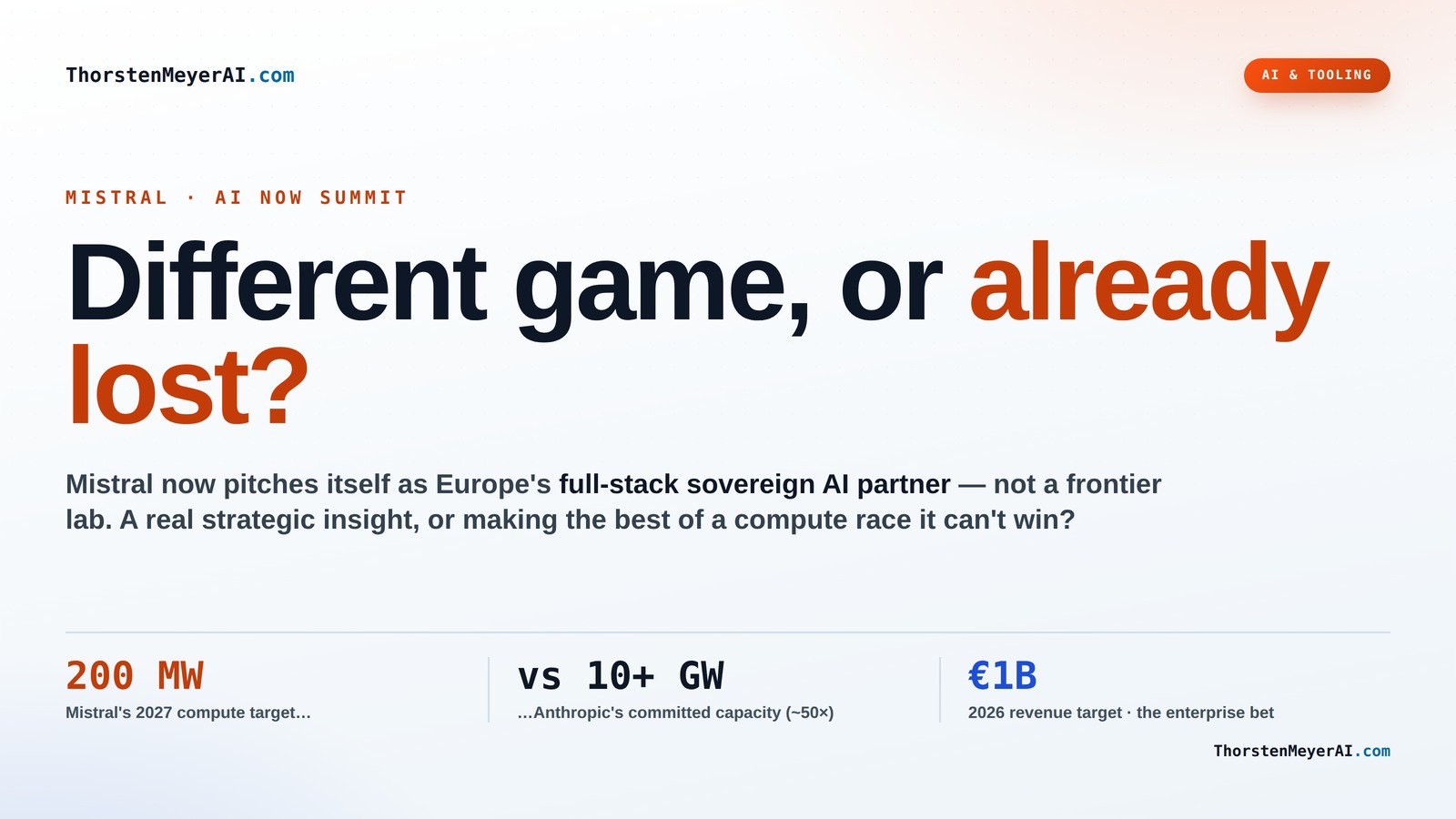
Different game, or already lost?
Mistral now pitches itself as Europe’s full-stack AI provider — compute, models, platform, consultancy — not a frontier-model lab. Is that a real strategic insight, or making the best of a race it can’t win? Both readings fit the same facts.
From model lab to full-stack provider
The clearest signal from the summit wasn’t a model — it was a posture. Heavy on enterprise logos and partnerships (ASML, BNP Paribas, Alexa+), light on new-model announcements. That absence is exactly what skeptics seized on.
Compute
40MW Paris DC + Sweden build · 200MW target by 2027
Models
Open & custom · efficient · you own and run them
Platform
Forge for custom models · Vibe for Work agent
Consultancy
Sales teams, integrators, EU provenance & support
Small & focused, or large & general?
Mistral bets on specialized small models. The claim isn’t that they win a reasoning leaderboard — they don’t. It’s that on the metrics that matter in production agent systems, a purpose-built small model wins. Flip the metric to see the case reverse.
Small specialized vs large general — by what you measure
In token-heavy agentic apps making hundreds of calls, speed/energy/cost compound. Toggle the metric.
Narrow models doing real work
Each is one model doing one thing efficiently — the tangible version of the strategy. Strong on their own terms; the open question is whether the bundle beats a free Chinese open-weight download.
On-prem KYC compliance
Mistral models run inside the bank’s walls for know-your-customer checks. Sensitive financial data never leaves. (BNP was Mistral’s first customer, 2023.)
Voxtral multilingual voice
A focused voice model powering Alexa+ across Europe — speed and efficiency over raw size.
Robostral industrial robotics
Plus a “physics AI” push (via the Emmi acquisition) into aerospace, automotive & semiconductor design and simulation.
Document AI / OCR at scale
Large-scale text extraction — the unglamorous, high-volume enterprise work small models excel at.
The strategy is downstream of the compute gap
Once you see the raw numbers, “why is Mistral behind?” answers itself — and the specialized-small-model strategy starts looking partly like a smart adaptation to a binding constraint, not a pure philosophical choice.
Compute & capital · Mistral vs a frontier leader, this same week
Not a knock — it’s the constraint that forces the efficiency-first, sovereignty-wedge strategy. Adapting intelligently to your position is what good strategy is.
“I want them to win, but I’m worried”
That ambivalence is the most accurate read of where Mistral sits. The enterprise pivot gets read two opposite ways — and both deserve airing.
On-prem, real sales teams, the Koyeb deployment acquisition, EU provenance — exactly what regulated enterprises want, and stickier than consumer mindshare. Targeting €1B revenue in 2026 with 1,000 staff, up from 15 people and one customer in 2023. US closed-API labs structurally can’t match the sovereignty axis.
“Software consultancy with a data center,” not a foundation-model moat. Enterprise B2B is where European startups go when they can’t win consumer or world-scale SaaS. Why pay Mistral on-prem when you could run Qwen free? One paying Le Chat Pro user said the quality gap with frontier labs is now hard to ignore.
Key Takeaways
- Mistral’s sovereignty focus emphasizes local control, enterprise customization, and model ownership—aimed at regulated European markets.
- Their full-stack approach, including owning data centers and hardware, sets them apart but raises questions about technical competitiveness.
- Small, purpose-built models are central to Mistral’s strategy for efficiency, cost, and real-world deployment—especially in niche applications.
- Critics argue Mistral lags in reasoning and contextual understanding compared to giants like OpenAI, but supporters see a different strategic game.
- For Europe, Mistral’s model signals a shift toward self-reliance, balancing innovation with sovereignty amid global AI competition.
As an affiliate, we earn on qualifying purchases.
What Does ‘Sovereignty’ Really Mean for Mistral?
Mistral’s sovereignty isn’t just a buzzword; it’s a core part of its identity. It means European control—owning model weights, deploying on local servers, and resisting dependence on US or Chinese cloud giants.
For a bank or government in Europe, this is gold. They want to keep sensitive data inside their own walls, not on a cloud run by someone else. Mistral’s on-prem models, like BNP Paribas using them for compliance, exemplify this shift towards local, controlled AI. This emphasis on sovereignty is about more than just data privacy; it’s a strategic assertion of independence in a landscape dominated by US and Chinese tech giants. The implications are profound: if European entities can successfully develop and deploy sovereign AI, they reduce reliance on foreign infrastructure, mitigate geopolitical risks, and retain control over critical data. However, this approach also entails trade-offs—such as potentially slower innovation cycles, limited access to the latest foundational models, and the challenge of building competitive AI capabilities from scratch. The balance between independence and performance will shape how well this strategy pays off in the long run.
This approach appeals to enterprises tired of the risk and regulation headaches that come with relying on closed, cloud-only services. But it also raises a key question: is sovereign AI enough when it comes to cutting-edge reasoning and understanding?


Ultimate CI/CD for Platform Engineering: Master DevOps Pipelines, GitOps, DevSecOps, Infrastructure as Code, Multi-Cloud Deployment, and AI-Driven Delivery Automation (English Edition)
As an affiliate, we earn on qualifying purchases.
As an affiliate, we earn on qualifying purchases.
How Mistral’s Full-Stack Approach Changes the Game
Mistral isn’t just a model company anymore. It’s becoming a full-stack AI provider—covering hardware, models, platforms, and even consulting. CEO Arthur Mensch summed it up as transforming electrons into tokens and intelligence.
They own a 40MW data center near Paris, with plans for a €1.2 billion build in Sweden, aiming for 200MW of European compute capacity by 2027. This is about controlling the entire pipeline, from raw hardware to deployed models. By owning the infrastructure, Mistral can optimize performance, security, and compliance—factors critical for enterprise adoption in sensitive sectors like finance and healthcare. This vertical integration aims to reduce dependency on external suppliers, increase customization options, and accelerate deployment timelines. However, it also requires massive investment and technological expertise. The trade-offs include the risk of overextending, the challenge of keeping pace with global hardware innovations, and the possibility that their infrastructure might not match the efficiency of established cloud giants. The strategic benefit lies in creating an ecosystem where European organizations can confidently deploy AI without leaving their borders, but sustaining this advantage will demand continuous innovation and operational excellence.
This vertical integration means Mistral can promise faster deployment, customization, and compliance—key for regulated industries. But does it have the tech muscle to keep up with the giants? That’s where the skepticism kicks in.

Large Model System Engineering in Practice AI Infrastructure Engineer Full-Stack Manual · Volume IV: The Complete Survival Manual for Ops Engineers in ... Operations Engineer Advancement Path)
As an affiliate, we earn on qualifying purchases.
As an affiliate, we earn on qualifying purchases.
The Open Weights Advantage: Why It Matters
Mistral’s open-weight models, like the 7B and Mixtral 8x7B, are designed for download, fine-tuning, and local hosting. Unlike OpenAI, which offers only API access, Mistral gives enterprises the keys to their AI kingdom.
This strategy is significant because it shifts power towards organizations that want control over their AI systems. Open weights enable customization tailored to specific enterprise needs, compliance with strict data privacy regulations, and the ability to operate independently of third-party API providers. For regulated sectors—such as finance, defense, or healthcare—this means reduced risk of vendor lock-in, improved security, and greater flexibility to adapt models over time. However, open weights also come with challenges: they require technical expertise to fine-tune and deploy effectively, and the quality of the models depends heavily on the organization’s resources. Furthermore, the open-weight approach is a competitive battlefield, with Chinese open models rapidly improving and offering similar transparency and control. The strategic advantage for Mistral lies in establishing itself as a trusted provider of European-controlled AI, but maintaining this edge will require continuous innovation, support, and ecosystem development.
Open weights represent a fundamental shift in how organizations approach AI deployment—favoring control, customization, and sovereignty. For Mistral, this could be a decisive factor in attracting enterprise clients wary of dependency and data security issues, especially in a Europe increasingly concerned with digital sovereignty.


Yahboom K230 AI Development Board 1.6GHz High-performance chip/2.4-inch Display/Open Source Robot Maker Python, Supports AI Visual Recognition CanMV Sensor (with Heightened Bracket)
- High-performance AI Chip: 1.6GHz processor with advanced KPU and CPU
- Real-time AI Processing: Supports complex image recognition and voice tasks
- Flexible Expansion: Includes 12Pin GPIO for sensors and modules
As an affiliate, we earn on qualifying purchases.
As an affiliate, we earn on qualifying purchases.
The Small, Fast Models: Why Focus on Narrow Tasks?
Mistral argues that small, purpose-built models can outperform giant general-purpose models in production environments. Why? Speed, energy efficiency, and low cost per token matter more in real-world applications.
Think about OCR for legal documents, multilingual voice assistants like Alexa+ in Europe, or industrial robotics. These are all narrow tasks, handled by models that are small, fast, and tuned for the job.
For example, Mistral’s Voxtral powers Alexa+ in Europe, processing voice commands in real-time without the lag and expense of a massive model. This focus on efficiency is a smart move—especially as many organizations prioritize cost and compliance over chasing the biggest AI benchmarks. The strategic importance of this approach lies in its alignment with real-world enterprise needs: rapid response times, lower operational costs, and easier integration into existing systems. While large models may excel in benchmark tests, they are often impractical for specific, localized applications where speed and resource constraints are critical. By focusing on niche tasks, Mistral can carve out a profitable segment that values reliability and efficiency over raw AI power, thus diversifying its offerings and reducing dependence on the high-stakes race for general intelligence.
This approach also allows for rapid iteration and customization, giving enterprises the ability to tailor models precisely to their operational contexts. The trade-off, of course, is that these models may lack the broad reasoning capabilities of larger counterparts, but in many practical scenarios, this trade-off is acceptable or even preferable.
Is Mistral Falling Behind or Playing a Different Game?
It’s a question that’s been hanging over Mistral since its rise. Critics argue that Mistral’s models lag in reasoning, context understanding, and multi-turn capabilities compared to OpenAI or Anthropic.
For instance, while Mistral’s models excel in niche applications, they don’t yet match the reasoning benchmarks of GPT-4 or Claude in complex tasks. That’s a real concern if the goal is to dominate the general-purpose AI market. This gap highlights the core trade-off: Mistral’s focus on sovereignty and local deployment may come at the expense of cutting-edge reasoning performance. The implication is that Mistral might be better suited for specialized, regulated sectors rather than competing head-to-head with the giants in broad, general-purpose AI. On the other hand, supporters argue that this strategic choice allows Mistral to cultivate a niche market where control and compliance are paramount, which could lead to a sustainable competitive advantage. The broader question is whether the market will prioritize raw reasoning power or value sovereignty and safety more—an uncertainty that will influence Mistral’s long-term positioning. This debate underscores the fundamental trade-off between technical prowess and strategic focus, shaping how Mistral is perceived in the AI ecosystem.
So, is Mistral a trailblazer or just a company playing catch-up? The answer depends on what future market segments matter most: high-end reasoning or regulated, sovereign AI.

What Does All This Mean for Europe’s AI Future?
European AI isn’t just about tech. It’s about sovereignty, control, and independence. Mistral’s approach signals a shift—more local, more customizable, less dependent on US giants.
For governments and regulated industries, owning the model weights and deploying on-premises offers peace of mind—no data leaks, no foreign control. But it also raises the bar for what “good enough” AI looks like. This shift could foster a more resilient AI ecosystem within Europe, reducing reliance on external providers and encouraging local innovation. However, it also risks fragmenting the AI landscape, creating a patchwork of incompatible systems that hinder interoperability and scale. The long-term success of this strategy hinges on Europe’s ability to develop a robust, competitive AI industry that can meet global standards while maintaining sovereignty. If successful, Europe could carve out a distinct niche—balancing innovation with regulation and control. But if the strategy stalls, it might lead to a less competitive, more fragmented AI ecosystem that struggles to keep pace with US and Chinese dominance. The key takeaway is that Mistral’s push for sovereignty isn’t just a corporate strategy; it’s a geopolitical move that could redefine Europe’s place in the global AI arena.
By pushing for a self-reliant AI infrastructure, Europe could set a precedent for other regions seeking independence from dominant tech powers. However, the challenge remains: can Europe sustain this approach without compromising on innovation and global competitiveness? The future of AI in Europe depends on striking the right balance between sovereignty and technological advancement, and Mistral’s strategy is at the heart of this delicate equation.
Frequently Asked Questions
What does ‘sovereign’ mean in Mistral’s AI strategy?
It means European control—owning model weights, deploying and running models locally, and resisting dependence on US or Chinese cloud giants. This approach prioritizes data privacy, compliance, and independence.Is Mistral mainly about European AI independence or technical superiority?
Mistral’s core is about sovereignty and control, especially for regulated sectors. While they aim for good enough models, their focus on open weights and local deployment is driven by independence, not outright model size or reasoning power.How do open-weight models differ from closed API models?
Open weights allow organizations to download, customize, and run models locally. Closed API models like OpenAI’s are hosted externally, with limited control over data and model behavior, making open weights more appealing for sensitive or regulated use.Why are governments and regulated industries so interested in model control?
Because they need to ensure data privacy, meet legal requirements, and avoid vendor lock-in. Owning and deploying models on-premises gives them control over upgrades, security, and compliance.Is Mistral falling behind in AI tech?
In some aspects like reasoning and context handling, yes. Critics point out that Mistral’s models don’t yet match the benchmarks set by giants like GPT-4. But their strategic focus is on sovereignty and deployment, not just raw performance.Conclusion
Mistral isn’t just building models. It’s shaping a new kind of AI landscape—one where control and sovereignty matter more than size or hype. Whether this leads to victory or just a regional detour depends on what markets and values matter most in the next era of AI.
As European enterprises and governments lean into sovereignty, they must ask: is this the future of AI independence, or just a different game with the same risks?




![Paged Out #9 [Pdf]](https://cables-and-networks.com/wp-content/uploads/2026/07/paged-out-9-pdf-featured-260x140.jpg)