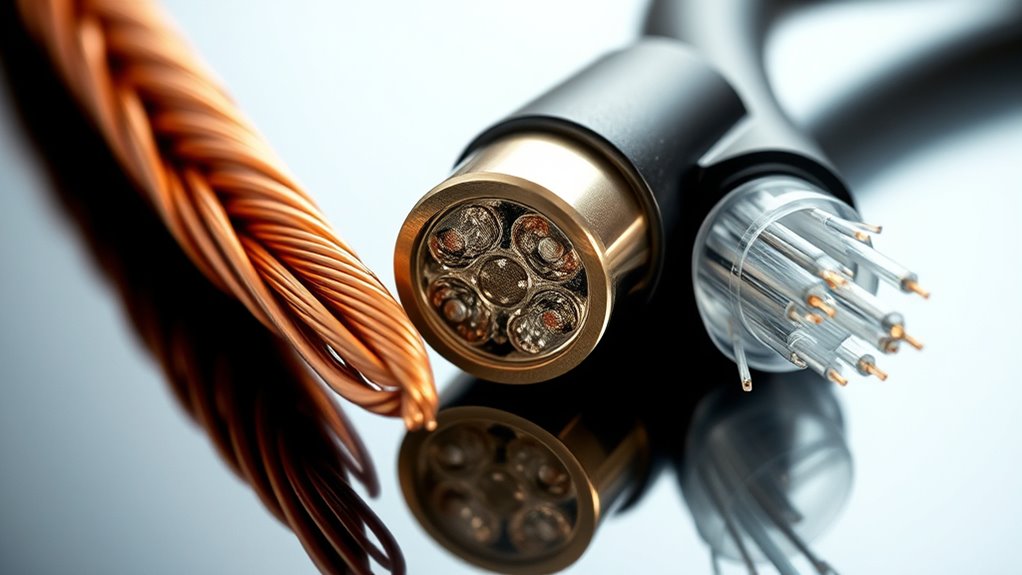

When choosing the right cable for your network, understanding the differences between twisted pair, coaxial, and fiber optic cables can considerably impact performance and cost. Each type offers unique advantages and limitations that could affect your setup’s speed, distance, and reliability. Knowing which cable best suits your needs might seem straightforward, but the more you learn, the more complex the decision becomes—especially when considering future expansion and technology demands.
Key Takeaways
- Twisted pair cables are most affordable and easy to install, ideal for basic home and LAN networks.
- Coaxial cables offer better shielding and higher bandwidth for cable TV and broadband over longer distances.
- Fiber optic cables provide the highest speed, bandwidth, and immunity to interference, suitable for enterprise and backbone networks.
- Twisted pair is more susceptible to external noise, while coaxial and fiber maintain signal integrity in noisy environments.
- Fiber optics are the most complex and costly to install, but deliver superior performance for high-demand, long-distance connections.

When choosing the right type of cable for your network, understanding the differences between twisted pair, coaxial, and fiber optic cables is vital. Each type has unique characteristics that impact performance, cost, and ease of installation. Knowing how they handle signal interference and the complexity involved in setting them up can help you make an informed decision suited to your needs.
Twisted pair cables are the most common and affordable option, often used for home networking and local area networks (LANs). They consist of pairs of insulated copper wires twisted together, which helps reduce electromagnetic interference. While twisted pair cables are effective for many applications, their susceptibility to signal interference from external sources like electrical noise or radio signals can impact data quality over longer distances. This makes them less ideal for environments with high interference. Installation is straightforward, especially for Ethernet connections, as these cables are flexible and lightweight. You can easily run them through walls or ceilings, and they typically don’t require specialized tools or technical expertise. However, their performance declines over longer runs, and they usually support bandwidths up to 1 Gbps, which may be limiting for high-demand networks.
Coaxial cables, on the other hand, feature a central conductor surrounded by a shield and an insulating layer. This design provides better protection against signal interference compared to twisted pair cables. Coaxial cables are often used for cable TV and broadband internet, especially when longer distances are involved. They handle signal interference more effectively, ensuring clearer signals over extended runs. However, installing coaxial cables can be more complex, as they’re thicker and less flexible. Proper connectors and tools are needed to guarantee secure connections, and routing them through tight spaces can be more challenging. Despite this, coaxial cables support higher bandwidths and longer distances than twisted pair cables, making them suitable for larger or more complex setups where signal integrity is vital.
Fiber optic cables represent the advanced option, transmitting data through pulses of light rather than electrical signals. This method completely eliminates signal interference issues, even over very long distances. Fiber optics support enormous bandwidths, making them ideal for backbone connections in data centers and enterprise networks. The installation process is more complex compared to twisted pair and coaxial cables. They require specialized tools and skills for splicing and connectorization, and their delicate glass fibers must be handled carefully. While the initial setup can be more costly and labor-intensive, fiber optics offer unmatched performance in terms of speed and interference immunity. They’re perfect for high-speed, high-capacity networks where signal integrity over long distances is a priority. Understanding signal interference is vital when selecting the appropriate cable type for your specific environment.

All Features Multifunction Network Caber Tester,UTP Continuity,Cable Tracer,4" IPS Touch Screen Network Tester Support TDR,DMM,OPM,Level Meter,Network Tools,POE++ Detect,RJ45 TDR,Length,FTP,NCV
【All Features 11-in-1 Network Cable Tester】All Features ethernet cable tester with 4-inch IPS touchscreen with 800×480 resolution. Multifunction...
As an affiliate, we earn on qualifying purchases.
Frequently Asked Questions
Which Cable Type Offers the Best Future-Proofing?
Fiber optic cables offer the best future-proofing because they provide superior cable durability and signal stability. You can count on them to handle increasing data demands without degradation. Unlike twisted pair or coaxial cables, fiber optics support higher bandwidths and longer distances, making them ideal for future technology needs. Investing in fiber guarantees your network remains reliable, scalable, and ready for advancements in communication infrastructure.
How Do Weather Conditions Affect Each Cable Type’s Performance?
Think of each cable as a brave traveler facing a storm. Coaxial cables withstand rain and wind better, offering good weather resilience and cable durability. Fiber optic cables, however, are more fragile; they can be damaged by moisture or extreme temperatures. Twisted pair cables are delicate and lose performance in bad weather. Protect them with proper insulation and routing to guarantee reliable performance regardless of the weather conditions.
Are There Specific Cables Preferred for Smart Home Integration?
For smart home integration, wireless alternatives are often preferred due to their ease of installation and flexibility. However, if you want reliable, high-speed connections, look for cables that guarantee smart home compatibility, like fiber optic cables for fast data transfer and minimal interference. Coaxial and twisted pair cables also work well, but wireless options often provide more convenience, especially in complex setups or where running cables is difficult.
What Are the Environmental Impacts of Manufacturing These Cables?
Environmental impacts from manufacturing cables are significant, with about 60% of the materials coming from non-renewable resources. You should know that recycling challenges hinder sustainable disposal, especially for coaxial and fiber optic cables, which contain complex materials. To reduce environmental harm, manufacturers focus on material sustainability, but the process remains difficult. Choosing cables with eco-friendly materials helps lessen your carbon footprint and promotes better recycling practices.
How Do Installation Costs Compare Among the Three Cable Types?
You’ll find that installation costs vary considerably among these cables. Twisted pair cables are the most affordable and easiest to install, thanks to their flexibility and simple connectors. Coaxial cables cost more due to their sturdiness and specialized connectors, making installation more complex. Fiber optic cables are the priciest and most challenging to install because they require precise handling, specialized tools, and skilled technicians, which increases overall installation complexity.

SGILE 9-in-1 Portable Crimping Tool Kit, 8P8C 6P6C 4P4C Connectors, RJ11/RJ12/RJ45 Cat5 Cat5e Network/Phone Cable Tester, Black
9 in 1 Network Maintenance Tools: 9-in-1 network maintenance tools meet the essential needs, which include crimping pliers,...
As an affiliate, we earn on qualifying purchases.
Conclusion
When choosing cables, consider your needs. Twisted pair is affordable for home use, while coaxial offers better range and bandwidth for cable TV. Fiber optic cables, with up to 100 terabits per second capacity, are perfect for high-speed, long-distance networks. If you need speed and future-proofing, fiber is the way to go. Remember, investing in fiber can be cost-effective long-term, especially as global internet traffic is expected to reach 200 zettabytes annually by 2025.

Klein Tools 80072 RJ45 Cable Tester Kit with LAN Scout Jr. 2, Coax Crimper / Stripper / Cutter Tool and 50-Pack Pass-Thru Modular Data Plugs
SMART BUY: A complete, high-performance kit that offers convenience and value
As an affiliate, we earn on qualifying purchases.

iMBAPrice Professional 11-in-1 Network Tool Kit for Cat5, Cat5e, Cat6 – Complete Ethernet Cable Crimper Set with RJ45 RJ11 Connectors, Cable Tester & 110 Punch Down Tool
All-in-One Networking Solution – Includes every essential tool for network setup: crimper, punch down tool, cable tester, modular...
As an affiliate, we earn on qualifying purchases.