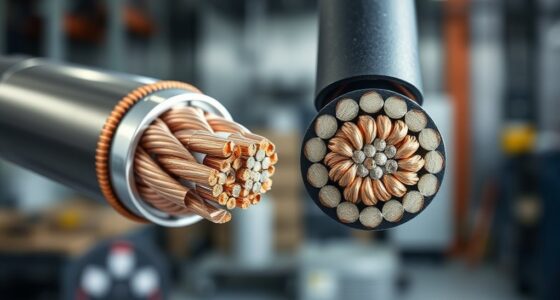
Imagine discovering that a critical network cable is causing intermittent power issues in your facility. Applying Ohm’s Law can help you diagnose whether high resistance, a loose connection, or corrosion is to blame. Understanding how voltage, current, and resistance relate allows you to troubleshoot effectively and prevent future problems. But how exactly does this fundamental law guide your approach to maintaining reliable cabling systems?
Key Takeaways
- Ohm’s Law relates voltage, current, and resistance, fundamental for understanding electrical behavior in cabling systems.
- Resistance measurement indicates cable integrity, with higher resistance signaling potential issues like corrosion or damage.
- Voltage drop depends on cable resistance and current flow; controlling it ensures proper device operation.
- Applying Ohm’s Law helps select appropriate cable sizes and lengths to minimize power loss and maintain performance.
- Resistance testing and voltage drop analysis are essential tools for troubleshooting, maintenance, and ensuring cable safety.
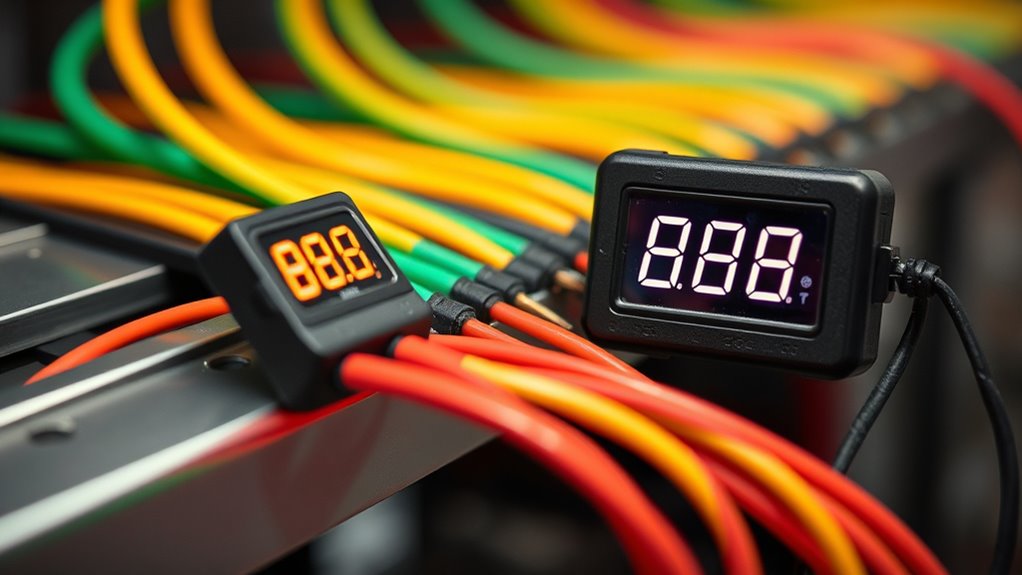
Understanding Ohm’s Law is fundamental when working with cabling, as it explains how voltage, current, and resistance interact within electrical circuits. When you’re installing or troubleshooting cables, knowing how to measure resistance accurately becomes vital. Resistance measurement helps you determine if a cable is functioning properly or if it has become damaged or degraded over time. A higher resistance indicates potential issues like corrosion, loose connections, or broken conductors, which can cause problems down the line. By assessing resistance, you can guarantee that your cabling setup maintains peak performance and safety.
Measuring resistance ensures cable integrity and safety over time.
Voltage drop is another key concept tied directly to Ohm’s Law. When current flows through a cable, some voltage is inevitably lost along its length, especially if the resistance isn’t negligible. This voltage drop can lead to insufficient power reaching your devices, causing them to malfunction or operate inefficiently. Understanding how resistance influences voltage drop allows you to select appropriate cable sizes and lengths to minimize energy loss. For example, using thicker or higher-quality cables reduces resistance, thereby lowering the voltage drop and guaranteeing your equipment receives the proper voltage levels.
In practical terms, you can apply Ohm’s Law to predict and control voltage drop in your cabling system. By measuring the resistance of a cable segment and knowing the current that will pass through it, you can calculate the expected voltage drop. This calculation helps you decide whether a cable is suitable for a specific application or if it needs to be upgraded. If resistance measurements reveal higher values than expected, it’s a sign to check connections, replace worn cables, or improve grounding. This proactive approach minimizes power losses and prevents issues caused by excessive voltage drop. Additionally, understanding air filtration and other technologies can help ensure your environment remains safe and healthy, especially when considering electrical safety and proper installation practices.
Furthermore, understanding the relationship among voltage, current, and resistance empowers you to troubleshoot effectively. If devices aren’t performing as they should, measuring resistance and analyzing voltage drop can quickly identify whether the problem stems from the cabling itself or other circuit components. This knowledge enables you to make informed decisions, reducing downtime and avoiding costly repairs. By mastering resistance measurement and monitoring voltage drops, you improve your ability to maintain reliable, efficient electrical systems.
Frequently Asked Questions
How Does Temperature Affect Resistance in Cabling?
You’ll notice that as temperature rises, resistance in cabling increases due to thermal expansion and insulation degradation. This can cause cables to heat up more, risking damage and reduced performance. When temperatures drop, resistance decreases, but extreme cold can make materials brittle. Managing temperature helps prevent insulation breakdown and maintains peak conductivity, ensuring your cabling stays reliable and efficient over time.
What Materials Offer the Best Resistance Characteristics?
You’ll find that conductive materials like copper and silver offer the best resistance characteristics, providing low resistance for efficient current flow. Copper is popular due to its excellent conductivity and affordability, while silver has even lower resistance but is more expensive. When choosing cables, consider insulation properties alongside conductive materials to guarantee safety and durability. High-quality insulation minimizes signal loss and protects against environmental factors, enhancing overall cable performance.
How Do Cable Length and Thickness Influence Voltage Drop?
You’ll notice that longer cable lengths increase voltage drop, while thicker cables reduce it. Cable insulation helps protect against signal attenuation, which worsens over distance. When you use thicker cables, the resistance decreases, minimizing voltage loss and preserving signal quality. Conversely, longer cables with thinner insulation tend to suffer more from voltage drop and signal attenuation, so choosing appropriate thickness and insulation is vital for maintaining essential performance in your wiring setup.
Can Ohm’s Law Predict Failure Points in Cabling?
Yes, Ohm’s Law can help predict failure points in cabling by analyzing potential voltage drops that lead to cable degradation or insulation failure. When you apply the law, you can identify areas where high resistance causes excessive heat or stress, risking damage. This proactive approach helps you pinpoint vulnerable sections, allowing for preventive maintenance and ensuring your cabling remains reliable and safe over time.
How Is Ohm’s Law Applied in High-Frequency Cabling?
You use Ohm’s Law in high-frequency cabling to understand signal attenuation and impedance matching. As frequency increases, resistance and reactance affect how signals travel, causing attenuation if not properly managed. By applying Ohm’s Law, you can calculate and optimize impedance to minimize signal loss and reflections, ensuring reliable data transmission. This helps in designing cables that maintain signal integrity at high frequencies, making your communication systems more efficient and robust.
Conclusion
By understanding Ohm’s Law, you’re like a skilled navigator guiding your cable system through the currents of electricity. Regular resistance tests act as your compass, helping you spot issues before they become storms. Staying proactive guarantees your infrastructure runs smoothly, safely, and efficiently—like a well-oiled machine. Remember, mastering this law keeps your electrical journey on course, preventing surprises and keeping everything connected and alive.