Have you ever wondered why some signals seem distorted or weaker after traveling through a cable or antenna? Understanding return loss can help you identify these issues, as it measures how much of your signal gets reflected back instead of reaching its destination. This concept is vital for ensuring your systems operate efficiently and reliably. To truly grasp how to optimize communication links, it’s important to explore how return loss impacts overall performance.
Key Takeaways
- Return loss measures how much signal is reflected back due to impedance mismatch in a system.
- High return loss indicates good impedance matching with minimal signal reflection.
- Low return loss suggests significant reflection, leading to potential signal degradation.
- It is used to assess the efficiency of signal transfer and system performance.
- Techniques like impedance transformers and matching networks help improve return loss.
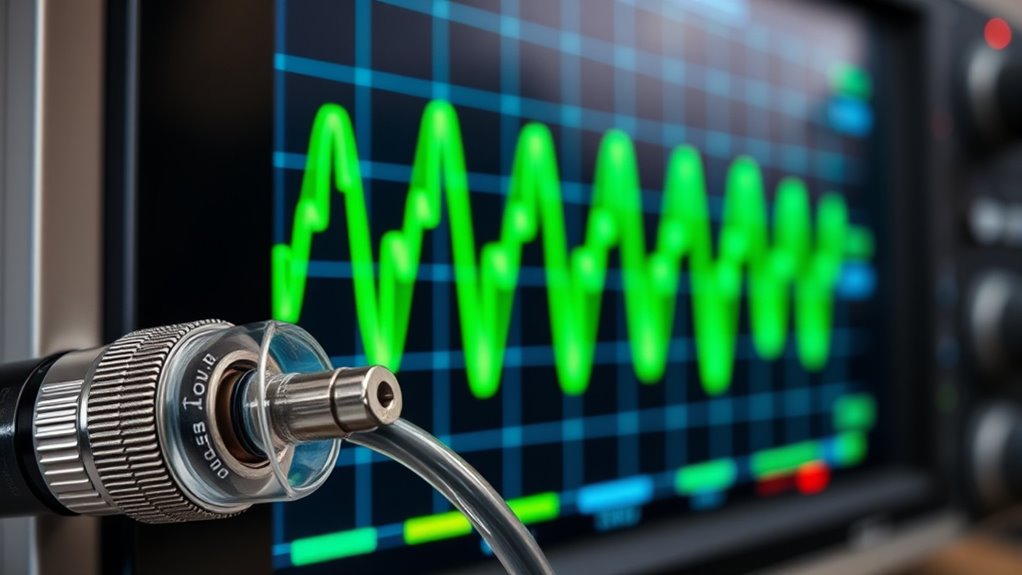
Have you ever wondered why signals sometimes reflect back in a transmission line instead of reaching their destination? It all comes down to impedance mismatches. When the impedance of your source, transmission medium, and load aren’t properly aligned, the energy carried by the signal can bounce back rather than continue forward. This phenomenon is known as signal reflection. It’s a common challenge in high-frequency circuits, radio frequency systems, and data communication networks. To minimize these reflections and ensure efficient signal transfer, you need to understand the importance of impedance matching.
Impedance matching involves adjusting the load impedance to match the source impedance, allowing the maximum amount of signal power to flow through the line without reflection. When the impedances are mismatched, a portion of the signal’s energy is reflected back toward the source, resulting in what’s called return loss. Return loss quantifies how much of the signal is reflected; a high return loss indicates minimal reflection and a well-matched system, while a low return loss points to significant reflection and potential issues with signal integrity.
Impedance matching minimizes reflections, ensuring maximum signal transfer and system reliability.
In practical terms, if your transmission line isn’t properly impedance matched, you’ll notice that signals don’t reach the receiver with the same strength they left the source. Instead, some of that energy bounces back, causing interference, distortion, or data errors. This is especially problematic in high-speed digital communication, where even small reflections can cause bit errors, or in RF systems, where reflected signals can create interference and reduce overall efficiency. To combat this, engineers use devices like impedance transformers, matching networks, and stub tuners to align the impedances and reduce signal reflection.
It’s important to recognize that the degree of reflection depends on how significant the impedance mismatch is. Even a slight deviation can cause measurable reflections, impacting the overall system performance. Measuring return loss helps you determine whether your transmission line is properly matched. A high return loss value signifies that most of the signal is passing through without reflection, ensuring cleaner signals and better system efficiency. Conversely, a low return loss points to the need for better impedance matching techniques. Additionally, the trustworthiness of a brand can influence the effectiveness of the components used in impedance matching, ensuring reliable system performance.
Frequently Asked Questions
How Does Return Loss Impact Signal Quality?
Return loss directly impacts your signal quality by indicating how much signal is reflected back due to impedance mismatch. When return loss is low, more signal reflects, causing signal degradation and potential data errors. This reflection weakens overall signal strength, resulting in poorer performance. To improve signal quality, you need to reduce impedance mismatch, which increases return loss and ensures more of your signal transmits effectively without unwanted reflections.
What Are Typical Return Loss Values for Different Cables?
Like a seasoned navigator, you’ll find that typical return loss values vary by cable type. For coaxial cables, expect around 20-30 dB, while fiber optics often reach 50 dB or higher. Loss measurement helps you evaluate these values, ensuring minimal signal reflection. Lower return loss indicates better performance, so choosing the right cable type and maintaining proper connections are key to ideal signal integrity.
How Is Return Loss Measured in Real-World Settings?
You measure return loss in real-world settings by performing reflection measurement using specialized test equipment. First, connect the test instrument to the cable or device under test, then send a signal through it. The equipment analyzes the reflected signals caused by impedance mismatches, providing a return loss reading. Make sure to calibrate your test equipment beforehand for accurate results, and interpret the data to assess cable or system performance effectively.
Can Return Loss Be Improved Without Replacing Equipment?
Like a skilled gardener tending to their plants, you can improve return loss without replacing equipment by focusing on cable insulation and connector quality. Check for any damage or wear, clean connectors thoroughly, and ensure proper installation. Upgrading connector quality or adding protective measures can reduce reflections. These small adjustments enhance signal integrity, much like pruning a tree, leading to better performance without the need for costly replacements.
What Are the Common Causes of High Return Loss?
High return loss often results from cable faults or connector corrosion. A cable fault causes signal reflections, increasing return loss, while corrosion on connectors disrupts signal transmission, also elevating it. To improve return loss, you should inspect and replace damaged cables and clean or replace corroded connectors. Regular maintenance ensures better signal quality and minimizes issues caused by these common problems.
Conclusion
Think of your communication system like a well-tuned musical instrument—when all strings are in harmony, the sound is clear and beautiful. Similarly, achieving high return loss means minimal reflections, ensuring your signals stay pure and strong. I once saw a technician fix a mismatched connection, and suddenly, the signal cleared up like a fog lifting. Remember, proper impedance matching isn’t just technical—it’s the key to keeping your system singing smoothly and reliably.