Have you ever wondered why twisted pair cables have such specific twist rates? The truth is, this small detail plays a big role in how well your data travels without interference. A proper twist rate helps reduce crosstalk and external noise, ensuring your signals stay clear. But what happens when that twist isn’t right? Understanding the importance of twist rate can make all the difference in maintaining reliable, high-quality connections.

Get business pricing on networking and server gear
- Business-only prices and quantity discounts
- Tax-exempt purchasing
- Multiple users, one account, clear invoices
Key Takeaways
- Proper twist rate enhances shielding, reducing electromagnetic interference and maintaining signal integrity.
- Incorrect twist rates decrease shielding effectiveness, increasing susceptibility to crosstalk and external noise.
- Consistent twist along the cable length is crucial for reliable data transmission and minimal signal degradation.
- Proper twist prevents issues like crosstalk and external interference, ensuring clearer signal transmission.
- Awareness of twist rate helps optimize cable installation, prolonging lifespan and improving overall system performance.

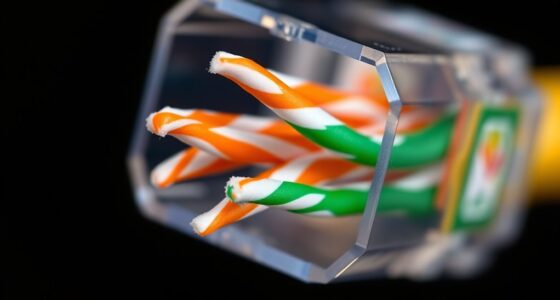
Understanding the twist rate in cables is essential for guaranteeing their ideal performance and durability. When you’re working with twisted pair cables, the twist rate determines how tightly or loosely the pairs are twisted together, which directly impacts their ability to transmit signals effectively. One of the critical factors influenced by the twist rate is shielding effectiveness. Properly twisted pairs reduce electromagnetic interference (EMI) and crosstalk, ensuring your signals stay clean and clear. If the twist rate is too high or too low, the shielding effectiveness diminishes, and you risk signal degradation, data loss, or interference from nearby cables or electronic devices. As you select or install cables, understanding the appropriate twist rate helps you maximize shielding and overall performance. Additionally, the material quality and manufacturing standards also play a role in the overall effectiveness of twisted pair cables.
Proper twist rate in cables enhances shielding, reduces interference, and ensures reliable signal transmission.
Choosing the right twist rate isn’t just about performance; it also affects how you approach installation techniques. When you install twisted pair cables, maintaining the correct twist rate along the entire length is crucial. If you untwist or straighten the pairs excessively at any point, you compromise their shielding effectiveness. This can make your cable more susceptible to external noise and decrease data integrity. To prevent this, you should handle cables carefully during installation, avoiding unnecessary untwisting or bending. Following manufacturer guidelines and ensuring consistent twist rates throughout the installation process helps maintain the cable’s designed shielding properties and overall reliability.
Furthermore, understanding the twist rate influences how you manage cable organization and routing. If you know the recommended twist rate for your specific application, you can plan your routes to minimize external interference and maximize shielding effectiveness. Properly twisted cables are less likely to pick up noise from electrical sources or neighboring cables. During installation, paying attention to twist uniformity helps prevent issues like crosstalk, which can cause data errors or slower network speeds. You might also consider using cable management accessories that support maintaining the twist integrity, especially in complex setups with multiple cables running parallel or through conduits.
In essence, your awareness of the twist rate’s role in shielding effectiveness and installation techniques equips you to make better choices for your cabling projects. It guarantees that your cables perform at their best, resist interference, and last longer. By carefully selecting cables with the appropriate twist rate and following proper installation procedures, you enhance the reliability of your network or system. Remember, the twist rate isn’t just a technical detail; it’s a key factor in safeguarding signal quality and maximizing the lifespan of your cables. Paying attention to this detail will save you time and money in troubleshooting and maintenance, making your overall setup more efficient and robust. Recognizing the importance of cable quality can further improve your installation outcomes.
As an affiliate, we earn on qualifying purchases.
Frequently Asked Questions
How Does Twist Rate Affect Cable Durability?
A proper twist rate enhances your cable’s durability by improving its mechanical strength, which directly affects its lifespan. When you maintain the correct twist rate, the cable resists stress and external forces better, preventing damage from bending or pulling. This means your cable lasts longer, stays reliable, and reduces the risk of failures. Consistent twisting guarantees your cable remains robust, giving you peace of mind in demanding environments.
Can Changing the Twist Rate Improve Signal Quality?
Yes, changing the twist rate can improve signal quality by enhancing signal integrity. When you adjust the twist rate, you reduce crosstalk and electromagnetic interference, which leads to clearer, more reliable data transmission. Additionally, a proper twist rate maintains cable flexibility, making installation easier without sacrificing performance. By optimizing the twist rate, you guarantee your twisted pair cables deliver consistent, high-quality signals while remaining flexible enough for various setups.
What Tools Are Used to Measure Twist Rate?
To measure twist rate, you use cable twist tools designed specifically for twist rate measurement. These tools help you determine the number of twists per unit length accurately. You can also use a digital caliper or a ruler combined with a magnifying glass to count twists over a known length. Proper cable twist tools guarantee precise measurements, helping you maintain ideal twist rates for better signal quality.
Does Twist Rate Impact Electromagnetic Interference?
You might think a higher twist rate improves cable flexibility, but it actually impacts electromagnetic interference (EMI) resistance. A well-chosen twist rate enhances electromagnetic shielding by reducing EMI susceptibility, ensuring clearer signals. Conversely, too tight or too loose twists weaken the shielding and make the cable more vulnerable. Consequently, balancing twist rate is essential for optimizing both electromagnetic interference resistance and cable flexibility, ensuring reliable data transmission.
Are There Industry Standards for Optimal Twist Rates?
Yes, industry standards specify ideal twist rates to guarantee twist uniformity and consistent performance. Organizations like TIA and ISO set manufacturing standards that define acceptable twist rate ranges, usually measured in twists per meter or inch. Adhering to these standards helps you maintain cable quality, reduce electromagnetic interference, and ensure reliable data transmission. Following these guidelines guarantees your cables meet industry expectations and perform effectively in real-world applications.
network cable with proper twist rate
As an affiliate, we earn on qualifying purchases.
As an affiliate, we earn on qualifying purchases.
Conclusion
Think of the twist rate like a carefully woven dance, each turn guiding signals smoothly through the cable. When you get it right, your data flows effortlessly, shielded from chaos outside. But if the twists are too tight or loose, it’s like a tangled thread, risking errors and noise. So, pay close attention to this small detail—your connection’s clarity and reliability depend on it, ensuring your digital world stays seamless and strong.
shielded twisted pair (STP) cable
As an affiliate, we earn on qualifying purchases.
As an affiliate, we earn on qualifying purchases.
As an affiliate, we earn on qualifying purchases.
Fall Picks
fall essentials
As an affiliate, we earn on qualifying purchases.