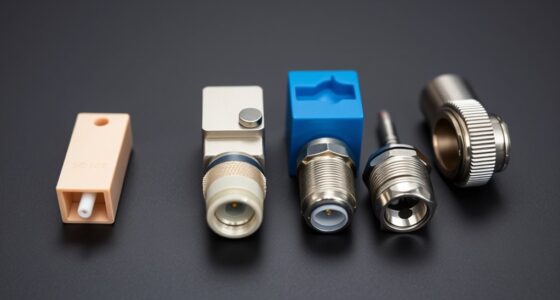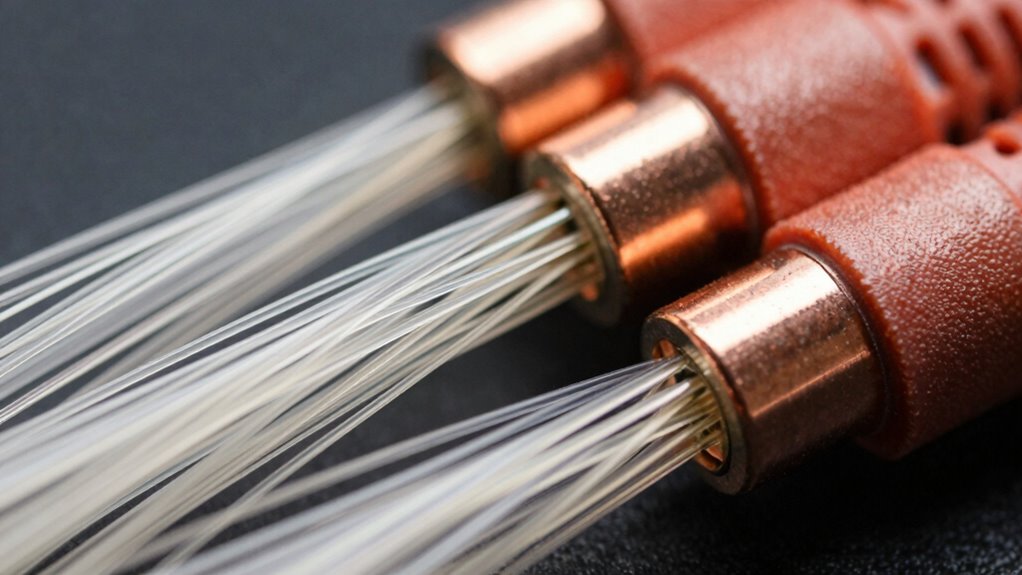

Fiber patching differs from copper patching mainly in the skills and tools required. You need specialized equipment like cleavers and splicing tools, along with precise handling to avoid damaging the delicate fibers. Unlike copper, fiber connections must be carefully aligned to guarantee peak performance and minimize signal loss. This process can be more complex and delicate, but with the right techniques, you’ll gain a more secure and scalable network—more details on this process are just ahead.

Get networking and server gear delivered free — and shop member deals
- Fast, free delivery on millions of items
- Access to Prime Big Deal Days deals on October 6–7
- Prime Video, Amazon Music and more included
Key Takeaways
- Fiber patching involves precise splicing of thin glass fibers, while copper patching uses straightforward connector attachments.
- Fiber patching requires specialized fusion or mechanical splicing equipment; copper patching uses simple plug-in connectors.
- Fiber connections demand careful handling to avoid micro-bending and signal loss; copper is more tolerant of physical contact.
- Fiber patching maintains higher security and signal integrity over long distances compared to copper.
- Upgrading fiber patches is easier due to higher capacity and flexibility in expanding or reconfiguring the network.
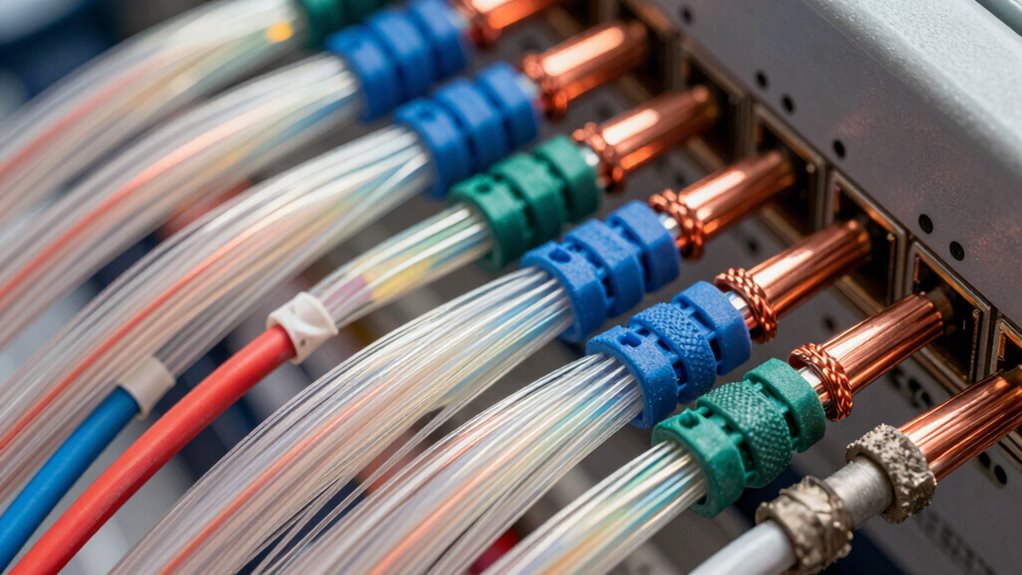
Have you ever wondered how fiber patching compares to traditional copper patching? When you’re considering upgrades or new installations, understanding the differences can help you make smarter choices. Fiber installation offers several benefits over copper, especially when it comes to speed, capacity, and security. Unlike copper cables, which rely on electrical signals, fiber optic cables use light to transmit data, allowing for much higher bandwidth and faster data transfer rates. This means your network can handle more traffic with less lag, making fiber patching ideal for data-heavy applications like cloud computing, video streaming, or large-scale enterprise systems.
In terms of network security, fiber patching provides a notable advantage. Because fiber optic cables don’t emit signals that can be tapped or intercepted easily, they inherently offer a more secure connection. This makes fiber installation a preferred choice for organizations that prioritize safeguarding sensitive information. Copper cables, on the other hand, can be more vulnerable to eavesdropping since electrical signals can sometimes be intercepted with the right equipment. If you’re aiming to minimize risks of data breaches or unauthorized access, fiber patching gives you a more robust layer of security without requiring additional encryption measures.
Another key difference lies in durability and maintenance. Fiber optic cables are less susceptible to electromagnetic interference, which can disrupt copper wiring and cause data loss or corruption. This resilience ensures your network stays stable and reliable, especially in environments with lots of electronic devices or electrical noise. Additionally, fiber patching tends to require less upkeep over time because fiber cables are less prone to corrosion and damage. This means fewer disruptions and lower long-term costs for your infrastructure. Furthermore, fiber patching can support future technological advancements more easily due to its scalability and higher capacity. Plus, advancements in fiber optic technology continue to enhance its performance and affordability, making it an increasingly viable option for many organizations. It is also worth noting that fiber installations often require precise calibration, which ensures optimal performance and longevity of the network.
Installation processes also differ markedly. Fiber installation can be more complex initially, often requiring specialized skills and equipment, but once installed, the cables are lightweight and flexible, making future upgrades or expansions easier. Copper patching, while generally simpler to set up, might face limitations as your network grows or demands increase. As your needs evolve, fiber patching scales more efficiently, supporting higher data loads and faster speeds without extensive rewiring.
As an affiliate, we earn on qualifying purchases.
Frequently Asked Questions
How Does Fiber Patching Impact Network Latency?
Fiber patching substantially reduces network latency because fiber offers high resilience and faster data transmission. Unlike copper, it’s less affected by signal interference, ensuring a stable, clear connection. This means your data moves quicker, minimizing delays. You’ll notice smoother streaming, faster uploads, and more reliable communication, especially over long distances. Fiber’s resilience and resistance to interference make it ideal for low-latency networks, improving overall performance and user experience.
What Is the Cost Difference Between Fiber and Copper Patching?
Think of fiber patching as planting a sleek, modern garden—costs are higher upfront but offer long-term growth. The cost comparison shows fiber patching usually costs more initially than copper, mainly due to expense factors like specialized equipment and installation. However, fiber’s durability and higher bandwidth can save you money over time. Copper tends to be cheaper at the start but may incur higher maintenance costs, making fiber a smarter investment long-term.
Are Fiber Patches More Environmentally Friendly Than Copper?
Yes, fiber patches are generally more environmentally friendly than copper ones. They have a lower environmental impact because fiber optic materials are more sustainable and require less energy to produce. Additionally, fiber patches don’t contain heavy metals like copper, reducing potential pollution. By choosing fiber, you support material sustainability and decrease your ecological footprint, making it a greener choice for your networking needs.
Which Patching Type Offers Better Future Scalability?
You’ll find fiber patching is the clear winner for future scalability, easily handling the most formidable scalability challenges. With its incredible bandwidth and minimal signal loss, fiber supports a future-proof infrastructure that can grow with your needs. Copper patching, on the other hand, faces limits in speed and distance, making it less suitable for long-term expansion. Investing in fiber guarantees your network remains robust, adaptable, and ready for tomorrow’s demands.
How Does Installation Complexity Differ for Fiber and Copper?
Fiber installation is generally more complex than copper because it involves delicate connector types like SC or LC, requiring precision and specialized installation tools. You need to handle fiber with care to avoid damage, and installation often demands more training. Copper patching, on the other hand, uses simpler connector types like RJ45 and standard tools, making it quicker and easier for you to set up, troubleshoot, and maintain.
As an affiliate, we earn on qualifying purchases.
Conclusion
You might think fiber and copper patching are just different cables, but their true differences impact your network’s speed and reliability. Fiber optics, often believed to be more future-proof, actually offer vastly higher bandwidth and resistance to interference. Copper, while still common and cost-effective, can’t match fiber’s performance over long distances. So, next time you choose, consider whether the myth of fiber’s superiority holds true for your specific needs.
As an affiliate, we earn on qualifying purchases.
As an affiliate, we earn on qualifying purchases.
Fall Picks
fall essentials
As an affiliate, we earn on qualifying purchases.