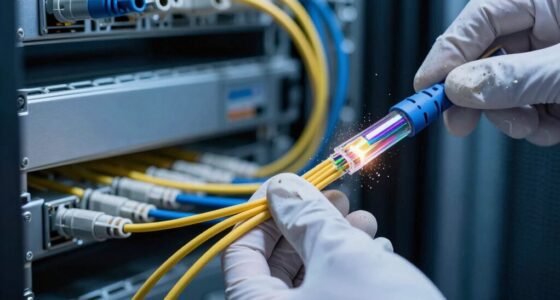

Dark fiber is an intriguing part of modern telecommunications infrastructure that you might not see every day. It consists of unused optical cables installed but not actively transmitting data, offering a unique opportunity for organizations to create dedicated, secure connections. Understanding how dark fiber is deployed and its potential benefits can reveal new possibilities for expanding network capacity and security. Curious about how this silent infrastructure is shaping the future of digital connectivity?

Get business pricing on networking and server gear
- Business-only prices and quantity discounts
- Tax-exempt purchasing
- Multiple users, one account, clear invoices
Key Takeaways
- Dark fiber refers to unused, installed optical fibers that are not currently transmitting data.
- It offers ready infrastructure for network expansion and upgrading without laying new cables.
- Organizations use dark fiber to create secure, private communication links immune to congestion.
- Service providers leverage dark fiber to reduce costs and increase network capacity through wavelength multiplexing.
- Dark fiber enables future-proof, scalable networks supporting high-speed internet, IoT, and advanced data applications.

Dark fiber refers to unused optical fiber cables that have already been installed but are not currently active or transmitting data. These fibers sit idle, waiting for a purpose, yet they hold immense potential for expanding and enhancing communication networks. As technology advances, fiber optic innovation continues to reveal new possibilities, making dark fiber a valuable asset in network infrastructure development. Instead of waiting for new cables to be laid, organizations and service providers can leverage existing dark fiber to quickly scale their network capacity or improve performance.
Unused optical fiber cables, or dark fiber, offer immense potential for expanding and enhancing communication networks efficiently.
When you consider fiber optic innovation, dark fiber becomes a key component. Its availability allows you to experiment with cutting-edge technologies like wavelength division multiplexing (WDM), which considerably increases data transmission rates over a single fiber. This flexibility means you can adapt your network to growing bandwidth demands without the lengthy process of deploying new cables. Furthermore, dark fiber offers a cost-effective way to boost connectivity, especially in dense urban areas or sprawling campuses where expanding traditional infrastructure can be disruptive and expensive.
In terms of network infrastructure development, dark fiber offers strategic advantages. If you’re looking to establish a private, secure communication channel, you can lease or own dark fiber to create a dedicated link that’s immune to congestion and cyber threats typically faced by shared networks. This is particularly attractive for organizations with high data security needs or those handling sensitive information. Additionally, dark fiber enables you to future-proof your network. As your organization grows or your data needs evolve, you can upgrade your existing dark fiber with new equipment, avoiding the need to tear up roads or lay new cables.
Using dark fiber also fosters innovation in network design. You’re not limited by the constraints of pre-existing infrastructure; instead, you can tailor your network architecture to meet specific performance and reliability goals. For example, universities, data centers, and government agencies often invest in dark fiber to create resilient, scalable networks that support research, cloud services, or critical operations. With the right technology, you can harness dark fiber to deliver ultra-fast internet connections, support IoT deployments, or enable high-definition video streaming.
Ultimately, dark fiber is a powerful tool for those seeking to push the boundaries of what’s possible with fiber optic technology. It empowers you to develop robust, flexible networks that can adapt to rapid technological changes. As fiber optic innovation continues to accelerate, dark fiber stands out as a smart investment—ready to be activated whenever you need it, ready to support your growth, and capable of transforming your network infrastructure into a future-ready platform. Additionally, understanding the importance of fiber optic infrastructure can help organizations make more informed decisions about deploying and utilizing dark fiber effectively.
As an affiliate, we earn on qualifying purchases.
Frequently Asked Questions
How Does Dark Fiber Compare to Leased Fiber Services?
You’ll find dark fiber offers more control over your fiber optic infrastructure compared to leased fiber services. With dark fiber, you can customize your network, increase scalability, and avoid shared bandwidth issues, making it ideal for growing or high-demand applications. Leased fiber, on the other hand, provides ready-to-use connectivity, but with less flexibility. Your choice depends on your need for network scalability and how much control you want over your infrastructure.
What Are the Security Benefits of Using Dark Fiber?
You gain enhanced security with dark fiber by controlling physical access, implementing strong encryption protocols, and monitoring your network continuously. You prevent unauthorized intrusions through physical security measures like secure facilities and restricted access. You protect data in transit with advanced encryption protocols, ensuring confidentiality and integrity. You reduce vulnerabilities by owning and managing your fiber, giving you full control over security measures, minimizing interception risks, and safeguarding sensitive information effectively.
Can Small Businesses Access Dark Fiber Networks?
Yes, small businesses can access dark fiber networks, but it’s less common due to the high costs and infrastructure requirements. If you do access dark fiber, you’ll benefit from dedicated, private connections that enhance your network scalability and security. To do this, you’ll need to work with providers who specialize in fiber optic infrastructure, ensuring you get a tailored solution that meets your growing business needs efficiently.
What Are the Costs Associated With Deploying Dark Fiber?
The costs associated with deploying dark fiber mainly involve fiber installation and ongoing maintenance. You should conduct a thorough cost analysis to understand expenses like trenching, equipment, and leasing fees. These upfront investments can be significant, but they offer long-term benefits like dedicated bandwidth and control. Keep in mind that prices vary based on distance, location, and the complexity of the installation, so detailed planning is essential.
How Is Dark Fiber Regulated by Government Agencies?
Think of government oversight as a traffic cop guiding dark fiber’s journey. You’re subject to fiber optic regulations that ensure safety, fair competition, and privacy. Agencies like the FCC and FTC monitor how providers deploy and lease dark fiber, making sure they abide by rules and avoid monopolies. While regulation varies by region, it’s designed to keep the network infrastructure transparent and open, so you benefit from reliable, equitable access.
As an affiliate, we earn on qualifying purchases.
Conclusion
So, next time you marvel at lightning-fast internet, remember it might just be dark fiber lurking in the shadows, waiting to be turned on. It’s like owning a hidden highway—completely built, but still waiting for your car to arrive. Ironically, what’s unused today could become the backbone of tomorrow’s digital world. Dark fiber’s potential is endless, even if it’s just sitting quietly, ready to light up when you least expect it.
fiber optic wavelength division multiplexing kit
As an affiliate, we earn on qualifying purchases.
As an affiliate, we earn on qualifying purchases.
private fiber optic internet connection
As an affiliate, we earn on qualifying purchases.
As an affiliate, we earn on qualifying purchases.
Fall Picks
fall essentials
As an affiliate, we earn on qualifying purchases.