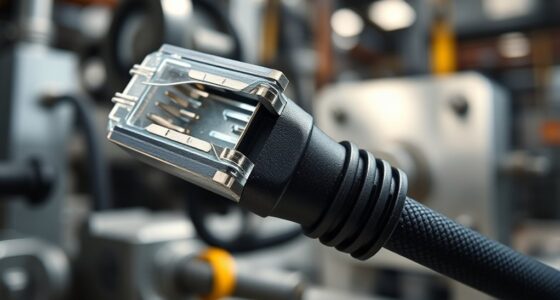
For an industrial IoT setup that needs to connect single-pair 100/1000BASE-T1 to ordinary Gigabit Ethernet, I would start with the MATENET version of this converter. Its published temperature range, compact dimensions and clearer power specifications make it the stronger general-purpose pick. The H-MTD model is the alternative when that connector matches the vehicle harness or test equipment already in use. Both bridge T1 to RJ45 and accept external power; neither is a simple PoE-powered endpoint. The deciding tradeoffs are connector compatibility, how much environmental and power detail is documented, and whether your installation can support a hands-on converter rather than a fully managed industrial switch.
Key Takeaways
- Choose the MATENET converter when you need documented operation from -40°C to +85°C and a compact 50 × 20 × 83 mm enclosure.
- Choose the H-MTD converter only when its H-MTD interface fits your cabling or test setup; the two connector types are not interchangeable.
- Both models convert 100/1000BASE-T1 to RJ45 Ethernet and require external power rather than running solely on PoE.
- The MATENET model provides more complete published details, including power draw, humidity range, PHY chips and IEEE protocol support.
- Neither product is a managed switch or a complete IoT gateway, so plan separately for routing, network security and protocol translation.
| Automotive Ethernet Media Converter – 100/1000BASE‑T1 to TX Adapter with Marvell 88Q2112 & Realtek RTL8211FI PHY, MATENET Connector, Industrial‑Grade Type‑C/DC Power |  | Best Overall: the more clearly specified MATENET bridge | T1 interface: MATENET | Ethernet interface: RJ45, 100/1000BASE-TX | PHY chips: Marvell 88Q2112 and Realtek RTL8211FI | VIEW ON AMAZON | See Our Full Breakdown |
| 100/1000Base-T1-TX-HMTD Automotive Ethernet Media Converter – 100/1000BASE-T1 to TX Adapter, Marvell 88Q2112 & Realtek RTL8211FI Phy, HMTD Connector, Industrial Grade Type-C/DC Power | 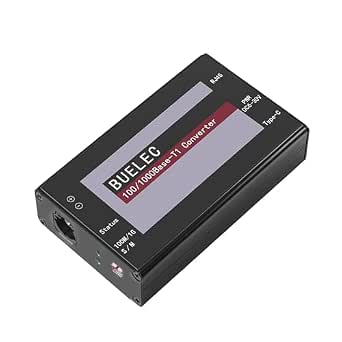 | Best for H-MTD Cabling: the connector-specific alternative | T1 interface: H-MTD | Ethernet interface: RJ45 | PHY chips: Marvell 88Q2112 and Realtek RTL8211FI | VIEW ON AMAZON | See Our Full Breakdown |
| single pair ethernet devices for industrial iot | T1 interface | Ethernet interface | PHY chips | Dimensions |
|---|---|---|---|---|
| Automotive Ethernet Media Conv | MATENET | RJ45, 100/1000BASE-TX | Marvell 88Q2112 and Realtek RTL8211FI | 50 × 20 × 83 mm |
| 100/1000Base-T1-TX-HMTD Automo | H-MTD | RJ45 | Marvell 88Q2112 and Realtek RTL8211FI | 3.27 × 1.97 inches listed |
More Details on Our Top Picks
Automotive Ethernet Media Converter – 100/1000BASE‑T1 to TX Adapter with Marvell 88Q2112 & Realtek RTL8211FI PHY, MATENET Connector, Industrial‑Grade Type‑C/DC Power
I rank this first because it gives buyers the clearest basis for checking fit before purchase. The converter connects MATENET 100/1000BASE-T1 to RJ45 100/1000BASE-TX, with full-duplex operation and a stated -40°C to +85°C range. That combination suits a range of automotive diagnostics and industrial IoT bench or cabinet tasks, provided the T1-side connector is actually MATENET. Its small 50 × 20 × 83 mm format is also easier to place near equipment than a larger gateway, although it still needs a safe mounting and cable-management plan.
The power choices are a practical advantage over a converter that depends on a single supply arrangement: the description lists USB-C at 5 V or a 6–30 V DC jack. The stated USB-C draw is no more than 355 mA, useful when planning a bench supply or vehicle test setup. VLAN tagging and QoS support may help preserve traffic handling across a connected network, while IEEE 802.3bw/ab support signals compatibility with the listed T1 and conventional Ethernet standards. I would still verify configuration requirements rather than assume VLAN or QoS behavior is adjustable from a user interface.
Compared with the H-MTD version, this is the safer general recommendation because it publishes more of the environmental and electrical envelope. The H-MTD unit may be the better physical match where that connector is already installed, but its supplied details leave more questions about temperature and power draw. The MATENET model’s tradeoff is equally clear: it needs an external supply and does not run solely from PoE. Buyers also need to confirm link-partner compatibility, connector pinout and whether the converter’s functions cover the application; this is not a router or a managed switch.
Pros:- Converts 100/1000BASE-T1 to 100/1000BASE-TX over MATENET and RJ45.
- Published operating range of -40°C to +85°C and humidity range of 0–95% RH.
- USB-C and 6–30 V DC jack power options suit bench and vehicle installations.
- Compact dimensions and listed VLAN, QoS and IEEE 802.3bw/ab support.
Cons:- Requires external power and cannot operate solely from PoE.
- MATENET connector limits its usefulness where installed T1 cabling uses H-MTD.
- It does not replace a managed switch, router or IoT protocol gateway.
Best for: Industrial IoT integrators and automotive test teams with MATENET T1 cabling who want a compact, broadly specified 100/1000BASE-T1-to-RJ45 bridge.
Not ideal for: Buyers with H-MTD-only cabling, PoE-only power, or a need for a managed switch, gateway or independently configurable network-security appliance.
- T1 interface:MATENET
- Ethernet interface:RJ45, 100/1000BASE-TX
- PHY chips:Marvell 88Q2112 and Realtek RTL8211FI
- Input power:5 V DC via USB-C, up to 355 mA, or 6–30 V DC jack
- Operating temperature:-40°C to +85°C
- Humidity range:0–95% RH
- Dimensions:50 × 20 × 83 mm
- Listed networking support:IEEE 802.3bw/ab, VLAN tagging and QoS
Our verdict“I would choose the MATENET version as the general-purpose pick when its connector fits and the application needs a well-documented, externally powered T1-to-RJ45 bridge.”
100/1000Base-T1-TX-HMTD Automotive Ethernet Media Converter – 100/1000BASE-T1 to TX Adapter, Marvell 88Q2112 & Realtek RTL8211FI Phy, HMTD Connector, Industrial Grade Type-C/DC Power
This model earns its place for buyers whose T1 wiring terminates in H-MTD, not MATENET. It provides the same core conversion job as the leading pick—100/1000BASE-T1 to RJ45 Gigabit Ethernet—and lists the same Marvell and Realtek PHY chips. For an automotive diagnostic rig, ADAS development setup or compatible industrial test station, matching the connector can matter more than choosing the model with the fuller spec sheet. A connector mismatch can turn an otherwise suitable converter into the wrong purchase.
The description calls out USB Type-C or DC-jack power, a 6–30 V DC supply range, and full-duplex 1 Gbps operation. It also identifies desk/table mounting and a 12-pin count. Those details help narrow down its physical role, but the pin count is not a substitute for a wiring diagram or a confirmed H-MTD pinout. Compared with the MATENET unit, the H-MTD version is less well documented on environmental limits: no operating-temperature or humidity range is supplied in the listed specs. I would ask for those details before using it in an exposed cabinet or other harsh location.
Its biggest advantage is specific rather than universal: it can match H-MTD cabling while delivering the same broad T1-to-RJ45 purpose. The drawback is that buyers may need more installation knowledge and should not assume a power supply is included. Like the MATENET model, it is a focused media converter rather than a complete network appliance. Choose it when H-MTD is a firm requirement and confirm the electrical, environmental and link-partner details; otherwise, the MATENET model is easier to evaluate from the available information.
Pros:- H-MTD-to-RJ45 conversion addresses installations that the MATENET model cannot connect to directly.
- Supports the stated 100/1000BASE-T1-to-Gigabit Ethernet conversion with full-duplex 1 Gbps capability.
- USB Type-C and DC-jack power options are listed.
- The same PHY chips as the MATENET pick make its core conversion purpose easy to compare.
Cons:- Published specifications omit operating-temperature and humidity ranges.
- No power supply is stated as included, and installation may require technical knowledge.
- H-MTD connector and pinout must match the actual harness; it is not interchangeable with MATENET.
Best for: Automotive and industrial networking teams whose existing single-pair Ethernet harness or test fixture uses H-MTD and who can confirm the pinout and installation requirements.
Not ideal for: Buyers with MATENET wiring, limited installation support, or deployments that require a published wide-temperature rating before procurement.
- T1 interface:H-MTD
- Ethernet interface:RJ45
- PHY chips:Marvell 88Q2112 and Realtek RTL8211FI
- Supply voltage:6–30 V DC listed; USB Type-C or DC jack described
- Maximum stated speed:1000 Mbps, full duplex
- Mounting type:Table/desk mount
- Pin count:12 listed
- Dimensions:3.27 × 1.97 inches listed
Our verdict“I would select the H-MTD converter when that connector is mandatory, but I would confirm pinout, environmental limits and included power before ordering.”

How We Picked
I ranked these two devices for one specific job: bridging industrial or automotive single-pair Ethernet to standard RJ45 Ethernet. That means the central questions are whether the connector fits the T1 cable already on site, whether the stated link speed and environmental range match the deployment, and whether available power suits the installation. I gave the MATENET unit the lead because its supplied specifications describe its operating temperature, humidity, dimensions and DC input options in more detail. Those facts make it easier to judge for a factory bench, vehicle development setup or equipment cabinet.
I did not treat similar product descriptions as proof that the hardware is identical. The H-MTD model has a distinct connector and a different set of published details, including its 12-pin description and desk/table mounting type; I would verify the connector pinout and installation method with the seller before committing to a permanent deployment. Both products list Marvell 88Q2112 and Realtek RTL8211FI PHYs, but feature lists alone do not establish interoperability with every T1 link partner. I also considered what the products do not claim: neither is described as a managed switch, security gateway or PoE-powered converter. I ranked them as focused media converters, not complete industrial networking systems.
| single pair ethernet devices for industrial iot | T1 interface | Ethernet interface |
|---|---|---|
| Automotive Ethernet Media Conv | MATENET | RJ45, 100/1000BASE-TX |
| 100/1000Base-T1-TX-HMTD Automo | H-MTD | RJ45 |
Factors to Consider When Choosing Single Pair Ethernet Devices For Industrial Iot
I would treat these devices as physical-layer Ethernet bridges, then check the surrounding system requirements separately. Neither connector choice nor a Gigabit label alone proves that a converter suits every industrial IoT network.
Match the connector to the cable first
MATENET and H-MTD are distinct T1-side connector options. I would identify the connector on the existing harness and verify its pinout against the converter documentation before ordering. The MATENET model is the better fit for MATENET cabling; the H-MTD model is the specific choice for H-MTD. An adapter should not be assumed to resolve a connector difference, since pin assignment and the cable assembly also matter. If a site uses a particular harness standard, I would confirm the mating part and cable requirements with the supplier.
Set expectations for link speed
Both products are described as supporting 100/1000BASE-T1 to standard RJ45 Ethernet, but the final link depends on the devices at both ends and their configuration. A 1000 Mbps-capable converter does not make a 100 Mbps link run at Gigabit speed. I would check the intended T1 mode, the RJ45 link partner, cable quality and any setup or negotiation requirements. For low-latency diagnostics and data collection, compatibility at the exact intended speed matters more than a headline maximum.
Plan power before choosing a mounting point
Neither listing describes PoE-only operation. The MATENET version gives a specific 5 V USB-C option and a 6–30 V DC input; the H-MTD version describes Type-C and DC input and lists a 6–30 V supply range. The H-MTD listing does not state that a power supply is included. I would check the allowed input and the supplied accessories, then account for cable strain relief and access to the power connector. In a vehicle or cabinet, a separate supply may be straightforward; a PoE-only location needs another power plan.
Match environmental documentation to the site
For equipment exposed to temperature swings or high humidity, the MATENET converter has a clearer published basis for selection: -40°C to +85°C and 0–95% RH. The H-MTD listing does not provide equivalent figures in the supplied specifications. That omission does not prove it cannot tolerate harsh conditions, but it leaves a procurement question unresolved. I would request a datasheet or written rating before installing either unit where vibration, moisture, dust or temperature are part of the operating environment; the descriptions alone do not specify a protection rating or vibration test level.
Know what a media converter does not do
A converter provides a path between two Ethernet media; it should not be mistaken for an IoT gateway, router or managed switch. The MATENET listing names VLAN tagging and QoS support, but the supplied information does not explain a configuration interface or management functions. I would plan separately for routing, firewall rules, network monitoring, device authentication and application-level protocol conversion. If the project requires those tasks in one enclosure, compare dedicated gateways or managed industrial switches rather than expecting either converter to provide them.
Verify integration details before deployment
Before installation, I would confirm that the T1 link partner supports the required mode and that both sides use compatible cabling and connectors. Ask about link indicators, configuration steps, firmware, certifications and environmental test evidence if these affect acceptance. The supplied listings do not answer every integration question, particularly for the H-MTD model. A quick check with the vendor can prevent a field issue that a headline compatibility claim would not reveal. For a permanent installation, document the power source, pinout and recovery procedure alongside the network diagram.
Frequently Asked Questions
What does a single-pair Ethernet media converter do?
It connects a single-pair Ethernet link such as 100/1000BASE-T1 to a conventional Ethernet interface such as RJ45, allowing compatible equipment on each side to exchange Ethernet traffic. I would think of these products as media converters, not application gateways: they do not automatically translate industrial protocols or provide routing and firewall functions. The exact speed and compatibility still depend on the link partners, wiring and setup.
Can I use the MATENET and H-MTD models with the same cable?
Not directly based on the listed connector types. The first model has a MATENET T1 interface, while the second uses H-MTD. I would not assume they are interchangeable or that a simple adapter will preserve the required pinout. Check the harness connector, pin assignment and supplier guidance before choosing a model or adding any adapter assembly.
Will either converter run from PoE?
The supplied specifications do not describe either device as operating solely from PoE. The MATENET version lists USB-C or a DC jack, and the H-MTD version describes USB Type-C and DC-jack power. I would budget for an appropriate external supply and confirm what is included, particularly for the H-MTD model, whose listing says no power supply is included.
Which model is better for a harsh industrial environment?
The MATENET converter is easier to justify from the available documentation because it lists an operating range of -40°C to +85°C and humidity of 0–95% RH. The H-MTD listing does not provide comparable environmental figures. I would still check for application-specific evidence such as vibration, ingress protection and compliance documentation; the listed temperature and humidity figures do not answer every environmental question.
Do these converters provide VLANs, routing or security controls?
The MATENET model’s description lists VLAN tagging and QoS support, but does not fully explain how those features are configured. Neither product is described as a router, firewall or complete security gateway. I would treat them as T1-to-RJ45 conversion devices and use separate network equipment for routing, segmentation policy, monitoring and security controls unless the seller confirms additional management functions.
Conclusion
For most buyers who need a documented bridge between MATENET single-pair Ethernet and RJ45, I recommend the first converter: its stated environmental range, compact size and clearer power details make it easier to evaluate. For teams with an H-MTD harness already in place, the second model is the connector-specific option, but I would confirm its pinout, environmental ratings and power-supply contents before deployment. If your requirement is PoE-only operation, managed switching or an IoT gateway, I would choose neither without further confirmation; these are focused media converters, not all-in-one industrial network devices.