Did you know that deploying fiber optic infrastructure nationwide can cost billions and take years to complete? As you consider the complexities involved, you’ll find that urban and rural areas face very different challenges—from maneuvering underground utilities to managing vast distances. Each step in the process demands careful planning, coordination, and adaptability. Understanding these hurdles is vital to appreciating what it takes to expand high-speed internet across diverse regions.
Key Takeaways
- Successful national fiber rollouts require comprehensive planning to address infrastructure, regulatory, and logistical challenges.
- Deployment methods (trenching, boring, aerial) must be chosen based on cost, environment, and community impact.
- Collaboration with multiple stakeholders is essential for efficient access to rights-of-way and regulatory compliance.
- Ensuring technical quality involves skilled installation, rigorous testing, and future-proofing considerations.
- Securing funding and prioritizing deployment areas are critical to overcoming resource and regulatory hurdles.

Have you ever wondered how a country can efficiently expand its high-speed internet infrastructure? It all starts with developing a robust fiber infrastructure that can support the growing demand for fast, reliable connectivity. But implementing such an extensive network doesn’t come without its hurdles. Deployment challenges are a significant part of the process, and understanding them can help you appreciate the complexity behind nationwide fiber rollouts.
One of the biggest hurdles you face is steering existing urban and rural landscapes. Urban areas often have dense infrastructure, with underground utilities, roads, and buildings that complicate installing new fiber lines. In contrast, rural areas present their own challenges—long distances, difficult terrain, and sparse populations make it less cost-effective and logistically complex to deploy fiber. You need to coordinate with multiple stakeholders, including local governments, utility companies, and property owners, to gain access to right-of-ways and public land. This process can be time-consuming and requires meticulous planning to prevent delays.
Another deployment challenge you encounter is the physical installation process itself. Laying fiber optic cables involves trenching, boring, or aerial deployment, all of which can be disruptive and costly. Trenching through busy streets or protected areas demands permits and careful scheduling to minimize traffic disruptions and community impact. Boring under roads or rivers adds engineering complexity and expense. Aerial deployment, while sometimes faster, depends on existing utility poles and can be limited by regulatory constraints or aesthetic considerations. Each method has its pros and cons, and choosing the right approach requires balancing cost, speed, and impact.
Furthermore, you must address technical and logistical hurdles related to maintaining quality standards during deployment. Ensuring consistent fiber splicing, avoiding damage during installation, and testing the network for performance are indispensable steps that demand skilled labor and precise coordination. Any mistake can lead to delays and increased costs, ultimately impacting the rollout schedule. Additionally, high refresh rates and low input lag are essential in certain deployments, especially when considering future-proofing the network for emerging technologies.
Funding and resource allocation also play indispensable roles. Securing enough investment for the entire project can be difficult, especially when dealing with large-scale national deployments. You need to carefully prioritize areas, allocate resources efficiently, and sometimes seek public-private partnerships to bridge funding gaps. Regulatory compliance adds another layer of complexity, requiring adherence to safety standards and environmental regulations, which can slow down progress if not managed properly.
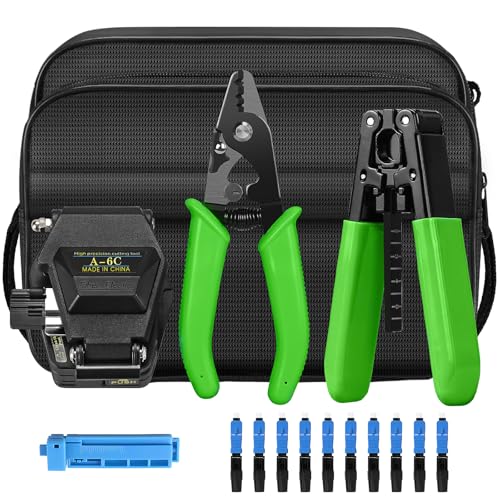
6-in-1 Fiber optic tool kit with high-precision A-6C Optical Fiber Cleaver and Multi functional three port Fiber optic stripping pliers, well as 10pcs SCUPC Fiber optic quick connector
【 Accessories List 】 The fiber optic tool set includes: hot melt cold junction Optical Fiber Cleaver/Multi functional…
As an affiliate, we earn on qualifying purchases.
As an affiliate, we earn on qualifying purchases.
Frequently Asked Questions
What Were the Main Challenges Faced During the Fiber Installation?
You faced challenges in installing fiber infrastructure, such as maneuvering complex underground and aerial setups. Gaining community engagement was also tough, as some residents were hesitant or unaware of the benefits. You had to coordinate with local authorities and manage logistical hurdles, including permits and access issues. Balancing technical requirements with community concerns required effective communication and planning to guarantee smooth fiber installation and widespread acceptance.
How Did the Project Impact Local Communities Economically?
The project was a game-changer, bridging the digital divide and fueling local economies. You might notice more businesses thriving online and new job opportunities popping up as a result. Through community engagement, residents felt more connected and invested. This transformation boosted local income, improved access to education and healthcare, and fostered a sense of pride, turning a once-fragmented community into a vibrant digital hub.
What Technological Innovations Were Employed in the Rollout?
You utilized advanced fiber optic technology to enhance the network infrastructure during the rollout. This included deploying high-capacity fiber optic cables and leveraging innovative installation techniques to speed up deployment and improve reliability. You also integrated smart monitoring systems to optimize maintenance and performance. These technological innovations guaranteed a robust, future-proof network infrastructure, providing faster, more reliable internet services for communities and supporting economic growth.
Were There Any Regulatory Hurdles Encountered During Deployment?
You might worry that regulatory hurdles could delay your project, but you’re prepared. During deployment, there were indeed regulatory compliance challenges, requiring swift policy adjustments to stay on track. By proactively engaging with regulators and adapting to evolving policies, you guarantee smooth progress. These hurdles tested your resilience, but your flexibility and commitment to compliance kept the fiber rollout on schedule, ultimately benefiting your community and stakeholders.
How Is the Project Ensuring Long-Term Sustainability and Maintenance?
You guarantee long-term sustainability by implementing thorough maintenance strategies that include regular inspections, proactive repairs, and upgrades. You focus on long-term planning by allocating resources for future upgrades and training staff to handle evolving technology. Additionally, you establish partnerships with local authorities and service providers to support ongoing maintenance and ensure the fiber network remains reliable and efficient for years to come.

Jonard Tools TK-120 Fiber Prep Kit – 12 Piece Fiber Optic Cable Access and Termination Tools Set with Stripping, Ringing, and Cutting Tools
FIBER PREP: Featuring our most popular slitting, ringing, stripping, and cutting tools, this Fiber Prep Kit provides a…
As an affiliate, we earn on qualifying purchases.
As an affiliate, we earn on qualifying purchases.
Conclusion
Imagine you’re guiding a river carving its path through varied terrain, shaping valleys and forging new channels. Just like that river, your fiber rollout navigates urban mazes and rural landscapes, overcoming obstacles and forging connections. Each challenge is a bend, each success a new course. With patience and collaboration, you create a flowing network that unites communities and fuels innovation, transforming a complex landscape into a seamless, essential current of progress.

250ft/75m OD-5mm Industrial TPU OM3 Fiber LC to LC Outdoor Armored Fiber Patch Cable, Duplex Multimode Fiber Optic Cable, 40Gb 10Gb, 50/125, Uniboot LC-LC with Pulling Eye Kit Installed on one end
Industrial TPU Jacket features strong tensile strength, high abrasion resistance, water proof, high and low-temperature resistance, uv-resistant, bending…
As an affiliate, we earn on qualifying purchases.
As an affiliate, we earn on qualifying purchases.

D YEDEMC Fiber Optic Cable Tester Portable Optical Fiber Power Meter FC/SC/ST Universal Interface Integrated OPM, VFL, and RJ45 Functions (OPM-VFL-1)
Function: can measure 8 standdard wavelengths 850/980/1300/1310/1490/ 1550/1625/1650nm , test range: -70dBm~+6dBm, Integrated OPM, VFL, and RJ45 Functions.
As an affiliate, we earn on qualifying purchases.
As an affiliate, we earn on qualifying purchases.