
Satellites have become a crucial part of expanding broadband access, especially in areas where traditional infrastructure falls short. They connect remote communities, islands, and developing regions to the internet, often at lower costs. With advancements like Low Earth Orbit satellites, latency issues are improving, making online activities smoother. As technology evolves, understanding how satellites transform global connectivity becomes increasingly important—there’s more to explore about their impact and potential.

Get business pricing on networking and server gear
- Business-only prices and quantity discounts
- Tax-exempt purchasing
- Multiple users, one account, clear invoices
Key Takeaways
- Satellites provide high-speed internet access to remote and underserved areas where terrestrial infrastructure is limited.
- Geostationary satellites offer broad coverage but have higher latency, suitable for general broadband service.
- Low Earth Orbit (LEO) satellites significantly reduce latency, enabling real-time applications like gaming and video calls.
- Satellite technology bridges the digital divide by expanding broadband reach to rural, island, and hard-to-access regions.
- Advancements in satellite constellations aim to improve global connectivity, reduce latency, and make high-speed internet universally accessible.
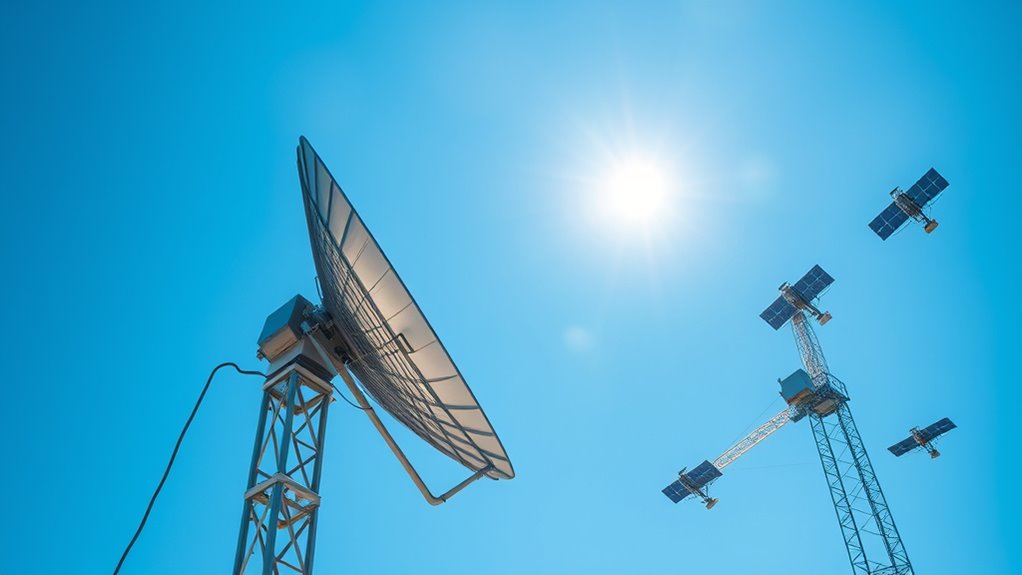
Satellites are transforming broadband connectivity by providing high-speed internet access to even the most remote areas. This revolution in coverage is particularly essential for regions where laying traditional fiber optic cables isn’t feasible or cost-effective. With satellite technology, you can now access the internet in rural communities, islands, and underserved locales, bridging the digital divide. However, understanding how satellite systems operate is fundamental in appreciating their role and limitations, especially concerning satellite latency and orbital coverage.
Satellites expand high-speed internet to remote areas, bridging the digital divide with unique coverage and latency challenges.
Satellite latency refers to the delay between sending a data request and receiving a response. It’s a significant factor in internet performance because high latency can lead to noticeable lag during activities like video calls, online gaming, or real-time data transfer. Geostationary satellites, which orbit approximately 35,786 kilometers above the Earth, tend to have higher latency due to the vast distance the signals must travel. This can result in delays of around 500 milliseconds or more, which might be frustrating for users expecting near-instant responses. Conversely, low Earth orbit (LEO) satellites orbit much closer to the surface—typically between 300 to 1,200 kilometers—reducing latency to about 20 to 50 milliseconds. This makes LEO systems more suitable for applications requiring real-time communication and fast response times.
Orbital coverage is another key aspect that determines a satellite network’s effectiveness. Geostationary satellites have a fixed position relative to the Earth, providing broad coverage over large areas. This makes them ideal for blanket coverage, especially over vast regions, but their high latency remains a challenge. On the other hand, LEO constellations consist of numerous satellites working together to guarantee continuous coverage as they orbit the planet rapidly. This approach enhances orbital coverage by reducing blind spots and improving overall network reliability. With more satellites in orbit, you benefit from more consistent connectivity, fewer interruptions, and better bandwidth.
As satellite technology advances, the balance between orbital coverage and latency continues to improve. Companies deploying LEO constellations, such as Starlink and OneWeb, aim to offer low-latency, high-capacity broadband worldwide. These systems are designed to overcome the traditional limitations of satellite internet, making high-speed connectivity more accessible and dependable, even in the most challenging environments. By understanding these factors—satellite latency and orbital coverage—you can better appreciate how satellites are not just supplementing existing infrastructure but transforming the way the world connects, especially in areas where terrestrial options are limited or nonexistent.
As an affiliate, we earn on qualifying purchases.
Frequently Asked Questions
How Do Satellite Signals Penetrate Dense Urban Areas?
You might wonder how satellite signals penetrate dense urban areas. To overcome satellite signal obstacles, modern technology uses higher frequency bands and advanced antennas to improve urban signal penetration. These innovations help bypass obstacles like tall buildings, ensuring better connectivity. While urban signal penetration can still be challenging, ongoing improvements in satellite design and signal processing make it increasingly possible to deliver reliable broadband even in crowded city environments.
What Are the Environmental Impacts of Satellite Launches?
Think satellite launches are eco-friendly? Think again! They contribute to space debris, cluttering our orbit like an overstuffed closet, and launch emissions that spew greenhouse gases into the atmosphere. These environmental impacts threaten wildlife and climate, all while we chase faster internet. So, next time you marvel at satellite tech, remember the hidden cost—an expanding mess of space junk and pollution down here.
How Do Weather Conditions Affect Satellite Broadband Performance?
Weather conditions can considerably affect your satellite broadband performance through weather interference and signal attenuation. Heavy rain, snow, or thick clouds can weaken the signal, causing slower speeds or interruptions. These atmospheric factors absorb or scatter the signals, making it harder for your satellite dish to maintain a stable connection. To minimize disruptions, make sure your dish has a clear line of sight and consider weather-resistant equipment.
What Are the Latency Differences Between Satellite and Fiber Internet?
Your internet speed feels like lightning, but satellite broadband has a significant signal delay, making it slower than fiber. Latency measurement shows satellite connections often experience 500 milliseconds or more, compared to just 10-20 milliseconds for fiber. This delay affects real-time activities like gaming or video calls, so if speed and responsiveness matter most, fiber wins hands down. Satellites are improving, but fiber still offers the lowest latency.
How Secure Is Satellite Broadband Against Cyber Threats?
Satellite broadband offers good security through satellite encryption, which protects your data during transmission. However, you should be aware of cyber vulnerabilities like signal interception or hacking attempts. To stay safe, make certain your provider uses strong encryption protocols and security measures. Regularly update your equipment and passwords. While satellite broadband is generally secure, staying vigilant helps prevent potential cyber threats and keeps your connection protected.
As an affiliate, we earn on qualifying purchases.
Conclusion
You now see how satellites are transforming broadband access worldwide. Did you know that over 3 billion people still lack reliable internet, many in remote areas? Satellites can reach those hard-to-connect spots, bridging the digital gap. With advancements like LEO satellites, latency drops markedly, making online experiences smoother. As you can imagine, satellites aren’t just boosting connectivity—they’re shaping a more connected, inclusive world for everyone.
As an affiliate, we earn on qualifying purchases.
remote area satellite internet kit
As an affiliate, we earn on qualifying purchases.
As an affiliate, we earn on qualifying purchases.
Halloween Picks
halloween
As an affiliate, we earn on qualifying purchases.