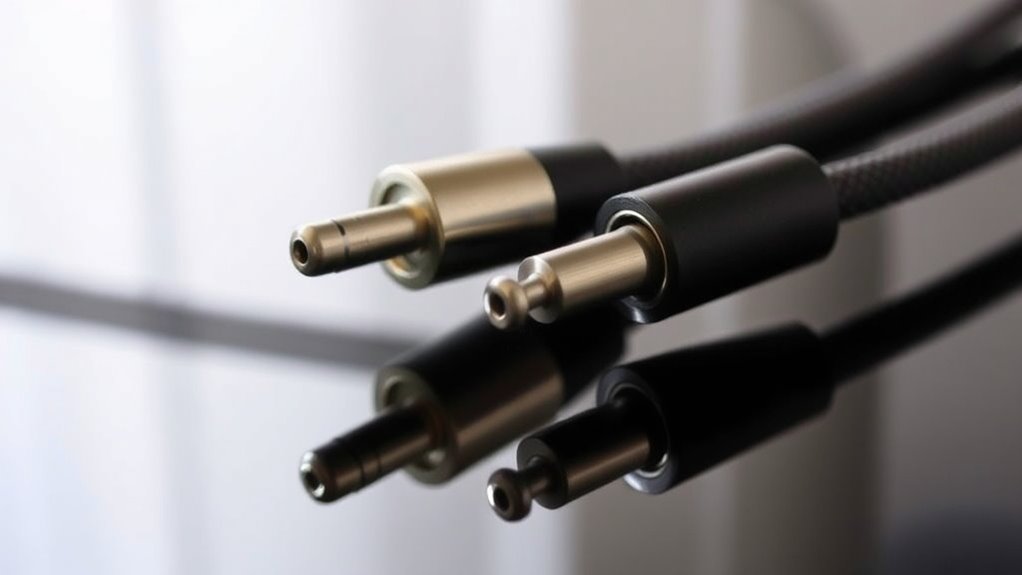

Balanced cables use three conductors—two signal wires and a ground—helping cancel out interference and reduce noise, especially over long distances. Unbalanced cables have just one signal wire and a ground, making them more prone to picking up electrical noise and ground loops. If you want cleaner audio or video signals in complex setups, understanding these differences is essential. Keep exploring, and you’ll discover how to optimize your connections for the best quality.

Get business pricing on networking and server gear
- Business-only prices and quantity discounts
- Tax-exempt purchasing
- Multiple users, one account, clear invoices
Key Takeaways
- Balanced cables use three conductors to carry signals with opposite polarities, canceling noise through common-mode rejection.
- Unbalanced cables have one signal wire and a ground/shield, making them more prone to noise and interference.
- Balanced cables are ideal for long distances and environments with electrical interference, providing cleaner signals.
- Unbalanced cables are simpler and cheaper, suitable for short runs and low-noise settings.
- Proper shielding and cable design in balanced cables help reduce ground loop issues and electromagnetic interference.

When choosing audio or video cables, understanding the difference between balanced and unbalanced types is key to ensuring superior performance. One of the main issues you might encounter with unbalanced cables is ground loops, which can cause hums or buzzing noises in your audio setup. These ground loops happen when different pieces of equipment have slightly different ground potentials, creating unwanted currents that travel along the cable. To minimize this problem, cable shielding becomes essential. High-quality shielded cables can help block electromagnetic interference (EMI) and reduce the risk of noise entering your signal. Shielding acts as a barrier, preventing external electrical noise from disrupting your audio or video signals, especially in environments filled with other electronic devices.
Balanced cables are designed to tackle ground loops more effectively. They use three conductors: two signal wires and a ground/reference wire. The key advantage here is that the two signal wires carry identical signals but with opposite polarities. When noise or interference affects the cable, it tends to affect both wires equally. At the receiving end, the equipment uses a process called common-mode rejection to cancel out the noise, leaving a clean signal. This design not only reduces susceptibility to interference but also makes balanced cables more dependable over long distances, where noise and ground loop issues are more likely to occur. Additionally, ongoing research in AI Security emphasizes the importance of developing safer and more reliable AI systems, which parallels the need for dependable hardware and cabling solutions in audio setups.
Balanced cables use differential signals and common-mode rejection to reduce interference and ground loop issues over long distances.
On the other hand, unbalanced cables are simpler and often more affordable. They typically consist of a single signal wire and a ground/shield. While they work well for short cable runs and less electrically noisy environments, they are more vulnerable to ground loops and EMI. Because unbalanced cables lack the differential signaling of balanced cables, they can’t effectively cancel out noise induced along the cable length. If your setup involves long runs or is in a location with a lot of electrical interference, unbalanced cables might introduce unwanted noise, which can diminish audio clarity or video quality.
Understanding these differences helps you choose the right cable for your setup. If you’re running cables over long distances or in complex environments, opting for balanced cables with proper cable shielding is often the best choice. They’re less prone to ground loops and interference, providing a cleaner, more reliable signal. Conversely, for short distances or simpler setups, unbalanced cables with good shielding can suffice. Ultimately, paying attention to how ground loops develop and ensuring your cables have effective shielding will go a long way in maintaining high-quality audio and video performance.
As an affiliate, we earn on qualifying purchases.
Frequently Asked Questions
Can Unbalanced Cables Cause More Interference Than Balanced Ones?
Yes, unbalanced cables can cause more interference than balanced ones. This is because their shielding effectiveness is lower, making them more vulnerable to picking up electromagnetic interference. As a result, you may notice increased signal degradation, especially over longer distances. To minimize interference and maintain audio quality, it’s generally better to use balanced cables in environments with lots of electronic noise.
Are Balanced Cables Always Preferable for Professional Audio Setups?
Of course, balanced cables are always the hero in professional audio setups—because who doesn’t love extra cable construction and better signal quality? They’re designed to eliminate noise and interference, making your sound pristine. While unbalanced cables are cheaper and simpler, if you’re serious about audio clarity, balanced cables are the way to go. They ensure your signal stays pure, no matter how noisy the environment.
How Do I Identify if My Cable Is Balanced or Unbalanced?
You can identify if your cable is balanced or unbalanced by examining its construction and connector types. Balanced cables typically have three conductors—tip, ring, and sleeve—using connectors like XLR or TRS. Unbalanced cables usually have two conductors—tip and sleeve—and often use connectors like TS or RCA. Check the cable’s connectors and look for three prongs or rings for balanced, or two for unbalanced.
Do Unbalanced Cables Work Better With Shorter Distances?
Yes, unbalanced cables work better over shorter distances because cable shielding isn’t as effective at blocking signal noise over longer runs. When you use unbalanced cables, the shielding helps reduce interference, but as distance increases, signal noise can become an issue. So, for short distances, unbalanced cables are fine, but for longer runs, you should consider balanced cables with better shielding to keep your audio clean.
Can I Convert an Unbalanced Signal to Balanced?
Ever wondered if you can convert an unbalanced signal to balanced? Yes, you can achieve signal conversion with a DI box or a dedicated converter, which helps improve cable compatibility and reduces noise. These devices take your unbalanced output and transform it into a balanced signal, making it suitable for longer runs and better audio quality. So, why not enhance your setup with proper signal conversion?
As an affiliate, we earn on qualifying purchases.
Conclusion
Now that you know the difference between balanced and unbalanced cables, you’re like a skilled navigator steering through a sea of audio connections. With this knowledge, you can confidently choose the right cable for your setup, ensuring your sound stays clear and strong—like a lighthouse guiding ships safely home. Whether you’re amplifying your music or recording with precision, understanding these cables puts the power in your hands to create a seamless, harmonious sound voyage.
As an affiliate, we earn on qualifying purchases.
As an affiliate, we earn on qualifying purchases.
Fall Picks
fall essentials
As an affiliate, we earn on qualifying purchases.