Cable certification goes beyond simple continuity testing by verifying whether your cables meet industry standards and can handle high-speed data, voice, or wireless needs. While continuity testing only checks for open circuits or breaks, certification measures parameters like attenuation, length, and performance under real-world conditions. This guarantees your cabling system is reliable, safe, and ready for demanding networks. Keep exploring to understand how proper certification can prevent future issues and support your network’s performance.

Get networking and server gear delivered free — and shop member deals
- Fast, free delivery on millions of items
- Access to Prime Big Deal Days deals on October 6–7
- Prime Video, Amazon Music and more included
Key Takeaways
- Certification assesses performance parameters like attenuation and crosstalk, while continuity testing only checks for physical connections.
- Certification ensures compliance with industry standards such as TIA/EIA and ISO/IEC.
- Certification verifies real-world data handling capacity, unlike simple continuity checks.
- Certification provides detailed documentation and reports for future reference and compliance verification.
- Continuity testing is quick and basic, whereas certification involves specialized equipment for comprehensive analysis.

When it comes to verifying your cabling systems meet safety and performance standards, understanding the difference between cable certification and continuity testing is crucial. While both involve checking your cables, they serve distinct purposes and provide different levels of assurance. Continuity testing is a quick, straightforward process that verifies whether a cable’s conductors are properly connected end-to-end. It confirms there are no breaks or open circuits, making it useful during installation to quickly identify obvious wiring issues. However, it doesn’t assess the quality of the connection or whether the cable can handle the required data rates or environmental conditions.
Continuity testing quickly confirms physical connections but doesn’t evaluate performance or environmental suitability.
Cable certification goes far beyond this basic check. It adheres to industry installation standards, such as TIA/EIA or ISO/IEC, ensuring your cabling system can reliably support network performance. Certification involves detailed testing of parameters like wire mapping, length, attenuation, crosstalk, and return loss. These measurements confirm that the entire cabling infrastructure will support high-speed data transfer, voice, and even wireless testing demands. Certification is typically performed with specialized equipment that provides a thorough report, giving you confidence that the installation meets or exceeds required standards. Additionally, comprehensive testing helps verify that the cable system can perform under real-world conditions, preventing future connectivity issues. Conducting these tests in accordance with installation standards ensures your system is compliant and optimized for current and future needs.
Wireless testing has added significance when it comes to modern networks. As more organizations rely on Wi-Fi for connectivity, certified cabling must support the bandwidth and signal integrity needed for seamless wireless access points. Certification ensures the cabling infrastructure can handle the high-frequency signals without interference, which is critical for reliable wireless performance. In contrast, continuity testing alone would miss these nuances, potentially leading to issues like dropped connections or slow data transfer, especially in environments where high-speed wireless access is essential. Proper installation standards govern how cabling should be installed, tested, and documented to ensure optimal performance and safety. Ensuring adherence to these standards is vital for test procedures that validate the entire network’s reliability and efficiency.
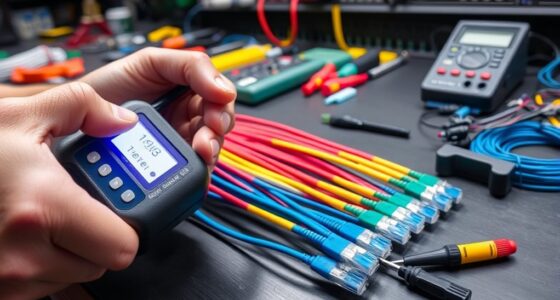
Ethernet cable certification tester
As an affiliate, we earn on qualifying purchases.
As an affiliate, we earn on qualifying purchases.
Frequently Asked Questions
How Long Does Cable Certification Typically Take?
Cable certification usually takes a few hours, depending on the complexity of the testing procedures and the length of the cable. You’ll want to guarantee certification accuracy by following thorough testing protocols. While simple continuity testing might be quick, certification involves detailed measurements like bandwidth and signal integrity, making the process longer. Expect the process to be more extensive, providing you with reliable results that confirm your cable’s performance standards.
What Equipment Is Required for Cable Certification?
For cable certification, you’ll need specialized test equipment like cable analyzers and certification testers. These tools measure parameters such as wire mapping, attenuation, and return loss, ensuring the cable meets industry standards. During the certification process, you’ll use this equipment to verify performance and compliance. Unlike simple continuity testing, certification requires extensive testing to confirm the cable’s overall quality and suitability for high-speed networks.
Can Certification Be Performed on Installed Cables?
Yes, you can perform certification on installed cables. During installation verification, certification procedures guarantee the cables meet industry standards for performance and safety. You’ll use specialized testing equipment to verify parameters like attenuation and crosstalk. This process confirms the installed cabling system functions correctly, providing confidence in its reliability. Certification on installed cables is essential for long-term performance, especially in complex or critical network environments.
What Are the Common Certification Standards?
You should know that common certification standards include ANSI/TIA-568, ISO/IEC 11801, and IEEE standards, which guarantee your cables meet industry requirements. During the certification process, you’ll verify standards compliance through rigorous testing, which goes beyond simple continuity checks. This thorough process confirms your installed cabling system can support bandwidth, performance, and safety standards, ensuring reliable network operation and future scalability.
How Often Should Cables Be Re-Certified?
You should re-certify your cables every 3 to 5 years, depending on their usage and environment. Regular certification guarantees ideal performance and safety, especially considering the cable lifespan can be affected by wear and environmental factors. Monitoring certification frequency helps you catch potential issues early, preventing failures and maintaining compliance. For critical or high-traffic cables, more frequent testing might be necessary to ensure continued reliability and safety.
As an affiliate, we earn on qualifying purchases.
Conclusion
Think of cable certification as a detailed health check for your wiring, ensuring every component functions perfectly and meets industry standards. Continuity testing, on the other hand, is like a quick heartbeat check—confirming the circuit is complete. While continuity testing is essential, cable certification dives deeper, uncovering hidden issues and verifying quality. Without proper certification, your cables are like a ship without a compass—safe from immediate danger but risking unseen pitfalls on the journey ahead.
cable attenuation and crosstalk testing equipment
As an affiliate, we earn on qualifying purchases.
As an affiliate, we earn on qualifying purchases.
wireless network cable certification tools
As an affiliate, we earn on qualifying purchases.
As an affiliate, we earn on qualifying purchases.
Evergreen bestsellers Picks
bestsellers
As an affiliate, we earn on qualifying purchases.