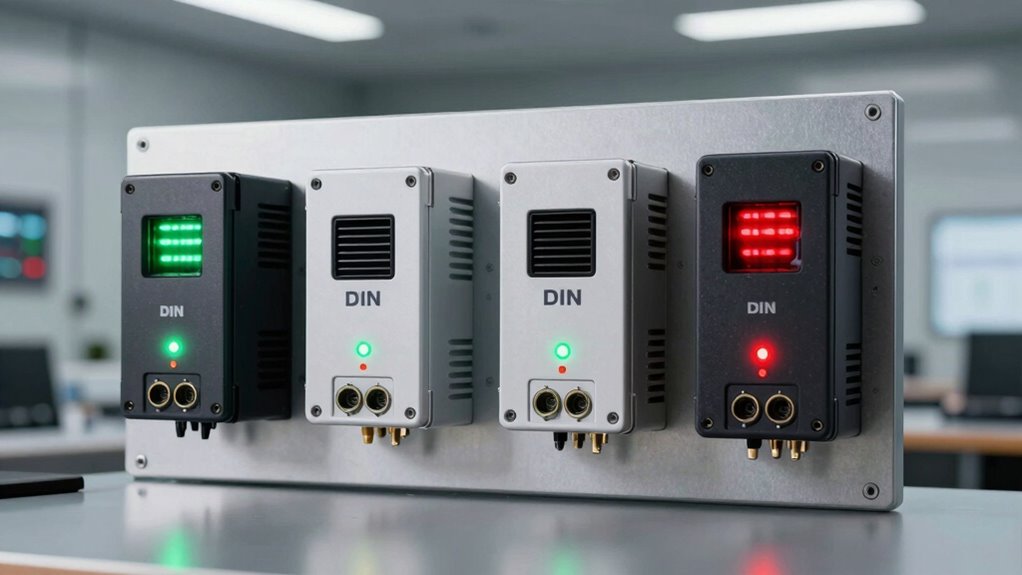

Choosing a DIN rail supply for a networked control panel starts with matching its output to the actual loads: a 24V controller and relay group has different needs from a 5V communications module or 12V accessory. My first choice for a typical 24V panel is the GPHDR-60-24, which pairs a compact profile with a stated 60W output. The 24V 2.5A 60W Industrial Control Supply is a practical alternative when adjustable output and explicit protection features matter, while the DR-15-5 is a better fit for low-power 5V electronics.

Get business pricing on networking and server gear
- Business-only prices and quantity discounts
- Tax-exempt purchasing
- Multiple users, one account, clear invoices
The central tradeoff is capacity versus cabinet space and application fit. A 60W, 24V supply gives more room for a controller, network hardware, and related devices, but it is not automatically suitable for every branch or wiring plan. The 5V and 12V choices can suit dedicated loads, yet their lower or different outputs make them poor substitutes for a 24V panel supply. I rank these options by how clearly their listed specifications support networked-control use, while treating missing details—such as output terminals, protection ratings, or thermal data—as questions to resolve before installation.
Key Takeaways
- For a general 24V networked control panel, the GPHDR-60-24 combines a stated 60W output with a compact, step-shape design; its plastic enclosure and limited thermal detail call for careful installation review.
- The 24V 2.5A Industrial Control Supply is the stronger match when adjustable output and stated short-circuit, overload, and over-voltage protection are priorities.
- The MAKERELE MDR is a dedicated 12V, 5A, 60W choice, not a direct replacement for the 24V supplies or a typical 5V electronics supply.
- The DR-15-5 supplies 5V at up to 3A, while the slimmer HDR-15-5 supplies 5V at up to 2.4A; check the connected device’s load before choosing between them.
- None of the listings provides enough detail to settle every panel-design question, so confirm wiring style, operating temperature, isolation, and compatibility with the connected equipment.
| Ultra Slim Step-Shape 3SU DIN Rail Power Supply, 24V 2.5A 60W GPHDR-60-24 |  | Best Overall for a Compact 24V Networked Panel | Model: GPHDR-60-24 | Output voltage: 24V DC | Output current: 2.5A | VIEW ON AMAZON | See Our Full Breakdown |
| 24V 2.5A 60W DIN Rail Power Supply for Industrial Control |  | Best for Adjustable 24V Output and Stated Protections | Output voltage: 24V DC | Output current: 2.5A | Power: 60W | VIEW ON AMAZON | See Our Full Breakdown |
| MAKERELE MDR 12V DIN Rail Power Supply 60W |  | Best Dedicated 12V Supply | Output voltage: 12V DC | Output current: 5A | Output power: 60W | VIEW ON AMAZON | See Our Full Breakdown |
| DR-15-5 DIN Rail Power Supply 15W 5V 3A Industrial SMPS |  | Best 5V Choice for Modest Loads | Model: DR-15-5 | Output voltage: 5V DC | Output current: 3A | VIEW ON AMAZON | See Our Full Breakdown |
| HDR-15-5 DIN Rail Power Supply 15W 5V 2.4A Ultra Slim |  | Best Compact Option for a Low-Draw 5V Device | Model: HDR-15-5 | Output voltage: 5V DC | Output current: 2.4A | VIEW ON AMAZON | See Our Full Breakdown |
| din rail power supplies for networked control panel | Output voltage | Output current | Model | Power |
|---|---|---|---|---|
| Ultra Slim Step-Shape 3SU DIN | 24V DC | 2.5A | GPHDR-60-24 | 60W |
| 24V 2.5A 60W DIN Rail Power Su | 24V DC | 2.5A | — | 60W |
| MAKERELE MDR 12V DIN Rail Powe | 12V DC | 5A | — | — |
| DR-15-5 DIN Rail Power Supply | 5V DC | 3A | DR-15-5 | 15W |
| HDR-15-5 DIN Rail Power Supply | 5V DC | 2.4A | HDR-15-5 | — |
More Details on Our Top Picks
Ultra Slim Step-Shape 3SU DIN Rail Power Supply, 24V 2.5A 60W GPHDR-60-24
For the broadest fit among these five, I place the GPHDR-60-24 first. It supplies the common 24V DC rail at 2.5A, or 60W, and the described step-shape profile is aimed at confined installations. That combination makes it a sensible starting point for a panel with a 24V controller and associated network or automation hardware, provided the calculated load stays within its rating. Its stated 100–240VAC input range also supports use across common mains supplies.
Compared with the other 24V, 60W candidate, this model emphasizes a slim form and lists CE and RoHS certifications, while the first-listed 24V unit explicitly describes adjustable output and several protection functions. The GPHDR listing gives fewer details about protection and thermal management, so I would not rank it above its rival for buyers who need those specifics documented. Its plastic enclosure and single output port are also real limits: layout, ventilation, and distribution to multiple devices need to be handled in the panel design rather than assumed from the product listing.
I would choose this model when cabinet space and a straightforward 24V, 60W rating lead the decision. I would skip it if the load requires a different voltage, if documented thermal characteristics are a purchasing requirement, or if the enclosure will face harsh mechanical conditions without suitable protection. Its compactness is useful, but it does not remove the need to check load margin and installation conditions.
Pros:- 24V DC at 2.5A gives a clear 60W capacity for compatible control loads.
- Slim step-shape design is intended for tight cabinet layouts.
- 100–240VAC input range suits common mains input conditions.
- CE and RoHS are listed certifications.
Cons:- Plastic enclosure may be less suited to exposed or mechanically demanding environments.
- Thermal management details are not provided in the supplied listing.
- Single output port offers no built-in multi-branch distribution.
Best for: Panel builders needing a compact, single-output 24V supply for a measured load below 60W.
Not ideal for: Buyers who need a metal enclosure, detailed thermal data, multiple outputs, or a documented adjustable-output feature.
- Model:GPHDR-60-24
- Output voltage:24V DC
- Output current:2.5A
- Power:60W
- Input voltage:100–240VAC
- Dimensions:4 x 2.4 x 2.6 inches
- Enclosure:Plastic
- Certifications:CE, RoHS
Our verdict“I rank it first for space-conscious 24V panels, provided its limited thermal and enclosure details meet the installation requirements.”
24V 2.5A 60W DIN Rail Power Supply for Industrial Control
This 24V, 60W supply is my close alternative to the GPHDR-60-24, and it takes second place because its listing offers more detail about practical electrical features. Adjustable output voltage gives a panel builder a way to fine-tune the DC level within the manufacturer’s permitted range, which may help on longer cable runs. The description also names short-circuit, overload, and over-voltage protection—useful information when comparing supplies for a control cabinet.
Both 24V models offer the same stated 2.5A output, so the deciding difference is not nominal capacity. The GPHDR emphasizes a slim profile and lists certifications; this unit provides listed dimensions and an input range of 85–264V, but it does not state certifications in the supplied details. Its 1.57 x 3.54 x 3.94-inch dimensions may suit some crowded panels, though the exact rail footprint and clearance still need confirmation against the cabinet layout. The described air cooling also means the installer should account for airflow and ambient temperature.
This is my pick when adjustment and named protection features matter more than a step-shape design. I would not treat those claims as a replacement for a complete datasheet, particularly for ripple, hold-up time, isolation, or derating information. It is also a rail-mount unit, not a wall-mount substitute. Compared with the 5V and 12V models below, its output is the more natural match for a 24V control rail, but it should not power devices that require another voltage without appropriate conversion.
Pros:- 24V, 2.5A output provides 60W for compatible panel loads.
- Adjustable output can help with permitted voltage tuning.
- Short-circuit, overload, and over-voltage protections are stated.
- 85–264V maximum/minimum input range is listed.
Cons:- Certifications and detailed ripple or transient specifications are not supplied.
- DIN rail mounting is required; it is not presented as a wall-mount option.
- The one-year warranty and air cooling may not suit every procurement or thermal plan.
Best for: Installers seeking a 24V, 60W DIN rail supply with adjustable output and clearly stated basic protections.
Not ideal for: Buyers who need a wall-mounted unit, listed certifications, or full electrical and environmental data before selection.
- Output voltage:24V DC
- Output current:2.5A
- Power:60W
- Input range:85–264V
- Form factor:DIN rail
- Cooling:Air
- Dimensions:1.57 x 3.54 x 3.94 inches
- Warranty:1 year
- Protection:Short circuit, overload, over-voltage
Our verdict“Choose this over the GPHDR-60-24 when adjustable output and explicitly listed protection features outweigh certification and enclosure details.”
MAKERELE MDR 12V DIN Rail Power Supply 60W
The MAKERELE MDR earns a distinct role because it delivers 12V DC at 5A, rather than trying to serve the 24V control rail. Its 60W rating gives it the same stated power as the two leading 24V units, but watts alone do not make outputs interchangeable. This model makes sense for a panel containing 12V accessories or equipment designed for a 12V input; using it for 24V hardware would be a mismatch without a suitable converter.
Against the 5V DR-15-5 and HDR-15-5, the MDR supplies a higher voltage and much more stated wattage, but it is not the better choice for low-voltage communications boards that require 5V. The listing calls out built-in filtering and short-circuit, overload, over-voltage, and temperature protection. Those details make its protection description more extensive than the GPHDR listing, though it provides less information about dimensions and enclosure durability. The barrel connector is a particular point to verify: check that it matches the equipment and wiring approach in the cabinet instead of assuming screw terminals.
I would shortlist this unit for a clearly defined 12V branch where DIN rail mounting and its connector are suitable. I would skip it as the main supply for a conventional 24V control panel, or if the project requires a specified terminal block or a rugged enclosure material; the listing describes plastic. It has useful protection claims, but the connection format and exact load needs should decide whether it belongs in the panel.
Pros:- 12V, 5A output provides a stated 60W for suitable loads.
- Short-circuit, overload, over-voltage, and temperature protections are listed.
- AC 100–240V input supports common mains ranges.
- Built-in filtering is described for the output.
Cons:- 12V output does not directly match 24V control or 5V electronics loads.
- Barrel connector may not suit standard panel wiring expectations.
- Plastic enclosure and dimensions are not detailed in the supplied specifications.
Best for: Panel builders powering compatible 12V equipment that needs up to 5A and can use the listed barrel connector.
Not ideal for: Buyers building a 24V control rail or powering 5V-only communications electronics directly.
- Output voltage:12V DC
- Output current:5A
- Output power:60W
- Input:AC 100–240V, 50/60Hz
- Connector:Barrel connector
- Enclosure:Plastic
- Protections:Short circuit, overload, over-voltage, temperature
- Mounting:DIN rail
Our verdict“This is the clearest pick for a dedicated 12V DIN rail branch, but not a substitute for the two 24V panel supplies.”
DR-15-5 DIN Rail Power Supply 15W 5V 3A Industrial SMPS
For networked panels with 5V devices, the DR-15-5 offers the higher output current of the two listed 5V units: 5V at 3A, for 15W total. That makes it the more capable choice when a communications module or several compatible low-power devices draw a little more current than the HDR-15-5 can provide. Its slim cabinet-oriented description and stated overload, over-voltage, and short-circuit protections suit the role of a dedicated low-voltage rail.
The HDR-15-5 is described as ultra-slim and provides 5V at 2.4A, so it may suit tighter layouts if the load remains within its lower current limit. The DR-15-5 trades that specific slim-profile emphasis for a 3A rating. Neither comes close to the 60W capacity of the 24V and 12V options, and neither should be chosen for a 24V controller just because it mounts on the same rail. Its listing mentions wide-range AC input but does not provide the exact range, dimensions, or terminal details, leaving useful installation questions unanswered.
I would select it for a measured, modest 5V load where the extra current headroom over the HDR-15-5 matters. I would pass if the planned devices need 24V, if their combined startup draw approaches or exceeds 3A, or if the panel specification demands a stated input range and footprint. Load budgeting remains central: the 15W label is a limit, not a recommendation to run the supply continuously at its maximum without checking manufacturer guidance.
Pros:- 5V at 3A offers more current than the HDR-15-5.
- DIN rail format is suited to cabinet mounting.
- Overload, over-voltage, and short-circuit protections are listed.
- High efficiency is described as helping limit heat buildup.
Cons:- 15W total output rules it out for larger loads.
- The exact input range and dimensions are not provided.
- Does not directly power equipment requiring 12V or 24V.
Best for: A panel builder needing a 5V rail with up to 3A for compatible low-power control or communications devices.
Not ideal for: Buyers needing a 24V supply, greater than 15W output, or fully stated dimensions and input-voltage limits.
- Model:DR-15-5
- Output voltage:5V DC
- Output current:3A
- Power:15W
- Mounting:DIN rail
- Power source:Corded electric
- Input range:Wide-range AC input; exact range not stated
- Warranty:1 year
Our verdict“I favor the DR-15-5 over the HDR-15-5 when a 5V load needs the lineup’s higher current limit.”
HDR-15-5 DIN Rail Power Supply 15W 5V 2.4A Ultra Slim
The HDR-15-5 is the space-first option in this group for a small 5V load. At 5V and 2.4A, it shares the DR-15-5’s 15W maximum power but has a lower current rating, so it belongs with devices whose combined demand stays within that limit. Its listed dimensions—3.66 x 0.69 x 2.15 inches—give a clearer sense of its slim cabinet profile than the DR-15-5 listing provides.
Compared with the DR-15-5, the HDR trades 0.6A of output current for a specifically described ultra-slim body and a stated 100–240VAC input range. That can make it a better physical fit in a tight panel, but not when the load needs the extra current. Compared with the 24V models, it is a narrow-purpose supply for 5V electronics, not a general control-panel source. Its protections cover short circuit, overload, and overvoltage, while the listing does not mention temperature protection or provide deeper electrical performance data.
I would choose it for a low-draw IoT or communications device where its dimensions help the layout and the 2.4A ceiling leaves adequate margin. I would skip it when the device’s startup current is uncertain, when a 5V load approaches the rating, or when a single supply must serve a 24V network-control rail. Confirm the load and heat conditions before fitting it; ultra-slim does not mean unrestricted airflow, and its air-cooling description makes enclosure conditions relevant.
Pros:- Ultra-slim dimensions can help in crowded cabinets.
- 5V output suits compatible low-voltage electronics.
- 100–240VAC input range is stated.
- Short-circuit, overload, and overvoltage protections are listed.
Cons:- 2.4A output is lower than the DR-15-5’s 3A rating.
- 15W capacity limits it to modest loads.
- Temperature protection is not listed in the supplied specifications.
Best for: Installers fitting a low-draw 5V device into a particularly narrow DIN rail panel space.
Not ideal for: Buyers needing more than 2.4A at 5V, a 24V rail, or stated temperature protection and broader electrical data.
- Model:HDR-15-5
- Output voltage:5V DC
- Output current:2.4A
- Wattage:15W
- Input range:100–240VAC
- Dimensions:3.66 x 0.69 x 2.15 inches
- Cooling:Air
- Protections:Short circuit, overload, overvoltage
Our verdict“Pick the HDR-15-5 over the DR-15-5 when the slimmer stated footprint matters more than the extra 0.6A.”

How We Picked
I ranked these five supplies around the actual job implied by networked control panels: providing the right DC rail for control and communications equipment while fitting a DIN-mounted cabinet. I gave the most weight to output voltage and capacity because a supply with the wrong rail is not useful simply because it is compact. For a common 24V control arrangement, the two 60W 24V units rank ahead of the 12V and 5V models; those lower-voltage products earn their places as dedicated-load options, not universal panel replacements.
I also compared the supplied descriptions for useful panel details: adjustment, protection claims, dimensions, input range, and any stated construction or certification information. A feature only helps when it answers a real selection question. For example, adjustable output can help compensate for voltage drop on a run, while a smaller body can ease layout in a crowded enclosure. I did not infer unlisted certifications, terminal types, isolation performance, or environmental ratings. Where information is absent, I treat that gap as a reason to verify the datasheet rather than assume a capability.
The order reflects voltage fit, stated capacity, cabinet practicality, and specification clarity. It is not a claim that any unit has been tested in a particular network installation. Buyers should still size for startup and peak current, check the supply’s temperature derating and protective-device requirements, and follow the manufacturer’s wiring instructions. Network equipment can be sensitive to supply quality, but the listings do not provide enough electrical data to compare ripple or transient response. I flag that limitation instead of treating general claims of stable output as a substitute for detailed specifications.
| din rail power supplies for networked control panel | Model |
|---|---|
| Ultra Slim Step-Shape 3SU DIN | GPHDR-60-24 |
| 24V 2.5A 60W DIN Rail Power Su | — |
| MAKERELE MDR 12V DIN Rail Powe | — |
| DR-15-5 DIN Rail Power Supply | DR-15-5 |
| HDR-15-5 DIN Rail Power Supply | HDR-15-5 |
Factors to Consider When Choosing Din Rail Power Supplies For Networked Control Panels
I would start with the load and panel architecture, then use footprint and listing detail to break ties. DIN rail compatibility alone does not make supplies interchangeable: the correct DC voltage, available current, and installation conditions determine whether a unit belongs in the design.
Match the output voltage before comparing wattage
Write down the voltage required by every load the supply will feed. In this lineup, the GPHDR-60-24 and 24V Industrial Control model target 24V DC; the MAKERELE MDR is 12V DC; and both 15W units provide 5V DC. A higher wattage does not compensate for the wrong output voltage. If a panel has several voltage rails, confirm whether separate supplies or approved DC conversion is appropriate for the equipment and design.
Size current for real operating conditions
Add the expected current draw of connected devices and check startup or peak demand, not only their nominal draw. The 24V units are each rated at 2.5A, the MAKERELE at 12V and 5A, the DR-15-5 at 5V and 3A, and the HDR-15-5 at 5V and 2.4A. The two 5V supplies have the same 15W headline but different current limits, so the DR-15-5 has more current capacity while the HDR-15-5 has the stated slimmer footprint. Leave appropriate margin under manufacturer guidance.
Treat cabinet space as a measured constraint
Measure available rail length and clearance around the unit, including wire bends and any space needed for cooling. The HDR-15-5 gives specific slim dimensions, while the GPHDR-60-24 is described as a compact step-shape model. The 24V Industrial Control supply also lists dimensions, but its profile may fit a different layout. Compare the listed measurements with the actual enclosure and check the manufacturer’s rail and clearance instructions; product descriptions alone do not establish fit for every cabinet.
Check connection and protection details
Do not assume every DIN rail supply connects the same way. The MAKERELE MDR lists a barrel connector, which may be convenient for compatible equipment but less suited to a conventional terminal-block wiring plan. The other listings do not give equally complete connector information, so verify terminals, wire size, and intended distribution before purchase. Protection claims also vary: the MDR lists temperature protection, the first 24V unit names short-circuit, overload, and over-voltage protection, and the 5V HDR listing names three basic protections.
Ask for the missing electrical and thermal data
For networked control equipment, general phrases such as stable output or built-in filtering do not replace specifications for ripple, transient response, isolation, hold-up time, and derating. Those details are not fully supplied for these five products. I would request the applicable datasheet and confirm operating temperature, ventilation requirements, protection coordination, and certifications needed for the installation. The GPHDR lists CE and RoHS, but buyers should confirm documentation and suitability for their own application rather than generalizing that information to the other models.
Frequently Asked Questions
Which supply is the best starting point for a typical 24V networked control panel?
I would begin by comparing the GPHDR-60-24 with the 24V 2.5A Industrial Control supply. Both state 24V and 60W output. The GPHDR emphasizes a compact step-shape body and lists CE and RoHS, while the other unit lists adjustable output and short-circuit, overload, and over-voltage protection. Choose according to which details matter to the panel, then verify the load, thermal conditions, and full datasheet.
Can I use the MAKERELE 12V model instead of a 24V supply?
Not for equipment that requires a 24V input. The MAKERELE provides 12V DC, so it is intended for compatible 12V loads even though its 60W rating matches the 24V models’ stated power. Check each device’s required voltage and connector before wiring. If the panel needs both 12V and 24V rails, plan for suitable separate supplies or an approved conversion method.
Which 5V option should I choose: DR-15-5 or HDR-15-5?
The DR-15-5 is rated at 5V and 3A, while the HDR-15-5 is rated at 5V and 2.4A. I would favor the DR when the load needs more current, and the HDR when its listed ultra-slim dimensions help the cabinet layout and 2.4A is enough. Both are 15W units, so compare the device’s continuous and startup demand against the specific current limit.
Does a DIN rail mount mean the supply will fit any control cabinet?
No. DIN rail mounting describes the mounting approach, not the unit’s complete footprint or the space needed for wiring and cooling. Compare the product’s dimensions with available rail length and enclosure clearance, and confirm its rail type and mounting instructions. The HDR-15-5 provides specific dimensions; for products with less complete fit information, request a datasheet or drawing before laying out the panel.
What should I verify before connecting network hardware to one of these supplies?
Confirm the hardware’s required DC voltage, continuous current, startup demand, connector type, and polarity. Then review the supply’s datasheet for ripple, transient response, isolation, operating-temperature limits, derating, and mounting clearances. The product descriptions do not provide all of those details, so I would not treat broad claims of stable output or protection as a substitute for checking compatibility and the requirements of the installation.
Conclusion
For a space-conscious 24V panel, I would start with the GPHDR-60-24, then confirm its thermal details and plastic enclosure suit the cabinet. For a buyer who values adjustable output and named basic protections, the 24V Industrial Control supply is the closer alternative. Choose the MAKERELE MDR only for a defined 12V branch, and select the DR-15-5 or HDR-15-5 for compatible 5V loads—the DR when current capacity matters more, the HDR when its slimmer stated footprint is the deciding factor. Before ordering any of them, match voltage and peak load, check installation conditions, and obtain the technical information the panel requires.
Halloween Picks
halloween
As an affiliate, we earn on qualifying purchases.