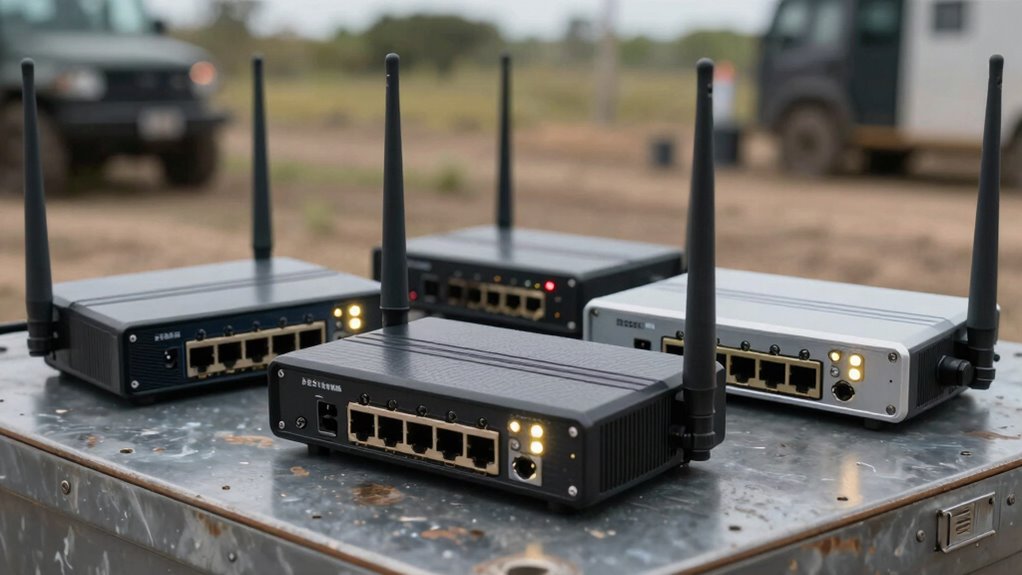

Choosing the right dual SIM industrial router for field deployments in 2026 involves balancing ruggedness, speed, and ease of management. The Yeacomm YF325 stands out for its rugged build and extensive LTE coverage, ideal for harsh environments. The Teltonika RUTM59 offers blazing 5G speeds and advanced security, perfect for demanding enterprise applications. Meanwhile, the MOFI6500-5GXeLTE-RM520-HP combines high-speed 4G/5G, Wi-Fi 6, and durability for future-proof network reliability. Each has tradeoffs: the Yeacomm’s setup can be complex, the Teltonika’s features may be overkill for casual use, and the MOFI’s advanced features require technical knowledge. I’ll walk through what makes each suitable for different needs so you can choose confidently.
Key Takeaways
- Ruggedness and LTE coverage are priority for extreme environments, favoring the Yeacomm YF325.
- High-speed, future-proof networks with advanced security suit demanding enterprise or fleet deployments, making the Teltonika RUTM59 ideal.
- Balancing high performance with Wi-Fi coverage and ease of use, the MOFI6500 excels for versatile, future-ready field applications.
- Tradeoffs include complexity versus simplicity—more features often mean more setup effort.
- Compatibility with existing networks and regional LTE bands should influence your choice based on deployment locations.
| 4G VPN Router Yeacomm YF325 Industrial LTE WiFi Modem Unlocked Dual SIM RS232 |  | Best Rugged LTE for Harsh Environments | Dual SIM Slots: Yes | VPN Support: Yes | WiFi: 802.11b/g/n | VIEW ON AMAZON | See Our Full Breakdown |
| Teltonika RUTM59 5G Industrial Router – Global 5G Sub-6 SA/NSA, Dual SIM Failover, GNSS GPS, 5 Gigabit Ethernet, USB, VPN & RMS Support |  | Best High-Speed 5G for Enterprise & Fleet | Connectivity Technology: 5G, Ethernet, LTE, USB | Number of Ports: 5 | Data Transfer Rate: 3.4 Gbps | VIEW ON AMAZON | See Our Full Breakdown |
| MOFI6500-5GXeLTE-RM520-HP 4G LTE & 5G Dual SIM Cellular Router with Wi-Fi 6 |  | Best Future-Proof Connectivity with Wi-Fi 6 | Connectivity: 4G LTE, 5G | SIM Support: Dual SIM with auto failover | Wi-Fi: Wi-Fi 6 with amplification | VIEW ON AMAZON | See Our Full Breakdown |
More Details on Our Top Picks
4G VPN Router Yeacomm YF325 Industrial LTE WiFi Modem Unlocked Dual SIM RS232
The Yeacomm YF325 is designed for extreme conditions, with an IP30 aluminum casing and an operating temperature range from -40°C to +85°C. Its dual SIM slots enable failover, which is critical for maintaining connectivity in remote or harsh settings. While it supports multiple LTE bands, it does not include Wi-Fi, limiting local wireless options. Compared with the other models, its rugged build and LTE coverage make it ideal for industrial sites with tough environmental demands, but it may pose a setup challenge for less technical users. The VPN support adds security, but the absence of Wi-Fi means additional devices are required for wireless connectivity.
Pros:- Rugged, weatherproof aluminum casing for harsh environments
- Supports dual SIM for failover and network redundancy
- Extensive LTE band support for global deployments
- Remote management capabilities
Cons:- No Wi-Fi capability, requiring separate wireless solutions
- Complex setup for non-technical users
- Limited compatibility with certain cellular providers
Best for: Industrial environments requiring rugged LTE with failover capability
Not ideal for: Users needing integrated Wi-Fi or simple plug-and-play setups
- Dual SIM Slots:Yes
- VPN Support:Yes
- WiFi:802.11b/g/n
- Supported LTE Bands:B1/2/3/4/5/7/8/28/FDD, B40/TDD
- Working Voltage:DC 5V to 36V
- Operating Temperature:-40°C to +85°C
Our verdict“This router excels in rugged, LTE-dependent environments but requires technical setup and additional wireless hardware.”
Teltonika RUTM59 5G Industrial Router – Global 5G Sub-6 SA/NSA, Dual SIM Failover, GNSS GPS, 5 Gigabit Ethernet, USB, VPN & RMS Support
The Teltonika RUTM59 offers cutting-edge 5G connectivity, supporting download speeds up to 3.4 Gbps, making it ideal for data-heavy deployments. Its dual SIM failover mechanism ensures connectivity remains stable, even if one network fails—a critical feature for fleet management or remote enterprise setups. With five Gigabit Ethernet ports and integrated GNSS GPS, it supports demanding multi-device environments and precise location tracking. However, its focus on industrial and enterprise markets means it is complex to set up and lacks Wi-Fi, limiting local wireless options. The high cost reflects its advanced features, so it’s better suited for organizations needing speed and security over simplicity.
Pros:- Supports blazing fast 5G speeds up to 3.4 Gbps
- Dual SIM with automatic failover for reliable uptime
- Multiple Gigabit Ethernet ports for extensive device connections
- Integrated GNSS GPS for location tracking
Cons:- No Wi-Fi capabilities, requiring additional wireless hardware
- More complex setup and configuration
- Higher price point due to advanced features
Best for: High-speed, reliable connectivity in demanding enterprise or fleet environments
Not ideal for: Casual users or applications requiring built-in Wi-Fi
- Connectivity Technology:5G, Ethernet, LTE, USB
- Number of Ports:5
- Data Transfer Rate:3.4 Gbps
- Maximum Upstream Data Rate:900 Mbps
- Operating System:RutOS
- Weight:1.2 pounds
Our verdict“The RUTM59 is a top-tier choice for high-speed, reliable field connectivity, especially suited for enterprise applications where speed and redundancy matter most.”
MOFI6500-5GXeLTE-RM520-HP 4G LTE & 5G Dual SIM Cellular Router with Wi-Fi 6
The MOFI6500-5GXeLTE-RM520-HP combines high-performance 4G LTE and 5G with Wi-Fi 6, making it an excellent choice for versatile field deployments. Its dual SIM auto failover ensures reliable network access, while Wi-Fi 6’s amplification extends coverage and speeds. The rugged metal case adds durability for demanding environments. This router is particularly well-suited for organizations seeking a balance of high speed, wireless coverage, and future-ready features. However, its setup can be complicated, requiring some technical expertise, and it’s more expensive than basic models, reflecting its advanced capabilities. It’s best for those needing an all-in-one solution that balances wired and wireless connectivity in demanding settings.
Pros:- Supports 4G LTE and 5G networks with high speeds
- Dual SIM with automatic failover ensures consistent connectivity
- Wi-Fi 6 with amplification for extended coverage
- Rugged metal construction for durability
Cons:- Setup complexity requiring technical skills
- Primarily aimed at business users, not casual consumers
- Higher cost for advanced features
Best for: Versatile deployments demanding high-speed 4G/5G and Wi-Fi 6 coverage
Not ideal for: Very basic needs or users seeking plug-and-play simplicity
- Connectivity:4G LTE, 5G
- SIM Support:Dual SIM with auto failover
- Wi-Fi:Wi-Fi 6 with amplification
- Construction:Rugged metal case
- Support:VPN, IP Pass-Through, Band Lock, Zerotier
Our verdict“The MOFI6500-5GXeLTE-RM520-HP offers a compelling mix of speed, wireless coverage, and durability, ideal for future-proof field deployments where performance matters most.”

How We Picked
Our selection process focused on ruggedness, network versatility, and management features, since these are critical in field deployments. We prioritized products with dual SIM failover for reliability, broad LTE or 5G support for speed, and rugged construction to withstand harsh environments. Features like Wi-Fi 6 and GNSS GPS were considered for future-proofing and location services. We also evaluated ease of setup and remote management, ensuring the options cater to a range of technical expertise. Finally, we balanced price and advanced capabilities to highlight options for different deployment scales and budgets.
Factors to Consider When Choosing Dual Sim Industrial Routers For Field Deployments
When selecting a dual SIM industrial router for field deployments, consider environmental durability, network speed, and management features. Rugged construction is vital if your deployment occurs in extreme conditions, while LTE or 5G support determines future-proofing and data speeds. Failover capabilities ensure continuous operation, especially in remote locations. Wi-Fi integration can reduce hardware requirements if local wireless access is needed. Compatibility with existing cellular networks and regional LTE bands influences coverage reliability. Finally, evaluate the complexity of setup and remote management features based on your team’s technical expertise.
Durability and Environmental Resistance
In field deployments, routers must withstand dust, moisture, and temperature extremes. Rugged cases, sealed enclosures, and wide temperature ranges are indicators of suitability. The Yeacomm YF325’s IP30 aluminum casing provides solid protection in harsh environments, whereas the MOFI’s rugged metal case offers durability combined with high performance. If your site faces extreme weather or vibration, prioritize these features to avoid costly downtime.
Connectivity and Speed
For reliable, high-speed data transfer, 5G support with gigabit Ethernet ports is ideal. The Teltonika RUTM59 provides unmatched download speeds, suitable for data-intensive applications like video streaming or large sensor data. In contrast, LTE options like the Yeacomm YF325 suffice for basic IoT or failover needs. Wi-Fi capability, as seen in the MOFI model, adds local wireless access, reducing reliance on wired connections and simplifying deployment in certain scenarios.
Failover and Redundancy
Dual SIM failover is a feature that ensures connectivity continuity if one network drops. This is critical in remote or mission-critical deployments. The Yeacomm and MOFI models support automatic failover, while the Teltonika excels with multiple Ethernet ports and integrated GPS for fleet tracking, adding layers of redundancy. Consider your environment’s reliability needs and choose accordingly.
Ease of Setup and Management
Advanced features like VPN, remote cloud management, and network monitoring improve operational control but may require technical skills. The Yeacomm router’s setup is more straightforward for industrial users familiar with network configurations, whereas the Teltonika and MOFI models offer extensive management options that might be overkill for casual users. Assess your team’s expertise before selecting a model.
Price and Future-Proofing
Prices vary significantly, with LTE-only models generally more affordable than high-speed 5G routers. The MOFI’s Wi-Fi 6 and dual 4G/5G support make it a future-proof choice, albeit at a higher cost. Balancing current needs with anticipated future requirements will help determine the best value. Remember, investing in a more capable device now can reduce replacement costs later.
Frequently Asked Questions
What should I prioritize when choosing a dual SIM industrial router?
Prioritize environmental durability, network reliability, and failover features. If deployment occurs in extreme conditions, rugged construction and wide temperature ranges are essential. For mission-critical operations, dual SIM failover and high-speed connectivity ensure continuous data flow. Compatibility with your local cellular bands and ease of remote management can also influence the decision.
Is Wi-Fi necessary in an industrial router?
Wi-Fi can reduce the need for additional hardware and simplify local connectivity, especially in sites where wired connections are impractical. However, many rugged industrial routers focus on cellular connectivity, leaving Wi-Fi as an optional feature. Assess whether local wireless access is a priority for your deployment—if so, models like the MOFI6500 with Wi-Fi 6 are advantageous.
How does 5G support benefit field deployments?
5G support dramatically increases data transfer speeds and reduces latency, enabling real-time applications such as video monitoring or large sensor networks. It also future-proofs your network, ensuring compatibility with upcoming cellular standards. However, 5G deployments can be more expensive and complex to set up, so consider your current bandwidth needs and regional coverage before investing.
What are the tradeoffs between high-end and basic dual SIM routers?
High-end models like the Teltonika or MOFI offer faster speeds, more features, and greater scalability but come with higher costs and complexity. Basic models like the Yeacomm focus on rugged LTE connectivity with simpler setup, making them suitable for environments where speed and advanced features are less critical. Choose based on your deployment’s technical requirements and budget.
Can these routers be managed remotely?
Most modern industrial routers include remote management capabilities, allowing for configuration, monitoring, and updates over the cloud or via secure VPNs. The Yeacomm YF325 supports Yeacomm’s cloud platform, while the Teltonika and MOFI devices offer more comprehensive management tools suited for large deployments. Remote management reduces on-site visits and simplifies troubleshooting, especially for widespread or hard-to-access locations.
Conclusion
If your field deployment requires rugged durability and LTE failover in harsh environments, the Yeacomm YF325 is a reliable choice. Organizations needing ultra-fast data transfer, fleet tracking, and advanced security should consider the Teltonika RUTM59. For those seeking a versatile, future-ready solution with high-speed 4G/5G and Wi-Fi 6, the MOFI6500 offers a compelling package. Matching the router’s capabilities to your environment, technical expertise, and budget will lead to the best long-term investment.