
🔍 Read the full analysis: 10 Best Network Attached Storage Devices For 2027: Choosing A NAS For Your Setup on ThorstenMeyerAI.com

Get business pricing on networking and server gear
- Business-only prices and quantity discounts
- Tax-exempt purchasing
- Multiple users, one account, clear invoices
TL;DR
A 10-device NAS roundup identifies the UGREEN DXP4800 Plus as its overall pick, the Synology DS225+ for two-bay setups and the BUFFALO LinkStation 210 4TB for buyers who want a drive included. These are editorial recommendations, not a new product launch or independently verified test results; buyers should confirm current specifications and plan a separate backup.
ThorstenMeyerAI.com has published a 10-device NAS buying guide that names the UGREEN DXP4800 Plus its overall pick, the Synology DS225+ its choice for two-bay storage and the BUFFALO LinkStation 210 4TB its pick for buyers who want a hard drive included. The recommendations frame a practical tradeoff for home and small-office users: more drive bays and flexibility generally mean more decisions and setup, while simpler systems can offer less room to expand.
The guide compares NAS devices as shared network storage for files, backups and media, as do other NAS roundups for home and small offices. Its 10 listed models are the UGREEN DXP4800 Plus, DXP4800 Pro and DH4300 Plus; the UGREEN DXP2800; the Synology DS225+, DS223 and DS223j; the UGREEN DH2300; and the BUFFALO LinkStation 210 in 2TB and 4TB versions. The source identifies the three UGREEN models ending in 4800 or 4300 as four-bay options, while the DS225+, DS223, DS223j, DXP2800 and DH2300 are two-bay choices, a category also covered in rack-mount NAS system guides.
Most of the listed devices are described as diskless enclosures, meaning buyers need to choose and install drives separately. The two BUFFALO LinkStation 210 options include a drive, with the 4TB version offering more included capacity than the 2TB model. That can simplify the purchase, but the guide advises checking whether a bundled drive can be replaced and what the system supports before buying.
The ranking weighs bay count, included storage, expandability, usability and maintenance. The source does not provide benchmark results, prices, test methodology details or a full model-by-model specification table in the supplied material. It advises readers to check manufacturers’ current specifications for supported drives, network connections, software features and storage configurations.
The 10 picks
- 1
 UGREEN NAS DXP4800 Pro 4-Bay Desktop NAS with Intel Core i3-1315U, 8GB DDR5,…View on Amazon →
- 2
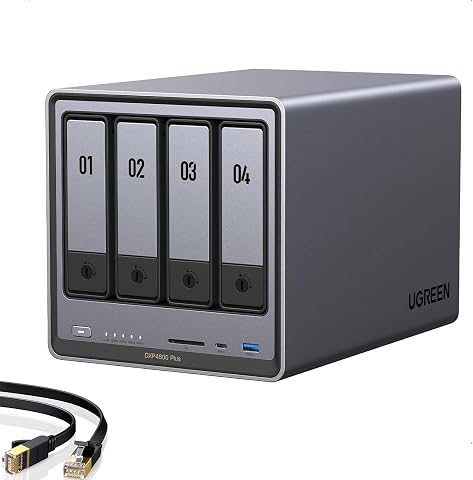 UGREEN DXP4800 Plus 4-Bay NASView on Amazon →
- 3
 UGREEN NAS DXP2800 2-Bay for Advanced Home Users, Remote Workers & CreatorsView on Amazon →
- 4
 UGREEN NAS DH4300 Plus 4-Bay NAS Storage EnclosureView on Amazon →
- 5
 Synology DS225+ 2-Bay Diskless NASView on Amazon →
- 6
 Synology DS223 2-Bay Diskless NASView on Amazon →
- 7
 UGREEN NAS DH2300 2-Bay Desktop NASync, Support Capacity 64TB (Diskless), Rem…View on Amazon →
- 8
 Synology DiskStation DS223j 2-Bay NAS Enclosure (Diskless)View on Amazon →
- 9
 BUFFALO LinkStation 210 4TB 1-Bay NASView on Amazon →
- 10BUFFALO LinkStation 210 2TB 1-Bay NAS with Included Hard DriveView on Amazon →
Choosing Between Capacity and Simplicity
The main value of the roundup is its decision framework: buyers should choose a NAS around expected data growth and willingness to manage drives, not simply select the model with the most bays. A four-bay enclosure can offer more options for adding capacity than a single-bay unit, but it can also require more drives, maintenance and upfront spending. A smaller system may be a better match for a fixed backup or shared-folder need.
The distinction matters because a NAS centralizes data but does not automatically provide a complete backup plan. The guide cautions that drive mirroring is not the same as an independent backup: accidental deletion, damage or theft can affect the device. Buyers should plan a separate copy on another device or in another location and check that the NAS software supports a backup schedule and restoration process they can maintain.
Network performance also depends on the NAS, drives, router or switch and the computers accessing it. Paying for a faster network connection may not help if the rest of the network cannot use it. The right choice depends on the whole setup, not the NAS alone.
Products Worth Considering

LG 27GR83Q-B 27-inch Ultragear QHD IPS Gaming Monitor

Jackery Solar Generator 1000 v2 with 200W Solar Panel, 1024Wh LiFePO4 Battery

Logitech MX Mechanical Wireless Illuminated Keyboard, Tactile Quiet, Graphite
As an affiliate, we earn on qualifying purchases.
How the Ten Models Differ
The guide divides its choices mainly by number of drive bays and whether storage is included. It presents the UGREEN DXP4800 Plus, DXP4800 Pro and DH4300 Plus as four-bay options for buyers who want more room to configure or expand storage. Its two-bay group includes products from both UGREEN and Synology, giving buyers alternatives to compare beyond capacity alone.
The two BUFFALO LinkStation 210 versions are the roundup’s single-bay, drive-included options. Their included storage can make the initial setup more straightforward, but they offer fewer drive choices than multi-bay enclosures. The source also stresses that Synology and UGREEN differ in software experience and setup approach, though the provided material does not document a detailed feature-by-feature comparison.
The recommendations are presented as editorial guidance from ThorstenMeyerAI.com, based on categories such as capacity, expansion, usability and maintenance. The supplied source does not establish that the rankings result from controlled laboratory testing or direct performance measurements.
“My best overall pick is the UGREEN DXP4800 Plus for buyers who want four drive bays and room to grow.”
— ThorstenMeyerAI.com, describing its overall recommendation
Specifications and Testing Still Need Checking
The supplied roundup material does not state the products’ current prices, detailed network ports, supported drive capacities, software versions or full storage-configuration options. Those details may vary by model, region or product revision, so buyers should verify them with the manufacturer before purchasing. The guide also provides no quantified performance tests or named testing conditions in the source text.
It is also unclear how the rankings would change for buyers with specific workloads, such as frequent large-file transfers, several simultaneous users or a particular backup requirement. The source offers broad selection criteria rather than measurements for those use cases. Its recommendations should be read as editorial picks, not proof that one device will outperform another in every setup.
Check Fit Before You Buy
Before choosing a model, estimate how much storage you use now and how quickly it is likely to grow. Then compare bay count, included-drive capacity, compatible drive sizes, network connections and the system’s backup and restore features against your actual devices and network. For diskless models, include the cost and installation of drives in the decision.
Buyers should also decide where a second copy of important files will live and how often it will be updated. The source does not identify a forthcoming product announcement, test update or other next milestone; the immediate next step is checking current manufacturer specifications and matching them to a maintainable storage and backup plan.
Key Questions
Which NAS does the guide name as its overall pick?
ThorstenMeyerAI.com names the UGREEN DXP4800 Plus as its overall pick for buyers seeking four drive bays and room to grow. That is the guide’s editorial recommendation, not a claim that it is best for every use.
Which listed NAS options include a hard drive?
The guide says both BUFFALO LinkStation 210 models include a drive: one with 2TB and one with 4TB. Most of the other listed options are described as diskless enclosures.
Is a two-bay NAS enough for home storage?
The guide presents two-bay devices as a fit for a more compact home storage setup. Whether one is enough depends on current capacity, expected growth, drive configuration and the number of people and devices using it.
Does a NAS replace a separate backup?
No. The guide says a NAS centralizes files but cannot protect against every failure. It recommends keeping a separate copy on another device or in another location; drive mirroring alone is not an independent backup.
Source: ThorstenMeyerAI.com