

TL;DR
Nvidia announced Rubin HPC on Nov. 16 at SC26, saying the GPU will have more than 50,000 CUDA cores and target scientific simulation and data processing. It is expected in 2028, but Nvidia has not disclosed precision performance, memory, power, pricing or benchmarks.
Nvidia announced Rubin HPC at the SC26 supercomputing conference in Chicago on Nov. 16, describing a GPU for scientific simulation and data processing with more than 50,000 CUDA cores on a single chip. The company expects the GPU to be available in 2028, but has not provided benchmarks or several specifications needed to assess its performance and cost.

Get business pricing on networking and server gear
- Business-only prices and quantity discounts
- Tax-exempt purchasing
- Multiple users, one account, clear invoices
The announcement appeared in a Nov. 16 Nvidia blog post by Dan Ernst, senior director of supercomputing products. Nvidia said Rubin HPC is part of its Vera Rubin platform and is intended for science, engineering and analytics workflows. The company called the core count a record, but did not give an exact number.
Nvidia also described a design intended to scale data movement and compute together. It said Rubin HPC will include “a sparse data acceleration capability” to keep its cores supplied with data and use seventh-generation NVLink for GPU-to-GPU connections. The post did not explain the sparse-data feature’s implementation or quantify its effect.
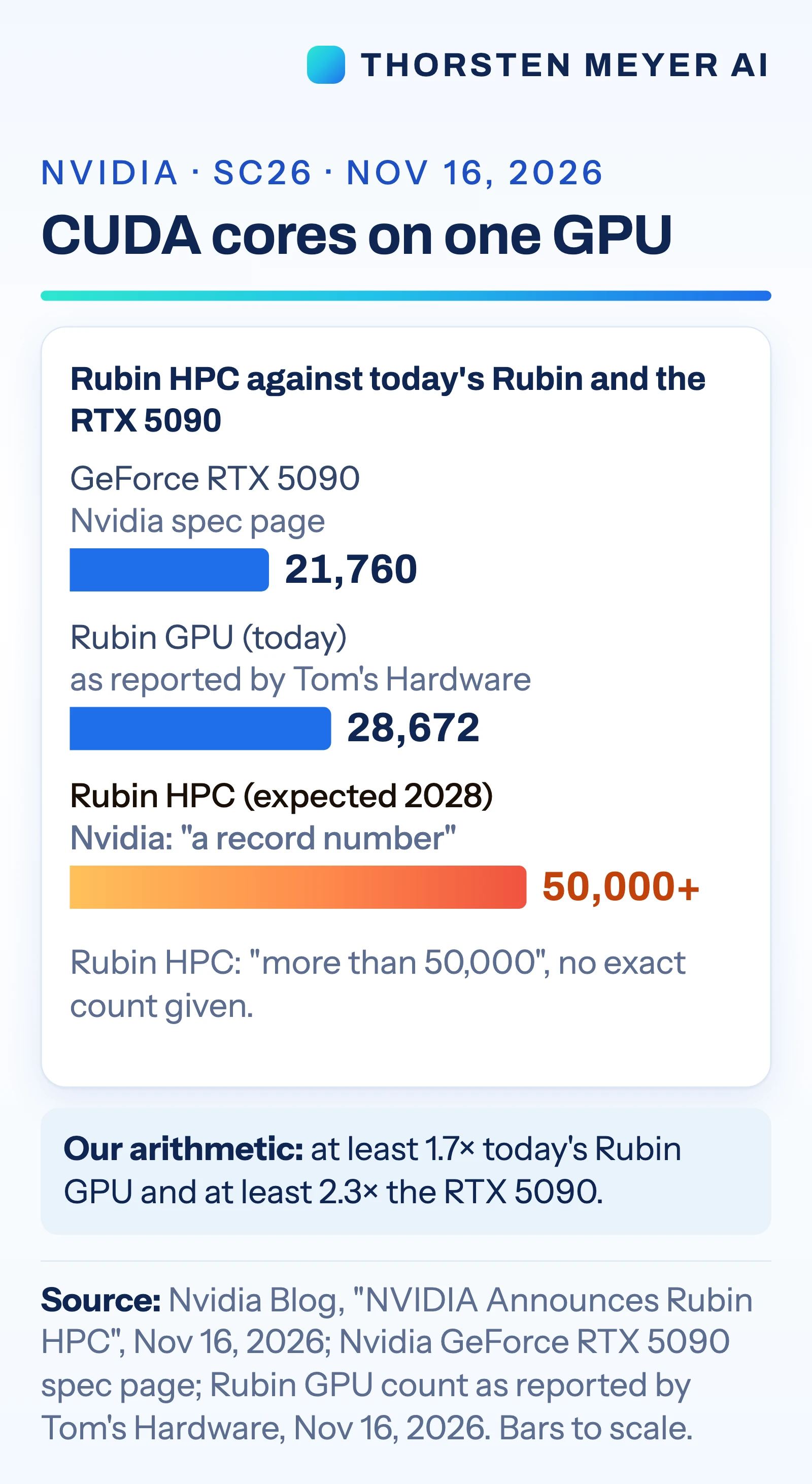
The announced core count is at least 1.7 times the 28,672 CUDA cores reported for today’s Rubin GPU by Tom’s Hardware, and at least 2.3 times the 21,760 cores Nvidia lists for the GeForce RTX 5090. Those are comparisons based on Nvidia’s lower bound of “more than 50,000”; they do not establish relative speed. CUDA core counts alone do not show how a chip performs on a particular workload.
What Faster Science Simulations Could Change
Nvidia is pitching Rubin HPC at a compute-intensive step in scientific and engineering work: testing candidate ideas in simulation before committing to laboratory experiments or building prototypes. Its examples include materials, molecules and designs. If the chip makes those simulations faster in practice, researchers could test more candidates or shorten the time between a result and the next refinement.
The company frames this as support for AI agents for science and engineering. In its account, an agent proposes possibilities, a simulation evaluates them, and the results guide the next proposal. That is Nvidia’s rationale for the GPU; the announcement does not report measured improvements in discovery time, research output or simulation throughput.
For supercomputing centers and research organizations, the practical question is not simply how many cores the GPU contains. Memory capacity and bandwidth, precision performance, power use, price and system availability will all affect whether it suits a given workload and budget. Those details have not been announced.
Products Worth Considering

Samsung Galaxy Tab A11+ Kids Edition, 128GB, Royal Blue

Logitech MX Brio Ultra HD 4K Webcam

DJI Mini 4K Drone Combo with 4K Camera, 3-Axis Gimbal, and Two Batteries
As an affiliate, we earn on qualifying purchases.
Rubin HPC Within Nvidia’s Platform
SC26 runs in Chicago from Nov. 15 to 20, 2026. Nvidia’s Rubin HPC announcement was one of the company’s posts for the conference. The source material describes the announcement as a blog post and reports no separate Nvidia newsroom press release for the chip.
Nvidia positions Rubin HPC as a GPU for workloads that move between large datasets and compute-intensive calculations. It says scientific applications may access a small number of scattered values from immense datasets, then repeat calculations at scale. The announced sparse data acceleration feature is meant to address that pattern, though Nvidia has not published technical details or independent measurements.
The company also says the chip will use seventh-generation NVLink. Nvidia’s Vera Rubin NVL72 product page identifies sixth-generation NVLink for the current Vera Rubin platform, according to the source material. Separately, Tom’s Hardware suggested the core count might point to a multi-die design similar to Rubin Ultra. That is an outlet’s inference; Nvidia has not disclosed Rubin HPC’s physical layout.
““a record number of CUDA cores — more than 50,000 on a single GPU””
— Nvidia, in its Nov. 16, 2026 blog post
Specifications Still Awaiting Disclosure
Nvidia has not published FP64 performance figures, memory capacity or bandwidth, power requirements, pricing, named systems or independent benchmarks for Rubin HPC. It has also not provided an exact CUDA core count or explained how its sparse data acceleration works. Without those details, readers cannot determine how the GPU will compare on specific scientific workloads or what it will cost to deploy.
The chip’s physical layout is also unconfirmed. Tom’s Hardware’s comparison with a possible Rubin Ultra-like multi-die configuration is speculation based on the core count, not a design disclosed by Nvidia. The company has not said which systems will ship with Rubin HPC or specified how its 2028 availability will be scheduled.
Details to Watch Before 2028
Nvidia says Rubin HPC is expected to be available in 2028. Before then, the company’s technical disclosures and system announcements will be needed to fill in the missing information about memory, precision, power, pricing and configuration. Independent benchmarks will be needed to test Nvidia’s performance claims across scientific and engineering applications.
For prospective buyers, the next useful milestone will be a system-level specification tied to availability and price. Until Nvidia publishes that information, the more-than-50,000 core figure describes the announced scale of the GPU, not its measured speed, suitability for a particular simulation or total cost of ownership.
Key Questions
What is Nvidia Rubin HPC?
Rubin HPC is a GPU Nvidia announced for scientific simulation and data processing in science, engineering and analytics workflows. The company says it is part of the Vera Rubin platform.
How many CUDA cores will Rubin HPC have?
Nvidia says the GPU will have more than 50,000 CUDA cores on one chip. It has not given an exact count.
When is Rubin HPC expected to be available?
Nvidia says Rubin HPC is expected in 2028. It has not announced specific systems or a more detailed shipping schedule in the cited material.
Does the core count prove Rubin HPC will be faster?
No. The core count is an announced specification, not a benchmark. Nvidia has not published performance results, FP64 figures or memory specifications that would show how it performs on particular workloads.
What key details has Nvidia not disclosed?
The announcement does not give Rubin HPC’s exact core count, memory capacity or bandwidth, power requirements, price, named systems or independent benchmarks. Nvidia also has not explained how its sparse data acceleration feature works.
Source: Thorsten Meyer AI