

It’s no coincidence that industrial environments demand more from their networking hardware than typical office setups. You need devices that can withstand harsh conditions, from extreme temperatures to corrosion. These rugged solutions guarantee your systems stay connected and secure, even in the toughest locations. But what features truly make industrial-grade hardware stand out, and how can they benefit your operations? The answers might change how you think about reliable connectivity.
Key Takeaways
- Designed to operate reliably in harsh environments with resistance to dust, moisture, extreme temperatures, and vibration.
- Supports advanced wireless protocols like IEEE 802.11ac and Wi-Fi 6 for high-speed, flexible connectivity.
- Features Power over Ethernet (PoE) for simplified installation and centralized power management.
- Equipped with rugged enclosures, corrosion resistance, and wide temperature ranges for environmental durability.
- Includes redundant power inputs and security features to ensure continuous, reliable network operation.
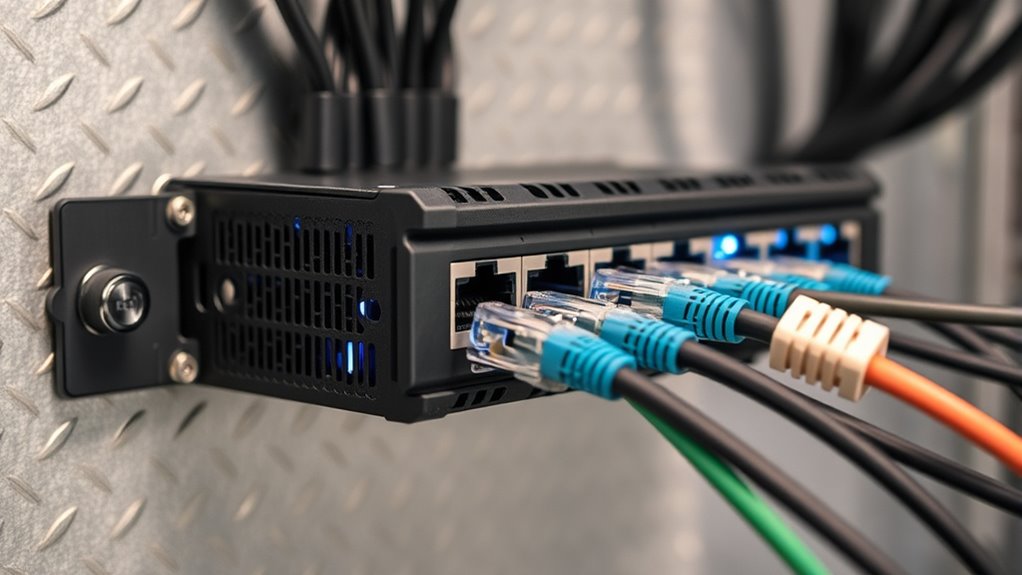
Industrial-grade networking hardware is indispensable for ensuring reliable and secure communication in harsh environments. When you operate in settings like factories, outdoor facilities, or remote locations, standard networking equipment often falls short due to exposure to dust, moisture, extreme temperatures, and vibration. To meet these challenges, you need rugged hardware designed specifically for these conditions. One critical feature to consider is support for advanced wireless protocols. These protocols enable seamless wireless connectivity, allowing your systems to communicate without the constraints of physical cables. With robust wireless standards like IEEE 802.11ac or Wi-Fi 6, your network can deliver high-speed data transfer even in demanding environments. This flexibility is essential when deploying sensors, cameras, or control systems across large, complex sites where wired connections might be impractical or costly.
Additionally, many industrial-grade devices incorporate support for Power over Ethernet (PoE). PoE simplifies installation by delivering both data and electrical power through a single Ethernet cable. This eliminates the need for separate power supplies or outlets at each device location, reducing clutter and lowering installation costs. When you choose hardware with PoE capabilities, you enable easier deployment of IP cameras, access points, and sensors, especially in areas where power sources are scarce or difficult to access. PoE also offers centralized power management, so you can monitor and control power usage remotely, improving energy efficiency and system reliability.
In harsh environments, the durability of your hardware is just as important as its features. Look for devices with rugged enclosures, corrosion resistance, and the ability to operate across wide temperature ranges. These characteristics guarantee your network stays operational, even under extreme conditions. Furthermore, reliable industrial-grade hardware often includes features like redundant power inputs and secure, industrial-grade connectors to prevent failures and ensure continuous operation.

TP-Link Omada SG2005P-PD | 5 Port Outdoor PoE Passthrough Gigabit Ethernet Switch | 1 PoE++ in@90W, 4 PoE+ Out Up to 64W | IP55, Static Routing, Access Control List, QoS, VLAN | PoE Powered ONLY
【PoE Passthrough】 With 1 x Gigabit PoE++ input, 4 x Gigabit PoE+ output, this device supports up to...
As an affiliate, we earn on qualifying purchases.
Frequently Asked Questions
How Does Industrial-Grade Hardware Differ From Consumer Networking Equipment?
You’ll notice that industrial-grade hardware differs from consumer equipment through its industrial robustness and environmental resilience. It’s built to withstand harsh conditions like extreme temperatures, dust, and vibrations, ensuring continuous operation. Unlike consumer devices, it’s designed for long-term reliability in demanding environments, making it ideal for critical systems that require stable, secure, and durable network connections. This resilience guarantees your network stays up and running, no matter the environment.
What Certifications Are Required for Industrial Networking Hardware?
You need to know that industrial networking hardware must meet tough certification standards and compliance requirements to survive in harsh environments. Think of it as armor for your network—UL, IEC, and CE certifications ensure durability, safety, and interoperability. Without these, your equipment risks failure or safety hazards. So, always verify that your hardware ticks all the certification boxes, guaranteeing reliability and peace of mind in your industrial setup.
Can Industrial-Grade Hardware Be Used Outdoors Effectively?
Yes, industrial-grade hardware can be used outdoors effectively. It’s designed with environmental resilience, so it withstands harsh weather, dust, and temperature fluctuations. You’ll find it easier to handle installation challenges because it’s built for rugged conditions, ensuring reliable performance in outdoor settings. Just verify you choose hardware with the right certifications and protection ratings to match your specific environment, and you’ll have a durable, long-lasting network solution.
How Is the Maintenance and Support Structured for Industrial Devices?
You get dedicated maintenance and support for industrial devices through remote diagnostics, which allow quick troubleshooting without onsite visits. Firmware updates are regularly provided to guarantee your hardware stays secure and efficient. Support teams often offer 24/7 assistance, giving you peace of mind. This structured approach minimizes downtime, keeps devices running smoothly, and lets you focus on your operations without worrying about hardware issues.
What Scalability Options Are Available for Growing Industrial Networks?
You can scale your industrial network through network redundancy and modular expansion. Redundancy guarantees continuous operation during failures, allowing your network to grow without downtime. Modular expansion lets you add new devices or segments seamlessly, providing flexibility as your needs evolve. By implementing these options, you’ll enhance your network’s capacity and reliability, ensuring it supports your expanding industrial operations efficiently and with minimal disruption.

TP-Link Omada WiFi 7 Wireless Access Point | BE11000 Tri-Band | 10G Port | Business Standard | Seamless Roaming | Easy Setup | 5-Year Warranty | Omada Remote Managed(EAP773)
𝐅𝐑𝐄𝐄 𝐎𝐦𝐚𝐝𝐚 𝐄𝐬𝐬𝐞𝐧𝐭𝐢𝐚𝐥 𝐏𝐥𝐚𝐭𝐟𝐨𝐫𝐦 𝐂𝐞𝐧𝐭𝐫𝐚𝐥𝐢𝐳𝐞𝐝 𝐑𝐞𝐦𝐨𝐭𝐞 𝐌𝐚𝐧𝐚𝐠𝐞𝐦𝐞𝐧𝐭: Unlock numerous advanced features by integrating with Omada Cloud Management Platform,...
As an affiliate, we earn on qualifying purchases.
Conclusion
In the rugged world of industrial environments, your networking hardware is the backbone that keeps everything running smoothly. Withstanding harsh conditions like a seasoned soldier, these devices offer reliability, resilience, and high-speed connectivity. They’re the silent heroes behind seamless communication, ensuring your systems never miss a beat. Investing in industrial-grade hardware is like planting a sturdy oak—built to stand the test of time and weather any storm that comes your way.

LINOVISION Industrial 8-Port Full Gigabit POE++ Switch with 4 BT 90W PoE Ports, 2 Gigabit SFP Uplinks, POE Budget 120W, POE Watchdog, DIN-Rail POE Switch for PTZ Camera/POE Lighting/ POE Monitor
8 PORT FULL GIGABIT POE SWITCH - Providing 8*10/100/1000Base-T Ethernet PoE ports and 2*1000Base-X SFP Ports. (Noted: Each...
As an affiliate, we earn on qualifying purchases.

TP-Link Omada SX3008F | 8 Port 10G SFP+ Enterprise Level Switch | L2+ Smart Managed | Omada SDN Integrated | IPv6 | Static Routing | L2/L3/L4 QoS, IGMP & LAG | 5 Year Manufacturer Warranty
【10G Lightning-Fast Connections】8× 10 Gbps SFP+ Ports enable high-bandwidth connectivity and non-blocking switching capacity.
As an affiliate, we earn on qualifying purchases.