🔍 Read the full analysis: 10 Best Mesh Wi-Fi Systems For Whole-Home Coverage In 2027 on ThorstenMeyerAI.com

Get business pricing on networking and server gear
- Business-only prices and quantity discounts
- Tax-exempt purchasing
- Multiple users, one account, clear invoices
TL;DR
A buying guide from ThorstenMeyerAI.com ranks 10 mesh Wi-Fi systems for different home layouts, budgets and device needs, placing the TP-Link Deco X55 first as a balanced Wi-Fi 6 option. Its recommendations are based on product features and intended use, not reported independent performance tests; actual coverage depends on placement, construction and internet service.
ThorstenMeyerAI.com has published a 2027 guide comparing 10 mesh Wi-Fi systems for whole-home coverage, recommending the TP-Link Deco X55 as its most balanced starting point. The ranking distinguishes practical Wi-Fi 6 kits from tri-band and Wi-Fi 7 alternatives, but it is a product-selection guide rather than a report of new testing results.
The guide says the Deco X55 combines Wi-Fi 6 with a three-node kit, making it a general-purpose choice for households that want more capacity than an older Wi-Fi 5 system without paying for a premium Wi-Fi 7 model. It presents the Deco XE75 as an option for buyers seeking a dedicated 6 GHz band, and the Netgear Orbi 770 as a higher-tier Wi-Fi 7 alternative.
The other recommendations span different needs: the TP-Link Deco 7 Pro is positioned as a performance-focused Wi-Fi 7 option, while the Deco 7 BE5000 offers a simpler dual-band Wi-Fi 7 design. The guide also includes the older Deco S4 for smaller homes and Eero 6+ for buyers who prefer a guided setup. It does not provide prices, measured speeds or a dated comparison of retail availability in the supplied material.
Rather than treating the newest Wi-Fi standard as an automatic advantage, the ranking weighs band configuration, backhaul, node count and management against likely household needs. The source says its coverage figures should be treated as planning estimates: walls, floors, interference and node placement can change results.
The 10 picks
- 1
 NETGEAR Orbi 770 Series WiFi 7 Mesh System, 3-PackView on Amazon →
- 2
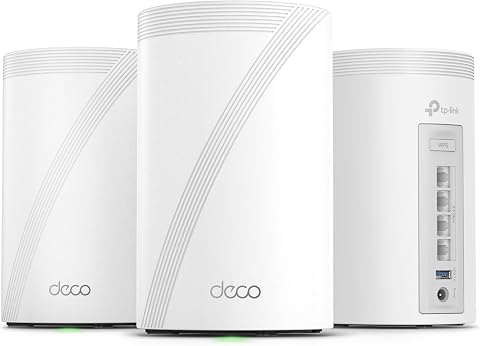 TP-Link Deco 7 Pro BE10000 Tri-Band Wi-Fi 7 Whole-Home Mesh System, 3-PackView on Amazon →
- 3
 Amazon eero 6+ Wi-Fi 6 Mesh System, 3-PackView on Amazon →
- 4
 NETGEAR Orbi 370 Series WiFi 7 Mesh System for Home (RBE373) – Wireless Route…View on Amazon →
- 5
 TP-Link Deco 7 BE5000 Dual-Band Wi-Fi 7 Mesh SystemView on Amazon →
- 6
 TP-Link Deco XE75 AXE5400 Tri-Band Wi-Fi 6E Mesh System, 3-PackView on Amazon →
- 7
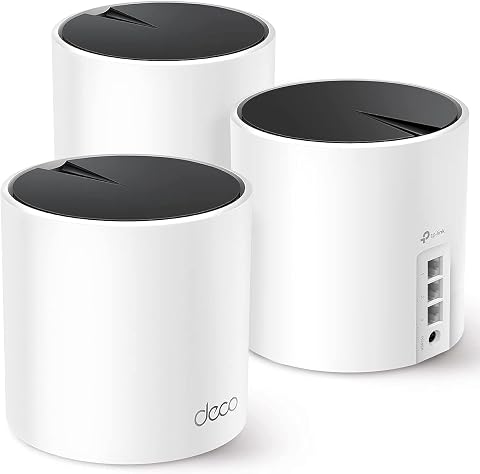 TP-Link Deco X55 AX3000 Wi-Fi 6 Mesh System, 3-PackView on Amazon →
- 8
 TP-Link Deco S4 AC1900 Mesh Wi-Fi System, 3-PackView on Amazon →
- 9
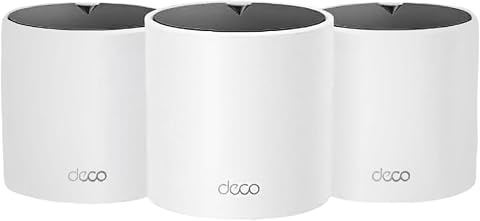 TP-Link Deco X15 AX1500 Dual-Band Wi-Fi 6 Mesh System, 3-PackView on Amazon →
- 10
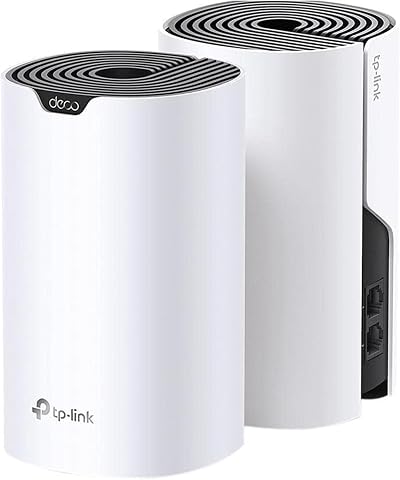 TP-Link Deco S4 Whole Home Mesh WiFi System (2-Pack)View on Amazon →
Choosing Capacity That Fits Your Home
The comparison matters because a mesh system is a multi-unit purchase, and a higher specification does not necessarily fix a weak connection. Buyers can spend more on Wi-Fi 7 or tri-band hardware without seeing a practical improvement if their devices do not support the features, their broadband plan is the bottleneck, or satellites are poorly placed.
The guide’s central distinction is between coverage and capacity. Extra bands may help manage traffic between nodes, particularly when they connect wirelessly, but they cannot overcome every obstruction or a weak link to the main router. In some homes, a less expensive kit with well-placed nodes—or Ethernet backhaul—may be a better fit than a premium system.
Products Worth Considering

Amazon Kindle Paperwhite (2024, 16 GB) – 7-inch Glare-Free Display, Black

Bose QuietComfort True Wireless Earbuds with Active Noise Cancellation, Bluetooth 5.3, USB-C Charging, IPX4, Black

Samsung Galaxy Tab A11+ 8GB RAM, 256GB Storage, Gray
As an affiliate, we earn on qualifying purchases.
How the 10 Picks Differ
The source ranks the products by how their features match household needs, with more emphasis on balanced capability than on the newest Wi-Fi generation alone. Its leading recommendation, the Deco X55, is presented as a middle ground; the XE75 and Deco 7 Pro offer tri-band configurations, while Wi-Fi 7 models target buyers with compatible devices or greater capacity demands.
That approach reflects a practical constraint of mesh networking: satellites need a reliable connection back to the main unit. Wireless backhaul uses radio capacity for that link, while Ethernet between nodes can reduce dependence on it. A two-pack may suit a compact layout, whereas a larger or divided home may need additional nodes or wired links rather than simply a newer wireless standard.
“The Deco X55 is the most balanced starting point.”
— ThorstenMeyerAI.com buying guide
What the Ranking Does Not Establish
The supplied guide does not include test methods, measured throughput, latency results or independent lab comparisons. Its ranking should be read as an editorial assessment of product features and fit, not proof that one system will outperform another in every home.
It also gives no publication date, current prices or confirmation that all 10 models remain available in every market in 2027. The excerpt names several systems but does not provide the full list of 10 products or detailed model-by-model specifications. Real-world results remain uncertain without a home’s layout, broadband speed, device mix and node positions.
Check Fit Before You Buy
Readers should compare the complete product list and current local prices before purchasing, then check whether their phones, computers and other devices support the Wi-Fi features they would be paying for. The next practical step is to map the rooms that need coverage and identify where nodes can sit with a clear connection to one another.
Where possible, buyers should also check Ethernet-port availability and whether wired backhaul suits their home. The source offers recommendations rather than a schedule for new tests or product updates, so no follow-up testing or revision date is confirmed.
Key Questions
Which mesh Wi-Fi system does the guide rank first?
ThorstenMeyerAI.com names the TP-Link Deco X55 as its most balanced starting point, citing its Wi-Fi 6 platform and three-node kit.
Is Wi-Fi 7 necessarily better for every home?
No. The guide says the benefit depends on compatible devices, broadband speed and network layout. A Wi-Fi 7 system may add capacity, but that does not guarantee better coverage or faster internet for every household.
When might a tri-band mesh system help?
A tri-band system such as the Deco XE75 or Deco 7 Pro may help with wireless backhaul capacity when nodes relay traffic over Wi-Fi. Results still depend on node placement, conditions and the system’s design; Ethernet backhaul may be an alternative.
Does a three-pack always cover more effectively than a two-pack?
Not automatically. The guide says a two-pack such as the Deco S4 may suit a compact home, while larger or divided layouts may need extra nodes. Poor placement or a weak connection between nodes can limit either setup.
Does the guide report independent speed tests?
The supplied source material does not give measured speed results or describe independent testing. Its rankings are presented as recommendations based on features and intended household use.
Source: ThorstenMeyerAI.com