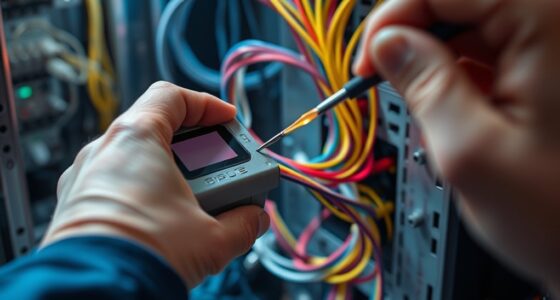

Imagine trying to find a leak in a pipe with just a flashlight—frustrating and uncertain. That’s similar to troubleshooting cables without the right tools. Time-Domain Reflectometers act like a sonar system, sending pulses down a cable and revealing faults through reflected signals. They’re essential for efficient diagnostics, but understanding how they work and what they reveal can make all the difference in resolving issues quickly. Curious how these devices pinpoint problems so precisely?
Key Takeaways
- TDRs send electrical pulses down cables to detect faults via reflected signals.
- Reflections reveal fault type, location, and severity based on signal shape and timing.
- Clear, calibrated signals improve accuracy in identifying issues like breaks or shorts.
- Suitable for various cables; portable and easy for on-site troubleshooting without system shutdowns.
- Technological advancements enhance signal clarity, enabling precise fault localization and faster repairs.

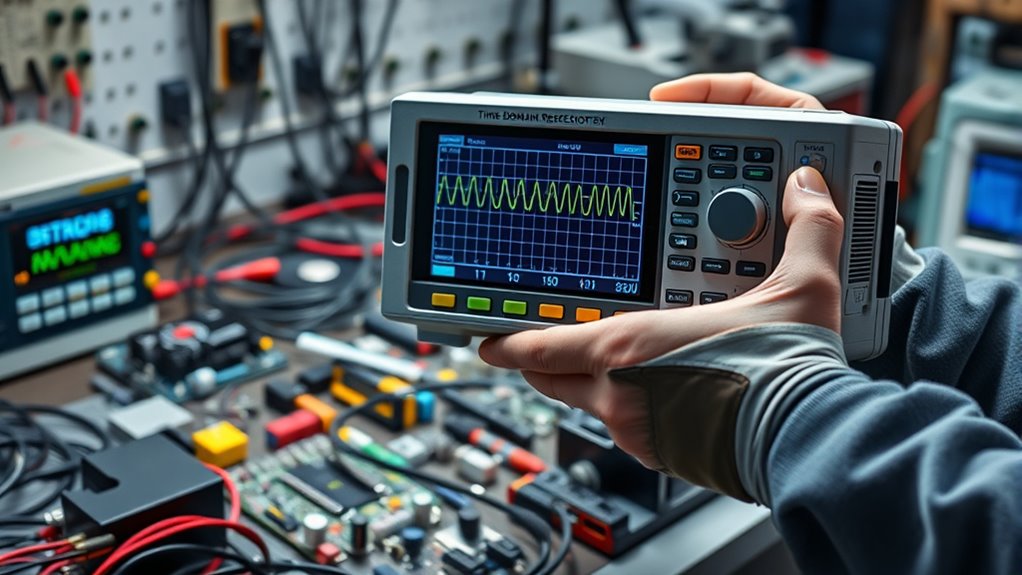
Time-domain reflectometers (TDRs) are essential tools used to detect and locate faults in electrical cables and fiber optic lines. When troubleshooting network issues or diagnosing cable problems, understanding how TDRs work can considerably streamline the process. These devices send a short electrical pulse down the cable, and by analyzing the reflected signals, you can pinpoint where faults or irregularities occur. This process, known as signal reflection analysis, is vital because it reveals valuable information about the cable’s condition without requiring extensive disassembly or physical inspection.
Time-domain reflectometers detect faults by analyzing reflected signals in cables and fiber lines.
In cable fault detection, TDRs act like a diagnostic radar, providing a visual representation of the entire cable length. When a fault exists, part of the initial pulse reflects back toward the TDR, creating a distinct echo on the display. The time it takes for the reflection to return correlates directly with the distance to the fault. For example, a sudden change in impedance caused by a break, short, or corrosion will generate a reflection. By examining these reflections, you can quickly identify the type and location of the problem, saving time and reducing guesswork.
Using a TDR for fault detection requires understanding the importance of the reflected signals. A clean, straight line indicates a healthy cable, while multiple or distorted reflections suggest issues such as loose connections, cracks, or damaged insulation. Signal reflection analysis allows you to distinguish between different types of faults based on the shape, size, and timing of the echoes. This insight helps you decide whether a fault is minor or critical and guides you in planning repairs or replacements.
Moreover, TDRs are adaptable to various cable types, including coaxial, twisted pair, and fiber optic lines. Their portability and ease of use mean you can perform inspections on-site without disconnecting the entire system. When troubleshooting, you’ll appreciate how quickly you can gather data and interpret the reflections, making TDRs invaluable for maintenance teams and network installers alike. Additionally, advancements in home theatre projectors technology have emphasized the importance of clear signals and proper calibration to ensure optimal performance and image quality during setup and troubleshooting.

All Features Multifunction Network Caber Tester,UTP Continuity,Cable Tracer,4" IPS Touch Screen Network Tester Support TDR,DMM,OPM,Level Meter,Network Tools,POE++ Detect,RJ45 TDR,Length,FTP,NCV
【All Features 11-in-1 Network Cable Tester】All Features ethernet cable tester with 4-inch IPS touchscreen with 800×480 resolution. Multifunction...
As an affiliate, we earn on qualifying purchases.
Frequently Asked Questions
What Are the Main Limitations of Time-Domain Reflectometers?
You should know that the main limitations of time-domain reflectometers are their sensitivity to signal reflection and measurement accuracy. They may struggle to detect very small defects or reflections, leading to missed issues. Additionally, complex cable environments or high-frequency signals can reduce measurement precision. These factors can hinder your ability to obtain reliable data, especially in challenging or noisy settings, making it important to understand their constraints.
How Do Environmental Factors Affect TDR Measurements?
Environmental factors greatly impact TDR measurements due to their sensitivity to conditions like temperature, humidity, and electromagnetic interference. You might notice fluctuations or inaccuracies because these factors affect signal reflection and propagation. To guarantee measurement consistency, you should perform tests in stable environments, shield equipment from interference, and account for environmental variations. This way, you maintain more reliable readings and minimize errors caused by external influences.
Can TDRS Detect All Types of Cable Faults?
Sure, TDRs are the superheroes of fault detection, but they can’t detect every cable fault lurking in your network villainous lineup. Different cable types, like coaxial or twisted pair, challenge their detective skills. While they’re great at spotting opens and shorts, they might miss subtle issues like high-resistance faults or internal damage. So, don’t rely solely on TDRs—combine tools for a thorough investigation into your cable’s mysterious ailments.
What Are the Safety Precautions When Using TDRS?
When using TDRs, you should always wear personal protective equipment like gloves and safety glasses to prevent injury. Make sure the equipment is properly grounded to avoid electrical shocks. Keep the area dry and avoid contact with live circuits. Follow the manufacturer’s instructions carefully, and double-check connections before testing. These precautions help protect you from electrical hazards and ensure accurate readings during troubleshooting.
How to Interpret Complex TDR Trace Patterns Accurately?
Interpreting complex TDR trace patterns is like decoding a map of signal reflection points. You should look for sudden changes, dips, or peaks indicating faults or discontinuities. Focus on the shape, amplitude, and timing of each reflection to pinpoint issues accurately. Trace interpretation requires careful analysis of signal reflections, considering the distance and nature of anomalies. With practice, you’ll read these patterns like a seasoned navigator, guiding repairs efficiently.

SGILE 9-in-1 Portable Crimping Tool Kit, 8P8C 6P6C 4P4C Connectors, RJ11/RJ12/RJ45 Cat5 Cat5e Network/Phone Cable Tester, Black
9 in 1 Network Maintenance Tools: 9-in-1 network maintenance tools meet the essential needs, which include crimping pliers,...
As an affiliate, we earn on qualifying purchases.
Conclusion
So, next time your cables act up, don’t just guess—grab a TDR. It’s almost funny how a simple pulse can reveal hidden faults you’d never spot with the naked eye. Sure, troubleshooting can be tedious, but with a TDR, you get quick, clear answers—no magic involved, just science. Who knew that a tiny device could save you hours of frustration? Irony at its best: technology making troubleshooting almost enjoyable.

Klein Tools 80072 RJ45 Cable Tester Kit with LAN Scout Jr. 2, Coax Crimper / Stripper / Cutter Tool and 50-Pack Pass-Thru Modular Data Plugs
SMART BUY: A complete, high-performance kit that offers convenience and value
As an affiliate, we earn on qualifying purchases.

iMBAPrice Professional 11-in-1 Network Tool Kit for Cat5, Cat5e, Cat6 – Complete Ethernet Cable Crimper Set with RJ45 RJ11 Connectors, Cable Tester & 110 Punch Down Tool
All-in-One Networking Solution – Includes every essential tool for network setup: crimper, punch down tool, cable tester, modular...
As an affiliate, we earn on qualifying purchases.