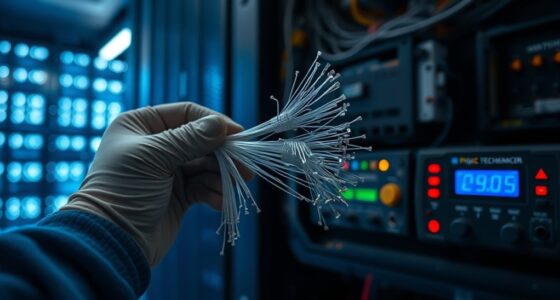
When dealing with crosstalk issues, you need to understand how electromagnetic interference can disrupt signal clarity. Proper shielding, grounding, and signal isolation are key strategies you can implement to minimize interference. But the question is, how effective are your current techniques, and what additional measures could make your system more reliable? Exploring these options can help you identify the most practical solutions for your specific setup.

Get business pricing on networking and server gear
- Business-only prices and quantity discounts
- Tax-exempt purchasing
- Multiple users, one account, clear invoices
Key Takeaways
- Implement shielding techniques like foil or braid around cables to block external EMI sources.
- Properly ground shields to safely dissipate interference and reduce crosstalk.
- Use twisted pair cables and ensure adequate spacing to minimize electromagnetic coupling between signals.
- Employ signal isolation methods such as optocouplers or transformers to prevent noise transfer.
- Optimize system design and routing, and perform real-world testing to identify and mitigate crosstalk sources.

Crosstalk issues can disrupt the clarity and performance of your electronic systems, but addressing them doesn’t have to be complicated. When signals interfere with each other, it can cause data corruption, reduced signal quality, and unpredictable device behavior. Luckily, implementing effective shielding techniques and ensuring proper signal isolation can markedly reduce these problems. Shielding involves surrounding cables or components with conductive materials, such as foil or braid, to block unwanted electromagnetic interference (EMI). By creating a barrier, shielding prevents external noise sources from coupling into your signals and minimizes the chance of crosstalk between adjacent lines. It’s especially useful when dealing with high-frequency signals or sensitive data lines. Proper shielding techniques also include grounding the shield correctly, which provides a path for interference to dissipate safely, enhancing overall system stability.
Effective shielding with proper grounding reduces crosstalk and enhances system stability.
In addition to shielding, signal isolation plays a pivotal role in managing crosstalk. Signal isolation techniques, such as optocouplers, transformers, or digital isolators, electrically separate different parts of your system. This separation prevents unwanted current or noise from traveling between components, effectively breaking the loop of interference. By isolating signals, you guarantee that disturbances in one section don’t propagate and affect others, which is essential in complex or sensitive applications. Combining shielding techniques with signal isolation provides an extensive approach to crosstalk mitigation. For example, you might shield a cable to block external interference and then use signal isolators along the pathway to prevent internal crosstalk from neighboring lines. This layered strategy offers maximum noise immunity and signal integrity.
When designing your system, pay attention to cable routing and layout. Keep signal lines separated and run them parallel only when necessary, maintaining adequate spacing to reduce coupling. Twisted pair cables are highly effective because their design cancels out electromagnetic interference, further reducing crosstalk. Additionally, consider the frequency of your signals; higher frequencies are more susceptible to interference, making shielding and isolation even more critical. Proper system layout and crosstalk mitigation strategies can significantly improve data integrity. Always test your system under real-world conditions to identify any remaining crosstalk issues. Use oscilloscopes or network analyzers to observe signal integrity and verify whether your shielding and isolation measures are effective.
Addressing crosstalk isn’t just about applying a single solution; it’s about combining multiple techniques tailored to your system’s needs. By employing shielding techniques and signal isolation strategically, you can markedly improve your system’s performance, reduce errors, and ensure reliable operation. Taking the time to optimize your layout, choose suitable shielding materials, and incorporate isolation methods will pay off by providing cleaner signals and more dependable electronic systems in the long run.
As an affiliate, we earn on qualifying purchases.
Frequently Asked Questions
How Do I Identify Crosstalk in My System?
You can identify crosstalk in your system by noticing unusual signal interference or noise that seems to come from nearby channels. Listen carefully for faint signals or distorted audio, especially when multiple cables or channels are active. Use noise reduction tools or testing equipment to pinpoint interference sources. If the noise fluctuates with cable movement or device operation, crosstalk is likely. Address it by rerouting cables or improving shielding.
What Tools Are Best for Measuring Crosstalk?
You should use specialized tools like crosstalk simulation software and measurement techniques such as time-domain reflectometry or vector network analyzers. These tools help you accurately measure crosstalk levels and identify problematic areas. By running crosstalk simulations, you can predict potential issues before physical testing. Combining these methods guarantees precise diagnostics, enabling you to pinpoint and mitigate crosstalk effectively in your system.
Can Crosstalk Occur in Digital Circuits?
Yes, crosstalk can occur in digital circuits, affecting signal integrity and causing data errors. It happens when signals in adjacent traces or components interfere due to inadequate circuit isolation. You should carefully design your layout, maintain proper spacing, and use shielding techniques to minimize interference. Ensuring good circuit isolation and monitoring signals helps prevent crosstalk, keeping your digital system reliable and error-free.
How Does Cable Shielding Reduce Crosstalk?
Cable shielding acts like a superhero cape, blocking interference before it reaches your signals. It reduces crosstalk by creating a barrier with shielding materials like foil or braid, which absorbs or redirects electromagnetic interference. Grounding techniques work alongside shielding to safely direct unwanted signals away from your cables. Together, they ensure your data stays clear and uncorrupted, even in noisy environments, giving you rock-solid, reliable connections every time.
Are There Software Solutions to Detect Crosstalk Issues?
Yes, you can use software solutions that leverage machine learning and signal processing to detect crosstalk issues. These tools analyze signal patterns and identify anomalies caused by crosstalk, often in real-time. By training algorithms on known crosstalk data, you improve detection accuracy, allowing you to troubleshoot faster and reduce interference. This approach helps you maintain peak signal quality without manual inspection, making your network more reliable and efficient.
As an affiliate, we earn on qualifying purchases.
Conclusion
By applying proper shielding, grounding, and signal isolation techniques, you can effectively reduce crosstalk, much like a skilled conductor keeps different instruments in harmony. Thoughtful system design—such as maintaining spacing and using twisted pair cables—ensures your signals stay clear and interference-free. Regular testing under real-world conditions helps you fine-tune your setup, making your system as resilient as a fortress against electromagnetic interference, and ultimately delivering reliable, high-quality performance.
As an affiliate, we earn on qualifying purchases.
As an affiliate, we earn on qualifying purchases.
Halloween Picks
halloween
As an affiliate, we earn on qualifying purchases.