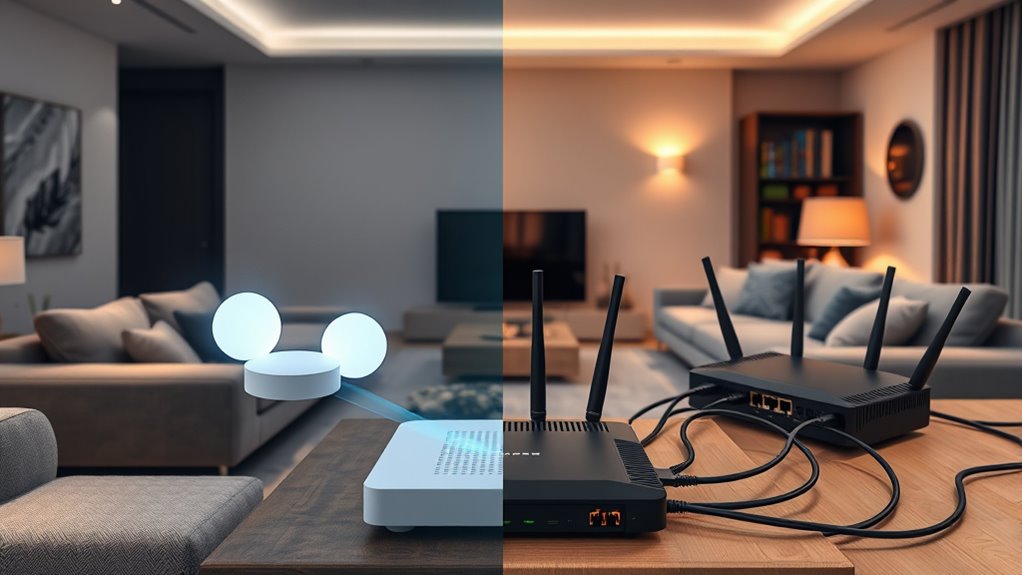

Imagine trying to build a reliable network in a large home—without enough support, your Wi-Fi feels like a fragile web. That’s where mesh systems and wired backhaul come into play, offering different paths to stability and coverage. While mesh Wi-Fi systems are easy to set up and expand, wired backhaul can provide a more consistent, high-speed connection. Which option truly fits your needs might surprise you, so it’s worth exploring both options carefully.
Key Takeaways
- Wired backhaul offers more stability, faster speeds, and reduced interference compared to wireless mesh connections.
- Mesh Wi-Fi systems are easier to install, expand, and manage through user-friendly apps.
- Wired backhaul provides enhanced security with Ethernet connections, ideal for sensitive or high-demand smart home setups.
- Mesh Wi-Fi supports seamless coverage and eliminates dead zones with flexible node placement.
- The choice depends on balancing ease of setup and scalability versus maximum performance and security.
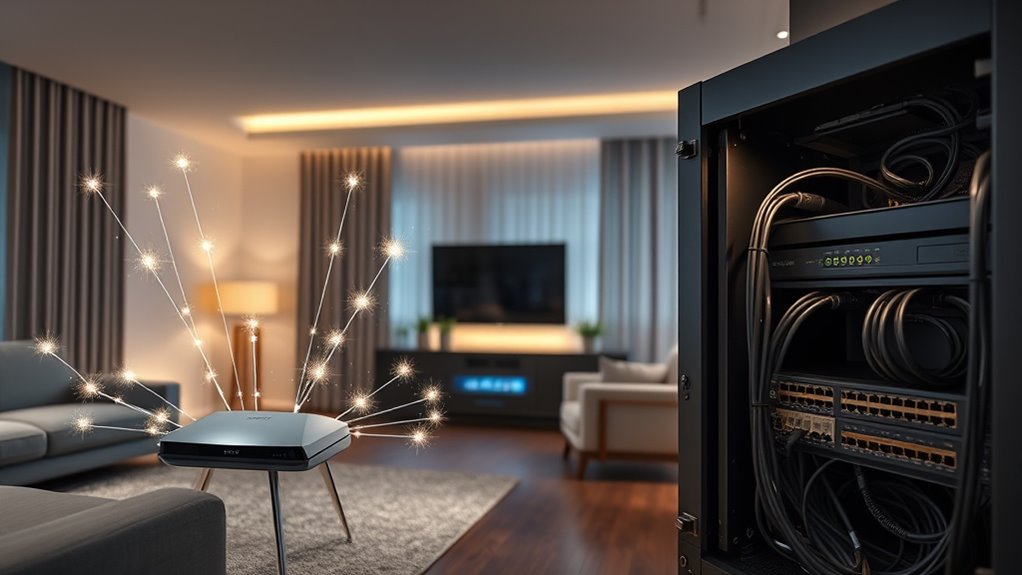
When setting up a reliable home network, choosing between Mesh Wi-Fi and wired backhaul can be a crucial decision. Both options aim to improve connectivity across your home, but they serve different needs, especially regarding smart home integration and security protocols. Mesh Wi-Fi systems are designed for easy expansion and seamless coverage, making them ideal if you want a straightforward setup that supports multiple smart devices. With a mesh network, you can place nodes throughout your house to eliminate dead zones, and most systems come with user-friendly apps to manage your network effortlessly. They often support smart home integration, allowing you to connect and control smart devices like thermostats, cameras, and lights from a single interface. Plus, many mesh systems include built-in security features, such as automatic firmware updates, device isolation, and parental controls, to help safeguard your network from external threats.
On the other hand, wired backhaul involves connecting your routers or access points using Ethernet cables. This setup provides a more stable and faster connection, especially beneficial if you’re streaming high-definition content, gaming, or handling large data transfers. Wired backhaul also enhances security protocols because Ethernet connections are inherently more secure than wireless ones, reducing the risk of hacking or unauthorized access. If you have a smart home with numerous devices that demand consistent bandwidth, wired backhaul ensures they stay connected without interference or lag. It’s particularly advantageous for advanced security systems, which often require a dedicated, reliable connection to transmit sensitive data securely. While installing wired backhaul involves more effort and initial investment, it offers a future-proof solution that can support high-performance needs as your smart home ecosystem expands.
Ultimately, your choice depends on your priorities. If you want simple, scalable coverage with integrated smart home features and manageable security, a Mesh Wi-Fi system is likely your best bet. Its flexibility makes it suitable for most households, especially when ease of use matters. If you’re seeking maximum stability, enhanced security protocols, and have the capability to run Ethernet cables, wired backhaul will deliver superior performance. It’s especially valuable in homes with high data demands or sophisticated security setups. Both options can be secure and effective when configured properly, but understanding your specific needs will help you make the right choice for your smart home.

TP-Link Deco X55 AX3000 WiFi 6 Mesh System – Covers up to 6500 Sq.Ft, Replaces Wireless Router and Extender, 3 Gigabit Ports per Unit, Supports Ethernet Backhaul, Deco X55(3-Pack)
Wi-Fi 6 Mesh Wi-Fi – Next-gen Wi-Fi 6 AX3000 whole home mesh system to eliminate weak Wi-Fi for…
As an affiliate, we earn on qualifying purchases.
As an affiliate, we earn on qualifying purchases.
Frequently Asked Questions
How Does Interference Affect Mesh Wi-Fi and Wired Backhaul Performance?
Interference from radio signals can substantially impact your mesh Wi-Fi, causing signal degradation and slowing your connection. It’s especially problematic if your Wi-Fi operates on crowded frequencies like 2.4 GHz. Wired backhaul isn’t affected by radio interference, so it maintains consistent performance. If you experience issues with mesh Wi-Fi, reducing interference sources like cordless phones or microwaves can help, but wired backhaul remains more stable in interference-prone environments.
Can Mesh Wi-Fi Systems Automatically Switch to Wired Backhaul?
You might think your mesh Wi-Fi system can magically switch to wired backhaul at a moment’s notice, but in reality, many systems don’t do this automatically. It’s a rare feature that offers true wireless flexibility without added hardware complexity. Most models require manual setup or specific configurations. If seamless switching matters to you, look for systems explicitly designed with this capability to avoid interruptions and maximize performance effortlessly.
What Are the Long-Term Cost Differences Between the Two Setups?
Over the long term, wired backhaul setups tend to be more cost-effective because they usually have higher installation costs but lower maintenance expenses. You might spend more initially on cabling and professional installation, but you’ll save on ongoing issues like signal interference or hardware replacements. Mesh Wi-Fi systems are cheaper to install but can incur higher maintenance costs over time due to frequent upgrades and troubleshooting, making wired setups more economical in the long run.
How Does Each Option Impact Network Security and Privacy?
You’re safer with wired backhaul since it offers a more secure connection, reducing the risk of hacking. Mesh Wi-Fi, however, uses network encryption to protect your data privacy, but its wireless nature can be more vulnerable to interference or eavesdropping. Both setups benefit from strong passwords and regular updates. Ultimately, wired backhaul provides a more secure environment, while Mesh Wi-Fi balances convenience with adequate security measures.
Are There Specific Environments Where One Option Is Clearly Better?
Imagine a bustling city street versus a quiet country lane. In urban environments, a mesh Wi-Fi system often shines, seamlessly covering large, complex spaces without extensive wiring. Conversely, in rural setups where stability is key, wired backhaul provides a reliable, steadfast connection, resisting interference and maintaining performance. So, if you’re in the city, mesh is the way to go; in rural areas, wired backhaul offers dependable service.

ScreenBeam Bonded MoCA 2.5 Network Adapter for Highest Speed Internet, Ethernet Over Coax – Starter Kit (Model: ECB7250K02)
Faster than Wi-Fi: The ECB7250 uses your home's coax cables to deliver internet speeds up to 2.5 Gbps,…
As an affiliate, we earn on qualifying purchases.
As an affiliate, we earn on qualifying purchases.
Conclusion
Ultimately, choosing between mesh Wi-Fi and wired backhaul depends on your needs. If you want easy setup and flexible coverage, mesh Wi-Fi is your friend. But if you crave unmatched stability and security, wired backhaul is the hero. Think of it as the race between convenience and performance—each has its place. Decide what matters most, and let your home’s connectivity flow seamlessly, like a well-orchestrated symphony, guiding you smoothly into the digital future.

TP-Link AC1200 WiFi Extender, 2023 Engadget Best Budget Pick, 1.2Gbps Signal Booster for Home, Dual Band 5GHz/2.4GHz, Covers Up to 1500 Sq.ft and 30 Devices,Support Onemesh, One Ethernet Port (RE315)
𝐒𝐭𝐫𝐨𝐧𝐠𝐞𝐫 𝐖𝐢-𝐅𝐢 𝐢𝐧 𝐄𝐯𝐞𝐫𝐲 𝐂𝐨𝐫𝐧𝐞𝐫 – Enjoy extended coverage with strong performance powered by Adaptive Path Selection and…
As an affiliate, we earn on qualifying purchases.
As an affiliate, we earn on qualifying purchases.

TP-Link TL-SG105, 5 Port Gigabit Unmanaged Ethernet Switch, Network Hub, Ethernet Splitter, Plug & Play, Fanless Metal Design, Shielded Ports, Traffic Optimization
𝗢𝗻𝗲 𝗦𝘄𝗶𝘁𝗰𝗵 𝗠𝗮𝗱𝗲 𝘁𝗼 𝗘𝘅𝗽𝗮𝗻𝗱 𝗡𝗲𝘁𝘄𝗼𝗿𝗸: 5× 10/100/1000Mbps RJ45 Ports supporting Auto Negotiation and Auto MDI/MDIX.
As an affiliate, we earn on qualifying purchases.
As an affiliate, we earn on qualifying purchases.